

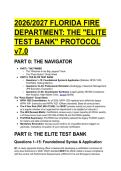
2026/2027 FLORIDA FIRE
DEPARTMENT: THE "ELITE
TEST BANK" PROTOCOL
v7.0
PART 0: THE NAVIGATOR
● PART I: THE PRIMER
○ The "Welcome to the Big Leagues" Hook
○ The "Panic Button" Cheat Sheet
● PART II: THE ELITE TEST BANK
○ Questions 1–15: Foundational Syntax & Application (Statutes, NFPA 1020,
FireTRAQ, Testing Metrics)
○ Questions 16–40: Professional Simulation (Andragogy, Classroom Management,
JPR Execution, Evaluation)
○ Questions 41–66: Grandmaster Synthesis (Legal Liability, HB 929 Compliance,
Item Analysis, High-Stakes Crisis...source liability.
The "Panic Button" Cheat Sheet:
● NFPA 1020 Consolidation: As of 2025, NFPA 1020 replaced and unified the legacy
NFPA 1041 (Instructor) and NFPA 1021 (Officer) standards. Base all curricula here.
● The 6-Year Rule (FAC 69A-37.059): You MUST possess exactly six years of experience
as a regular member of an organized fire department to be eligible for Instructor I.
● The 40/4 Renewal Matrix: Certification renews every 4 years requiring 40 CEUs; exactly
4 of those hours must cover FAC 69A-37/69A-39 and FireTRAQ updates.
● FireTRAQ Supremacy: FireTRAQ has completely replaced the legacy FCDICE system
for rosters and state compliance tracking.
● Mandatory Revocation: Issuing course credit to an unqualified person triggers an
automatic, mandatory revocation of your instructor certification.
PART II: THE ELITE TEST BANK
Questions 1–15: Foundational Syntax & Application
Q1: A newly appointed training officer is tasked with developing a certification curriculum for
entry-level instructors in 2026. Which standard MUST the officer utilize to ensure compliance
with the current Job Performance Requirements (JPRs) for Fire and Emergency Services
,Instructors? A) NFPA 1041 B) NFPA 1021 C) NFPA 1001 D) NFPA 1020
● The Answer: D (NFPA 1020)
● Distractor Analysis:
○ A is incorrect: NFPA 1041 is the legacy standard. It was retired and consolidated
into a newer standard in 2025.
○ B is incorrect: NFPA 1021 is the legacy Fire Officer standard, which was also
consolidated.
○ C is incorrect: NFPA 1001 outlines Firefighter I and II JPRs, not instructor
qualifications.
The Mentor's Analysis: The National Fire Protection Association consolidated emergency
response and safety documents to streamline standards. NFPA 1020 now houses the JPRs for
Fire Instructors, Fire Officers, and EMS Officers. Professional Intuition: Never build a 2026
curriculum on a pre-2025 legacy standard; your program will fail state accreditation audits
instantly.
Q2: Under Florida Administrative Code (FAC) 69A-37.059, a candidate applying for Fire Service
Instructor I certification must possess a minimum of how many years of experience as a regular
member of an organized fire department? A) 3 years B) 4 years C) 5 years D) 6 years
● The Answer: D (6 years)
● Distractor Analysis:
○ A is incorrect: Three years is a common baseline for specialized technical rescue
teams, not state instructor certification.
○ B is incorrect: Four years is the renewal cycle timeframe, not the initial prerequisite.
○ C is incorrect: Five years is a distractor often confused with Fire Officer
prerequisites in some jurisdictions.
The Mentor's Analysis: Florida enforces a strict 6-year operational baseline. The state requires
instructors to have deep, internalized fireground experience before they are allowed to shape
the next generation. Professional Intuition: Time in grade equals operational maturity. You
cannot teach what you have not extensively lived.
Q3: A Florida Fire Service Instructor must renew their certification every four years. According to
FAC 69A-37, which specific continuing education requirement is MANDATORY within the 40
required CEU hours? A) 8 hours of live fire evolution supervision. B) 4 hours of education
related to Rules Chapter 69A-37/69A-39 and FireTRAQ. C) 10 hours of instructional
methodology updates. D) 4 hours of advanced multimedia design.
● The Answer: B (4 hours of education related to Rules Chapter 69A-37/69A-39 and
FireTRAQ.)
● Distractor Analysis:
○ A is incorrect: Live fire refreshers are specific to Live Fire Training Instructor (LFTI)
certifications, not standard Instructor I.
○ C is incorrect: While methodology is good, it is not the legally codified minimum
requirement for the 4-hour block.
○ D is incorrect: Multimedia design is an elective, not a statutory mandate.
The Mentor's Analysis: Administrative ignorance is the leading cause of certification lapse.
Florida mandates that instructors stay current on the laws governing their practice.
Professional Intuition: Teaching mechanics is only half the job; maintaining legal and
administrative compliance is the foundation that allows you to teach.
Q4: In 2026, the Florida Bureau of Fire Standards and Training replaced the legacy FCDICE
system. Which system MUST an instructor use to enter course grades within 20 days of the last
day of class? A) VectorSolutions LMS B) TargetSolutions C) FireTRAQ D) State Fire Marshal
, Portal
● The Answer: C (FireTRAQ)
● Distractor Analysis:
○ A is incorrect: VectorSolutions is a third-party commercial LMS, not the state's
official reporting database.
○ B is incorrect: TargetSolutions is a legacy name for a commercial product.
○ D is incorrect: While it is the overarching body, the specific database application
required is FireTRAQ.
The Mentor's Analysis: The administrative transition from FCDICE to FireTRAQ is an absolute
hard-deck reality for Florida instructors. Failure to input grades in the correct system within the
20-day window invalidates student efforts and risks instructor probation. Professional Intuition:
If it isn't in FireTRAQ, it didn't happen.
Q5: The Florida Legislature recently enacted the Captain Anthony Gillan Act (HB 929) to
address firefighter health and safety. As an Instructor I, which topic is now a state-mandated
priority to integrate into your training culture and curriculum? A) Advanced swift water rescue
techniques. B) Mental health best practices related to resiliency, stress management, and peer
support. C) Drone (sUAS) operation under NFPA 2400. D) Electric vehicle (EV) extrication
protocols.
● The Answer: B (Mental health best practices related to resiliency, stress management,
and peer support.)
● Distractor Analysis:
○ A is incorrect: Swift water is a technical specialty, not a sweeping legislative
mandate for all health and safety.
○ C is incorrect: sUAS is covered under NFPA 2400, but is not the focus of HB 929.
○ D is incorrect: EV fires are an emerging hazard, but HB 929 specifically targets the
alarming rates of firefighter cancer and suicide.
The Mentor's Analysis: HB 929 fundamentally shifted the state's approach by legally
acknowledging that mental health and occupational cancer are as lethal as structural collapses.
Instructors are the cultural gatekeepers. Professional Intuition: You are not just teaching
tactical survival; you are teaching holistic career survival. Normalize mental health resilience
early.
Q6: When utilizing the principles of andragogy to instruct a class of adult volunteer firefighters,
which approach will yield the MOST effective learning environment? A) Relying strictly on a
pedagogy of lectures to ensure uniform memorization. B) Acting as a facilitator who helps
students attach new concepts to their existing operational experience. C) Mandating silent
note-taking during all theoretical modules. D) Utilizing norm-referenced testing to rank students
against one another publicly.
● The Answer: B (Acting as a facilitator who helps students attach new concepts to their
existing operational experience.)
● Distractor Analysis:
○ A is incorrect: Pedagogy is the art of teaching children. Adult learners (andragogy)
reject passive, rote lectures.
○ C is incorrect: Adults require collaborative, problem-centric engagement, not
dictatorial silence.
○ D is incorrect: Public ranking destroys the psychological safety required for adult
learning and collaboration.
The Mentor's Analysis: Adults bring a lifetime of mental models to the classroom. If you lecture
at them, they shut down. If you facilitate by linking new data (e.g., flow path dynamics) to their
DEPARTMENT: THE "ELITE
TEST BANK" PROTOCOL
v7.0
PART 0: THE NAVIGATOR
● PART I: THE PRIMER
○ The "Welcome to the Big Leagues" Hook
○ The "Panic Button" Cheat Sheet
● PART II: THE ELITE TEST BANK
○ Questions 1–15: Foundational Syntax & Application (Statutes, NFPA 1020,
FireTRAQ, Testing Metrics)
○ Questions 16–40: Professional Simulation (Andragogy, Classroom Management,
JPR Execution, Evaluation)
○ Questions 41–66: Grandmaster Synthesis (Legal Liability, HB 929 Compliance,
Item Analysis, High-Stakes Crisis...source liability.
The "Panic Button" Cheat Sheet:
● NFPA 1020 Consolidation: As of 2025, NFPA 1020 replaced and unified the legacy
NFPA 1041 (Instructor) and NFPA 1021 (Officer) standards. Base all curricula here.
● The 6-Year Rule (FAC 69A-37.059): You MUST possess exactly six years of experience
as a regular member of an organized fire department to be eligible for Instructor I.
● The 40/4 Renewal Matrix: Certification renews every 4 years requiring 40 CEUs; exactly
4 of those hours must cover FAC 69A-37/69A-39 and FireTRAQ updates.
● FireTRAQ Supremacy: FireTRAQ has completely replaced the legacy FCDICE system
for rosters and state compliance tracking.
● Mandatory Revocation: Issuing course credit to an unqualified person triggers an
automatic, mandatory revocation of your instructor certification.
PART II: THE ELITE TEST BANK
Questions 1–15: Foundational Syntax & Application
Q1: A newly appointed training officer is tasked with developing a certification curriculum for
entry-level instructors in 2026. Which standard MUST the officer utilize to ensure compliance
with the current Job Performance Requirements (JPRs) for Fire and Emergency Services
,Instructors? A) NFPA 1041 B) NFPA 1021 C) NFPA 1001 D) NFPA 1020
● The Answer: D (NFPA 1020)
● Distractor Analysis:
○ A is incorrect: NFPA 1041 is the legacy standard. It was retired and consolidated
into a newer standard in 2025.
○ B is incorrect: NFPA 1021 is the legacy Fire Officer standard, which was also
consolidated.
○ C is incorrect: NFPA 1001 outlines Firefighter I and II JPRs, not instructor
qualifications.
The Mentor's Analysis: The National Fire Protection Association consolidated emergency
response and safety documents to streamline standards. NFPA 1020 now houses the JPRs for
Fire Instructors, Fire Officers, and EMS Officers. Professional Intuition: Never build a 2026
curriculum on a pre-2025 legacy standard; your program will fail state accreditation audits
instantly.
Q2: Under Florida Administrative Code (FAC) 69A-37.059, a candidate applying for Fire Service
Instructor I certification must possess a minimum of how many years of experience as a regular
member of an organized fire department? A) 3 years B) 4 years C) 5 years D) 6 years
● The Answer: D (6 years)
● Distractor Analysis:
○ A is incorrect: Three years is a common baseline for specialized technical rescue
teams, not state instructor certification.
○ B is incorrect: Four years is the renewal cycle timeframe, not the initial prerequisite.
○ C is incorrect: Five years is a distractor often confused with Fire Officer
prerequisites in some jurisdictions.
The Mentor's Analysis: Florida enforces a strict 6-year operational baseline. The state requires
instructors to have deep, internalized fireground experience before they are allowed to shape
the next generation. Professional Intuition: Time in grade equals operational maturity. You
cannot teach what you have not extensively lived.
Q3: A Florida Fire Service Instructor must renew their certification every four years. According to
FAC 69A-37, which specific continuing education requirement is MANDATORY within the 40
required CEU hours? A) 8 hours of live fire evolution supervision. B) 4 hours of education
related to Rules Chapter 69A-37/69A-39 and FireTRAQ. C) 10 hours of instructional
methodology updates. D) 4 hours of advanced multimedia design.
● The Answer: B (4 hours of education related to Rules Chapter 69A-37/69A-39 and
FireTRAQ.)
● Distractor Analysis:
○ A is incorrect: Live fire refreshers are specific to Live Fire Training Instructor (LFTI)
certifications, not standard Instructor I.
○ C is incorrect: While methodology is good, it is not the legally codified minimum
requirement for the 4-hour block.
○ D is incorrect: Multimedia design is an elective, not a statutory mandate.
The Mentor's Analysis: Administrative ignorance is the leading cause of certification lapse.
Florida mandates that instructors stay current on the laws governing their practice.
Professional Intuition: Teaching mechanics is only half the job; maintaining legal and
administrative compliance is the foundation that allows you to teach.
Q4: In 2026, the Florida Bureau of Fire Standards and Training replaced the legacy FCDICE
system. Which system MUST an instructor use to enter course grades within 20 days of the last
day of class? A) VectorSolutions LMS B) TargetSolutions C) FireTRAQ D) State Fire Marshal
, Portal
● The Answer: C (FireTRAQ)
● Distractor Analysis:
○ A is incorrect: VectorSolutions is a third-party commercial LMS, not the state's
official reporting database.
○ B is incorrect: TargetSolutions is a legacy name for a commercial product.
○ D is incorrect: While it is the overarching body, the specific database application
required is FireTRAQ.
The Mentor's Analysis: The administrative transition from FCDICE to FireTRAQ is an absolute
hard-deck reality for Florida instructors. Failure to input grades in the correct system within the
20-day window invalidates student efforts and risks instructor probation. Professional Intuition:
If it isn't in FireTRAQ, it didn't happen.
Q5: The Florida Legislature recently enacted the Captain Anthony Gillan Act (HB 929) to
address firefighter health and safety. As an Instructor I, which topic is now a state-mandated
priority to integrate into your training culture and curriculum? A) Advanced swift water rescue
techniques. B) Mental health best practices related to resiliency, stress management, and peer
support. C) Drone (sUAS) operation under NFPA 2400. D) Electric vehicle (EV) extrication
protocols.
● The Answer: B (Mental health best practices related to resiliency, stress management,
and peer support.)
● Distractor Analysis:
○ A is incorrect: Swift water is a technical specialty, not a sweeping legislative
mandate for all health and safety.
○ C is incorrect: sUAS is covered under NFPA 2400, but is not the focus of HB 929.
○ D is incorrect: EV fires are an emerging hazard, but HB 929 specifically targets the
alarming rates of firefighter cancer and suicide.
The Mentor's Analysis: HB 929 fundamentally shifted the state's approach by legally
acknowledging that mental health and occupational cancer are as lethal as structural collapses.
Instructors are the cultural gatekeepers. Professional Intuition: You are not just teaching
tactical survival; you are teaching holistic career survival. Normalize mental health resilience
early.
Q6: When utilizing the principles of andragogy to instruct a class of adult volunteer firefighters,
which approach will yield the MOST effective learning environment? A) Relying strictly on a
pedagogy of lectures to ensure uniform memorization. B) Acting as a facilitator who helps
students attach new concepts to their existing operational experience. C) Mandating silent
note-taking during all theoretical modules. D) Utilizing norm-referenced testing to rank students
against one another publicly.
● The Answer: B (Acting as a facilitator who helps students attach new concepts to their
existing operational experience.)
● Distractor Analysis:
○ A is incorrect: Pedagogy is the art of teaching children. Adult learners (andragogy)
reject passive, rote lectures.
○ C is incorrect: Adults require collaborative, problem-centric engagement, not
dictatorial silence.
○ D is incorrect: Public ranking destroys the psychological safety required for adult
learning and collaboration.
The Mentor's Analysis: Adults bring a lifetime of mental models to the classroom. If you lecture
at them, they shut down. If you facilitate by linking new data (e.g., flow path dynamics) to their


