

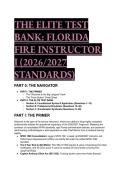
THE ELITE TEST
BANK: FLORIDA
FIRE INSTRUCTOR
I (2026/2027
STANDARDS)
PART 0: THE NAVIGATOR
● PART I: THE PRIMER
○ The "Welcome to the Big Leagues" Hook
○ The "Panic Button" Cheat Sheet
● PART II: THE ELITE TEST BANK
○ Section A: Foundational Syntax & Application (Questions 1–15)
○ Section B: Professional Simulation (Questions 16–40)
○ Section C: Grandmaster Synthesis (Questions 41–66)
PART I: THE PRIMER
Welcome to the apex of fire service instruction, where your ability to forge highly competent
professionals dictates the operational supremacy of the 2026/2027 fireground. Mastering the
synthesis of consolidated NFPA standards, rigid Florida administrative statutes, and advanced
adult learning methodologies is what separates an elite Chief Mentor from a localized training
liability.
● NFPA 1020 Consolidation: Legacy NFPA 1041 is dead; all 2026/2027 Instructor Job
Performance Requirements (JPRs) now strictly fall under the unified NFPA 1020
standard.
● The 6-Year Rule & 40/4 Matrix: FAC 69A-37.059 requires 6 years of experience for initial
certification, and 40 CEUs every 4 years for renewal (4 hours strictly covering FAC
rules/FireTRAQ).
● Captain Anthony Gillan Act (SB 1202): Training injuries carry line-of-duty financial
, liabilities; total disability during training mandates employer-paid health premiums for the
firefighter's family.
● FireTRAQ Supremacy: FCDICE is obsolete; all class rosters and grades must be logged
in FireTRAQ within exactly 20 days.
PART II: THE ELITE TEST BANK
Section A: Foundational Syntax & Application
Q1: A newly appointed training officer is drafting a lesson plan for an upcoming 2026 recruit
academy. To ensure the curriculum meets the current national baseline for instructor
professional qualifications, which standard MUST the instructor FIRST reference? A) NFPA
1041 B) NFPA 1020 C) NFPA 1403 D) NFPA 1500
● The Answer: B (NFPA 1020)
● Distractor Analysis:
○ A is incorrect: NFPA 1041 is a legacy standard that was sunset and consolidated
into NFPA 1020 as part of the Emergency Response and Responder Safety
Consolidation Project for 2025/2026.
○ C is incorrect: NFPA 1403 dictates Live Fire Training Evolutions, not foundational
instructor qualifications.
○ D is incorrect: NFPA 1500 covers fire department occupational safety and health
programs.
The Mentor's Analysis: The landscape changed fundamentally in 2025. NFPA 1020
consolidated Fire Officer, EMS Officer, and Fire Instructor into one master matrix. If your
syllabus cites NFPA 1041 in 2026, you are operating on outdated doctrine, opening your
department to immediate administrative scrutiny. Professional Intuition: Never train to a ghost
standard. Update your master templates the moment NFPA consolidates a numeric designation.
Q2: Under Florida Administrative Code (FAC) 69A-37.059, an applicant submitting Form
DFS-K4-1451 for Fire Service Instructor I certification must provide documented proof of which
MINIMUM operational experience? A) 3 years as a company officer. B) 4 years as a certified live
fire instructor. C) 6 years of experience as a regular member of an organized fire department. D)
8 years of combined volunteer and career fire service experience.
● The Answer: C (6 years of experience as a regular member of an organized fire
department.)
● Distractor Analysis:
○ A is incorrect: Officer rank is not a prerequisite for Instructor I certification.
○ B is incorrect: Live Fire Instructor (BFST3530) is a specialized certification requiring
prior Instructor certification.
○ D is incorrect: While experience can be mixed, the statute specifically dictates a
6-year minimum, making the 8-year claim an arbitrary overreach.
The Mentor's Analysis: The Bureau of Fire Standards and Training (BFST) gatekeeps the
Instructor I title to ensure that those teaching the craft have actually operated within it. Six years
ensures the instructor has survived the novice phase and possesses the contextual schema
necessary to teach safely. Professional Intuition: Time in grade translates to credibility in the
classroom. Six years is the absolute floor, not the ceiling.
Q3: You have successfully concluded delivering a 45-hour Fire Service Course Delivery
(BFST1740) module. To remain compliant with BFST mandates, you must enter the student
, course grades into the FireTRAQ portal within a MAXIMUM of how many days? A) 7 days B) 14
days C) 20 days D) 30 days
● The Answer: C (20 days)
● Distractor Analysis:
○ A is incorrect: Seven days is an internal department target, not the state mandate.
○ B is incorrect: 14 days is a common payroll cycle, unrelated to state training
reporting timelines.
○ D is incorrect: 30 days puts the instructor in violation of state administrative rules
regarding timely record management.
The Mentor's Analysis: Administrative lethargy destroys careers. FAC 69A-37.059 explicitly
dictates the 20-day rule. Failure to log grades delays a firefighter’s state certification, impacts
their Supplemental Compensation, and triggers audits on your training facility. Professional
Intuition: Do not wait for day 19. Enter grades the moment the final exam is scored. Admin
delays are unforced errors.
Q4: A Florida Fire Instructor I is preparing for their quadrennial certification renewal. They have
completed 36 hours of general instructional methodology workshops. To legally secure their
renewal, what SPECIFIC content must the remaining 4 hours cover? A) Advanced PowerPoint
and virtual reality (VR) integration. B) Education or training related to rule Chapter 69A-37 or
69A-39, F.A.C., and FireTRAQ. C) Live Fire Training principles under NFPA 1403. D) Cancer
Decontamination Equipment Grant protocols.
● The Answer: B (Education or training related to rule Chapter 69A-37 or 69A-39, F.A.C.,
and FireTRAQ.)
● Distractor Analysis:
○ A is incorrect: While VR is an emerging trend, it is not an administrative mandate for
renewal.
○ C is incorrect: Live Fire requires a separate 8-hour refresher for the LFTI
certification, not the baseline Instructor renewal.
○ D is incorrect: Cancer Decon (FAC 69A-37.503) is critical, but the 4-hour mandate
is strictly reserved for administrative code and state portal updates.
The Mentor's Analysis: The state mandates a 40-hour renewal block every four years. The
4-hour carve-out for FAC 69A-37/39 ensures instructors remain tethered to the legal realities
and system mechanics (FireTRAQ) that govern their authority. Professional Intuition: Treat the
administrative code as your operational rule of engagement. Ignorance of FAC updates is legally
indefensible.
Q5: You are delivering the 45-hour Florida Fire Service Course Delivery (BFST1740) module.
According to standard BFST curriculum guidelines, what is the MINIMUM cumulative score a
student must achieve to pass the state written examination? A) 60% B) 70% C) 80% D) 85%
● The Answer: B (70%)
● Distractor Analysis:
○ A is incorrect: 60% is a failing grade in all BFST certification courses.
○ C is incorrect: While 80% is commendable, 70% is the established statutory
minimum passing threshold for Instructor I.
○ D is incorrect: 85% is the required passing score for the Live Fire Training Instructor
exam, not basic Course Delivery.
The Mentor's Analysis: The 70% baseline is the absolute "Hard Deck" for foundational
certification courses in Florida. While we push for mastery, 70% is the administrative line
between a state certification and a failure. Professional Intuition: Never artificially inflate
grades to push a student across the 70% line. Your signature on that roster is a legal warranty
BANK: FLORIDA
FIRE INSTRUCTOR
I (2026/2027
STANDARDS)
PART 0: THE NAVIGATOR
● PART I: THE PRIMER
○ The "Welcome to the Big Leagues" Hook
○ The "Panic Button" Cheat Sheet
● PART II: THE ELITE TEST BANK
○ Section A: Foundational Syntax & Application (Questions 1–15)
○ Section B: Professional Simulation (Questions 16–40)
○ Section C: Grandmaster Synthesis (Questions 41–66)
PART I: THE PRIMER
Welcome to the apex of fire service instruction, where your ability to forge highly competent
professionals dictates the operational supremacy of the 2026/2027 fireground. Mastering the
synthesis of consolidated NFPA standards, rigid Florida administrative statutes, and advanced
adult learning methodologies is what separates an elite Chief Mentor from a localized training
liability.
● NFPA 1020 Consolidation: Legacy NFPA 1041 is dead; all 2026/2027 Instructor Job
Performance Requirements (JPRs) now strictly fall under the unified NFPA 1020
standard.
● The 6-Year Rule & 40/4 Matrix: FAC 69A-37.059 requires 6 years of experience for initial
certification, and 40 CEUs every 4 years for renewal (4 hours strictly covering FAC
rules/FireTRAQ).
● Captain Anthony Gillan Act (SB 1202): Training injuries carry line-of-duty financial
, liabilities; total disability during training mandates employer-paid health premiums for the
firefighter's family.
● FireTRAQ Supremacy: FCDICE is obsolete; all class rosters and grades must be logged
in FireTRAQ within exactly 20 days.
PART II: THE ELITE TEST BANK
Section A: Foundational Syntax & Application
Q1: A newly appointed training officer is drafting a lesson plan for an upcoming 2026 recruit
academy. To ensure the curriculum meets the current national baseline for instructor
professional qualifications, which standard MUST the instructor FIRST reference? A) NFPA
1041 B) NFPA 1020 C) NFPA 1403 D) NFPA 1500
● The Answer: B (NFPA 1020)
● Distractor Analysis:
○ A is incorrect: NFPA 1041 is a legacy standard that was sunset and consolidated
into NFPA 1020 as part of the Emergency Response and Responder Safety
Consolidation Project for 2025/2026.
○ C is incorrect: NFPA 1403 dictates Live Fire Training Evolutions, not foundational
instructor qualifications.
○ D is incorrect: NFPA 1500 covers fire department occupational safety and health
programs.
The Mentor's Analysis: The landscape changed fundamentally in 2025. NFPA 1020
consolidated Fire Officer, EMS Officer, and Fire Instructor into one master matrix. If your
syllabus cites NFPA 1041 in 2026, you are operating on outdated doctrine, opening your
department to immediate administrative scrutiny. Professional Intuition: Never train to a ghost
standard. Update your master templates the moment NFPA consolidates a numeric designation.
Q2: Under Florida Administrative Code (FAC) 69A-37.059, an applicant submitting Form
DFS-K4-1451 for Fire Service Instructor I certification must provide documented proof of which
MINIMUM operational experience? A) 3 years as a company officer. B) 4 years as a certified live
fire instructor. C) 6 years of experience as a regular member of an organized fire department. D)
8 years of combined volunteer and career fire service experience.
● The Answer: C (6 years of experience as a regular member of an organized fire
department.)
● Distractor Analysis:
○ A is incorrect: Officer rank is not a prerequisite for Instructor I certification.
○ B is incorrect: Live Fire Instructor (BFST3530) is a specialized certification requiring
prior Instructor certification.
○ D is incorrect: While experience can be mixed, the statute specifically dictates a
6-year minimum, making the 8-year claim an arbitrary overreach.
The Mentor's Analysis: The Bureau of Fire Standards and Training (BFST) gatekeeps the
Instructor I title to ensure that those teaching the craft have actually operated within it. Six years
ensures the instructor has survived the novice phase and possesses the contextual schema
necessary to teach safely. Professional Intuition: Time in grade translates to credibility in the
classroom. Six years is the absolute floor, not the ceiling.
Q3: You have successfully concluded delivering a 45-hour Fire Service Course Delivery
(BFST1740) module. To remain compliant with BFST mandates, you must enter the student
, course grades into the FireTRAQ portal within a MAXIMUM of how many days? A) 7 days B) 14
days C) 20 days D) 30 days
● The Answer: C (20 days)
● Distractor Analysis:
○ A is incorrect: Seven days is an internal department target, not the state mandate.
○ B is incorrect: 14 days is a common payroll cycle, unrelated to state training
reporting timelines.
○ D is incorrect: 30 days puts the instructor in violation of state administrative rules
regarding timely record management.
The Mentor's Analysis: Administrative lethargy destroys careers. FAC 69A-37.059 explicitly
dictates the 20-day rule. Failure to log grades delays a firefighter’s state certification, impacts
their Supplemental Compensation, and triggers audits on your training facility. Professional
Intuition: Do not wait for day 19. Enter grades the moment the final exam is scored. Admin
delays are unforced errors.
Q4: A Florida Fire Instructor I is preparing for their quadrennial certification renewal. They have
completed 36 hours of general instructional methodology workshops. To legally secure their
renewal, what SPECIFIC content must the remaining 4 hours cover? A) Advanced PowerPoint
and virtual reality (VR) integration. B) Education or training related to rule Chapter 69A-37 or
69A-39, F.A.C., and FireTRAQ. C) Live Fire Training principles under NFPA 1403. D) Cancer
Decontamination Equipment Grant protocols.
● The Answer: B (Education or training related to rule Chapter 69A-37 or 69A-39, F.A.C.,
and FireTRAQ.)
● Distractor Analysis:
○ A is incorrect: While VR is an emerging trend, it is not an administrative mandate for
renewal.
○ C is incorrect: Live Fire requires a separate 8-hour refresher for the LFTI
certification, not the baseline Instructor renewal.
○ D is incorrect: Cancer Decon (FAC 69A-37.503) is critical, but the 4-hour mandate
is strictly reserved for administrative code and state portal updates.
The Mentor's Analysis: The state mandates a 40-hour renewal block every four years. The
4-hour carve-out for FAC 69A-37/39 ensures instructors remain tethered to the legal realities
and system mechanics (FireTRAQ) that govern their authority. Professional Intuition: Treat the
administrative code as your operational rule of engagement. Ignorance of FAC updates is legally
indefensible.
Q5: You are delivering the 45-hour Florida Fire Service Course Delivery (BFST1740) module.
According to standard BFST curriculum guidelines, what is the MINIMUM cumulative score a
student must achieve to pass the state written examination? A) 60% B) 70% C) 80% D) 85%
● The Answer: B (70%)
● Distractor Analysis:
○ A is incorrect: 60% is a failing grade in all BFST certification courses.
○ C is incorrect: While 80% is commendable, 70% is the established statutory
minimum passing threshold for Instructor I.
○ D is incorrect: 85% is the required passing score for the Live Fire Training Instructor
exam, not basic Course Delivery.
The Mentor's Analysis: The 70% baseline is the absolute "Hard Deck" for foundational
certification courses in Florida. While we push for mastery, 70% is the administrative line
between a state certification and a failure. Professional Intuition: Never artificially inflate
grades to push a student across the 70% line. Your signature on that roster is a legal warranty


