

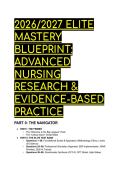
2026/2027 ELITE
MASTERY
BLUEPRINT:
ADVANCED
NURSING
RESEARCH &
EVIDENCE-BASED
PRACTICE
PART 0: THE NAVIGATOR
● PART I: THE PRIMER
○ The "Welcome to the Big Leagues" Hook
○ The "Critical Action" Cheat Sheet
● PART II: THE ELITE TEST BANK
○ Questions 1–28: Foundational Syntax & Application (Methodology, Ethics, Levels
of Evidence)
○ Questions 29–58: Professional Simulation (Appraisal, EBP Implementation, NINR
Priorities, 2026 AI Trends)
○ Questions 59–88: Grandmaster Synthesis (CCC-R, OPT Model, High-Stakes
, Clinical Translation)
PART I: THE PRIMER
The transition from a passive consumer of textbook data to a high-level Clinical Architect
demands aggressive mastery of evidence translation. In the 2026/2027 healthcare landscape,
blind reliance on unit tradition is a liability; mastery of the LoBiondo-Wood & Haber
Evidence-Based Practice (EBP) frameworks intercepts high-stakes cognitive errors and averts
systemic failure. This document is designed to forge academic knowledge into lethal
professional intuition.
The "Critical Action" Cheat Sheet
Level Evidence Type (Study Design) Clinical Application Utility
I Systematic Review / Gold standard for universal
Meta-Analysis of RCTs clinical practice guidelines.
II Single Randomized Controlled Proves causality via
Trial (RCT) manipulation, control, and
randomization.
III Quasi-Experimental Study Lacks randomization; used
when unethical to withhold
treatment.
IV Non-experimental (Cohort, Observational; establishes
Case-Control) correlation, not absolute
causation.
V Systematic Review of Synthesizes lived experiences
Qualitative/Descriptive (Meta-synthesis).
VI Single Descriptive / Qualitative Maps phenomena
Study (Phenomenology, Ethnography,
Grounded Theory).
VII Expert Opinion / Committee Lowest rigor; relies on authority
Reports rather than controlled data.
● Qualitative Rigor (FACTS): Fittingness (Transferability), Auditability (Confirmability),
Credibility (Internal Validity), Trustworthiness (Overall), Saturation (The definitive stopping
point).
● The OPT Model: Outcome-Present State-Test. The practitioner must identify the Keystone
Issue that bridges the patient's current deteriorating state to the desired outcome via
targeted EBP interventions.
● NINR 2022-2026 Lenses: Every 2026 EBP initiative must filter through: Health Equity,
Social Determinants of Health (SDOH), Population and Community Health, Prevention
and Health Promotion, or Systems and Models of Care.
● NCSBN NCJMM: Recognize Cues, Analyze Cues, Prioritize Hypotheses, Generate
Solutions, Take Action, Evaluate Outcomes.
PART II: THE ELITE TEST BANK
, Questions 1–28: Foundational Syntax & Application
Q1: A nurse researcher is designing a study to explore the lived experiences of patients
navigating the 2026 AI-driven hospital admission process. The researcher assumes reality is
subjective and mentally constructed. Which research paradigm BEST aligns with this
methodology? A) Positivism B) Constructivism C) Determinism D) Empiricism
● The Answer: B (Constructivism)
● Distractor Analysis:
○ A is incorrect: Positivism assumes an objective reality exists independent of human
observation, driving quantitative research. * C is incorrect: Determinism is a
philosophical belief regarding causality, not a paradigm for exploring lived
experiences.
○ D is incorrect: Empiricism relies strictly on objectively measurable data.
The Mentor's Analysis: Qualitative research is the architecture of human experience. You
cannot measure grief or confusion with a caliper. Constructivism (the Naturalistic paradigm) is
the definitive framework when investigating how clients subjectively construct their reality.
Q2: A 2026 Level II evidence study investigates the effect of a new targeted genomic therapy on
blood pressure. The researcher measures the patients' blood pressure using a newly calibrated
digital sphygmomanometer. Blood pressure represents which type of variable? A) Confounding
variable B) Independent variable C) Dependent variable D) Demographic variable
● The Answer: C (Dependent variable)
● Distractor Analysis:
○ A is incorrect: Confounding variables are uncontrolled external factors that skew
results.
○ B is incorrect: The independent variable is the genomic therapy (the intervention
being manipulated).
○ D is incorrect: Demographic variables describe population traits, not the primary
measured outcome.
The Mentor's Analysis: The dependent variable depends on your intervention. It is the
outcome you are observing. If you manipulate the Independent variable (the cause), you
measure the Dependent variable (the effect). Keep the syntax clean.
Q3: During a multi-site RCT, the clinical research nurse (CRN) discovers that the principal
investigator failed to provide a Spanish-language consent form to a predominantly
Spanish-speaking patient cohort, violating the Belmont Report. Which core ethical principle was
DIRECTLY breached? A) Beneficence B) Nonmaleficence C) Respect for Persons D) Justice
● The Answer: C (Respect for Persons)
● Distractor Analysis:
○ A is incorrect: Beneficence involves maximizing benefits and minimizing harm.
○ B is incorrect: Nonmaleficence is "do no harm," which falls under beneficence in
research ethics.
○ D is incorrect: Justice involves the fair distribution of research burdens across
demographics.
The Mentor's Analysis: Respect for Persons demands absolute autonomy. Autonomy cannot
exist without informed consent, and consent cannot exist without comprehension. Failing to
provide native-language documentation strips the subject of their autonomy.
Q4: A nurse manager is appraising a 10-year prospective study that tracked cardiovascular
outcomes in shift workers. The study simply observed the workers over time without intervening.
MASTERY
BLUEPRINT:
ADVANCED
NURSING
RESEARCH &
EVIDENCE-BASED
PRACTICE
PART 0: THE NAVIGATOR
● PART I: THE PRIMER
○ The "Welcome to the Big Leagues" Hook
○ The "Critical Action" Cheat Sheet
● PART II: THE ELITE TEST BANK
○ Questions 1–28: Foundational Syntax & Application (Methodology, Ethics, Levels
of Evidence)
○ Questions 29–58: Professional Simulation (Appraisal, EBP Implementation, NINR
Priorities, 2026 AI Trends)
○ Questions 59–88: Grandmaster Synthesis (CCC-R, OPT Model, High-Stakes
, Clinical Translation)
PART I: THE PRIMER
The transition from a passive consumer of textbook data to a high-level Clinical Architect
demands aggressive mastery of evidence translation. In the 2026/2027 healthcare landscape,
blind reliance on unit tradition is a liability; mastery of the LoBiondo-Wood & Haber
Evidence-Based Practice (EBP) frameworks intercepts high-stakes cognitive errors and averts
systemic failure. This document is designed to forge academic knowledge into lethal
professional intuition.
The "Critical Action" Cheat Sheet
Level Evidence Type (Study Design) Clinical Application Utility
I Systematic Review / Gold standard for universal
Meta-Analysis of RCTs clinical practice guidelines.
II Single Randomized Controlled Proves causality via
Trial (RCT) manipulation, control, and
randomization.
III Quasi-Experimental Study Lacks randomization; used
when unethical to withhold
treatment.
IV Non-experimental (Cohort, Observational; establishes
Case-Control) correlation, not absolute
causation.
V Systematic Review of Synthesizes lived experiences
Qualitative/Descriptive (Meta-synthesis).
VI Single Descriptive / Qualitative Maps phenomena
Study (Phenomenology, Ethnography,
Grounded Theory).
VII Expert Opinion / Committee Lowest rigor; relies on authority
Reports rather than controlled data.
● Qualitative Rigor (FACTS): Fittingness (Transferability), Auditability (Confirmability),
Credibility (Internal Validity), Trustworthiness (Overall), Saturation (The definitive stopping
point).
● The OPT Model: Outcome-Present State-Test. The practitioner must identify the Keystone
Issue that bridges the patient's current deteriorating state to the desired outcome via
targeted EBP interventions.
● NINR 2022-2026 Lenses: Every 2026 EBP initiative must filter through: Health Equity,
Social Determinants of Health (SDOH), Population and Community Health, Prevention
and Health Promotion, or Systems and Models of Care.
● NCSBN NCJMM: Recognize Cues, Analyze Cues, Prioritize Hypotheses, Generate
Solutions, Take Action, Evaluate Outcomes.
PART II: THE ELITE TEST BANK
, Questions 1–28: Foundational Syntax & Application
Q1: A nurse researcher is designing a study to explore the lived experiences of patients
navigating the 2026 AI-driven hospital admission process. The researcher assumes reality is
subjective and mentally constructed. Which research paradigm BEST aligns with this
methodology? A) Positivism B) Constructivism C) Determinism D) Empiricism
● The Answer: B (Constructivism)
● Distractor Analysis:
○ A is incorrect: Positivism assumes an objective reality exists independent of human
observation, driving quantitative research. * C is incorrect: Determinism is a
philosophical belief regarding causality, not a paradigm for exploring lived
experiences.
○ D is incorrect: Empiricism relies strictly on objectively measurable data.
The Mentor's Analysis: Qualitative research is the architecture of human experience. You
cannot measure grief or confusion with a caliper. Constructivism (the Naturalistic paradigm) is
the definitive framework when investigating how clients subjectively construct their reality.
Q2: A 2026 Level II evidence study investigates the effect of a new targeted genomic therapy on
blood pressure. The researcher measures the patients' blood pressure using a newly calibrated
digital sphygmomanometer. Blood pressure represents which type of variable? A) Confounding
variable B) Independent variable C) Dependent variable D) Demographic variable
● The Answer: C (Dependent variable)
● Distractor Analysis:
○ A is incorrect: Confounding variables are uncontrolled external factors that skew
results.
○ B is incorrect: The independent variable is the genomic therapy (the intervention
being manipulated).
○ D is incorrect: Demographic variables describe population traits, not the primary
measured outcome.
The Mentor's Analysis: The dependent variable depends on your intervention. It is the
outcome you are observing. If you manipulate the Independent variable (the cause), you
measure the Dependent variable (the effect). Keep the syntax clean.
Q3: During a multi-site RCT, the clinical research nurse (CRN) discovers that the principal
investigator failed to provide a Spanish-language consent form to a predominantly
Spanish-speaking patient cohort, violating the Belmont Report. Which core ethical principle was
DIRECTLY breached? A) Beneficence B) Nonmaleficence C) Respect for Persons D) Justice
● The Answer: C (Respect for Persons)
● Distractor Analysis:
○ A is incorrect: Beneficence involves maximizing benefits and minimizing harm.
○ B is incorrect: Nonmaleficence is "do no harm," which falls under beneficence in
research ethics.
○ D is incorrect: Justice involves the fair distribution of research burdens across
demographics.
The Mentor's Analysis: Respect for Persons demands absolute autonomy. Autonomy cannot
exist without informed consent, and consent cannot exist without comprehension. Failing to
provide native-language documentation strips the subject of their autonomy.
Q4: A nurse manager is appraising a 10-year prospective study that tracked cardiovascular
outcomes in shift workers. The study simply observed the workers over time without intervening.


