

Written by students who passed Immediately available after payment Read online or as PDF Wrong document? Swap it for free 4.6 TrustPilot
logo-home
Document preview thumbnail
Preview 3 out of 23 pages
Exam (elaborations)

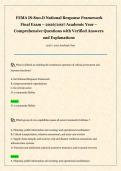
FEMA IS-800.D National Response Framework Final Exam – 2026/2027 Academic Year – Comprehensive Questions with Verified Answers and Explanations

Document preview thumbnail
Preview 3 out of 23 pages

FEMA IS-800.D National Response Framework Final Exam – 2026/2027 Academic Year – Comprehensive Questions with Verified Answers and Explanations 2026 / 2027 Academic Year Q: What is defined as enabling the continuous operation of critical government and business functions? A. the National Response Framework B. nongovernmental organizations C. the private sector D. a community lifeline Answer D. a community lifeline Answer A. Planning; public information and warning; and operational coordination Q: Which group of core capabilities spans all seven Community Lifelines ? A. Planning; public information and warning; and operational coordination B. Critical transportation; situation assessment; and mass care services C. Supply chain integrity and security; risk and disaster resilience assessment; and infrastructure systems D. Forensics and attribution; physical protective measures; and economic recovery Q: The police, fire, and emergency medical services are usually categorized inside which government? A. Local government B. Federal government C. Private Sectior D. Regional government Answer B. Federal government Q: Which of the following is part of the community lifelines that represent the most basic services a community relies on? A. Grocery and Fast Food B. Child care C. Internet D. Food, Water and Shelter Answer A. Grocery and Fast Food Q: Operational Coordination is considered a cross cutting capability. In this sense, cross cutting means? A. Is used to span multiple agencies B. Is used solely by one mission area C. Is used in all five of the mission area D. Is used to cross all levels of government Answer D. Is used to cross all levels of government Q: Which organization serves as the principal operations center for the Department of Homeland Security? A. National Military Command Center (NMCC) B. National Operations Center (NOC) C. Disaster Response Center (DRC) D. Strategic Information and Operations Center (SIOC) Answer B. National Operations Center (NOC) Q: The National Response Framework is: A. Written exclusively for professional emergency management practitioners. B. A comprehensive guide to prevention, protection, response, recovery, and mitigation. C. Always in effect, and elements can be implemented as needed on a flexible, scalable basis to improve response. D. Triggered following a declaration by the Secretary of Homeland Security. Answer B. A comprehensive guide to prevention, protection, response, recovery, and mitigation. Q: What is the correct function for the National Center for Missing & Exploited Children (NCMEC)? A. Facilitates the identification of children and their reunification B. Provides volunteers with the proper training for emergency preparedness C. Provides relief to survivors and help people prevent, prepare, and response to emergencies D. Shares knowledge and resources throughout the disaster cycle Answer D. Shares knowledge and resources throughout the disaster cycle Q: In order to help form a common operating picture of the incident and secure additional resources the Incident Commander relays requirements to: A. Local emergency operations center B. Unified Coordination Group C. Regional response coordination center D. State/tribal emergency operations Answer A. Local emergency operations center Q: States request assistance from other states through interstate mutual aid and assistance agreements such as: A. Emergency Management Assistance Compacts (EMACs) B. Tiered Response C. Stafford Act D. Economy Act or other applicable authorities Answer A. Emergency Management Assistance Compacts (EMACs) Q: What is the definition for "Mitigation" mission area? A. Secure the homeland against terrorism and man made or natural disasters. B. Reduce loss of life and property by lessening the impact of disasters. C. Assist communities affected by an incident to recover effectively. D. Avoid, prevent, or stop a threatened or actual act of terrorism. Answer B. Reduce loss of life and property by lessening the impact of disasters. Q: A guiding principle of the National Response Framework is that: A. Unity of effort results when responding agencies are willing to relinquish their authorities. B. Readiness to act encourages response partners to self-dispatch to an incident scene. C. Response partners use nonstandard structures to allow for flexible and scalable responses. D. Effective partnership relies on engaging all elements of the whole community. Answer D. Effective partnership relies on engaging all elements of the whole community. Q: Select one of the three core capabilities that spans all Mission Areas? A. Physical Protective Measures B. Operational Coordination C. Search and Rescue D. Fire Fighting Answer B. Operational Coordination Q: What is the definition for the "Protection" mission area? A. Reduce loss of life and property by lessening the impact of disasters. B. Secure the homeland against terrorism and man made or natural disasters. C. Avoid, prevent, or stop a threatened or actual act of terrorism. D. Assist communities affected by an incident to recover effectively. Answer B. Secure the homeland against terrorism and man made or natural disasters. Q: The response protocols and structures described in the National Response Framework align with what doctrine to support a unified approach to response? A. A Whole Community Approach to Emergency Management B. National Incident Management System (NIMS) C. Incident Action Planning Guide D. Comprehensive Preparedness Guide 201 Answer B. National Incident Management System (NIMS) Q: The National Response Framework: A. Is designed to be implemented only for catastrophic incidents, since local resources are usually sufficient in smaller emergencies. B. Mandates that the private-sector entities responsible for critical infrastructure and key resources develop and exercise contingency plans. C. Is intended to provide guidance for the whole community. Answer D. Is based on the premise that governments have sole responsibility for responding to major emergencies. Q: The National Response Framework is: A. Focused on natural disasters, whereas the Protection and Prevention Frameworks focus on technological and human-caused incidents. B. Activated only after a Presidential disaster declaration. C. In effect at all times and applicable to all types and sizes of incidents. D. Directs the incident command structure established at the incident. Answer C. In effect at all times and applicable to all types and sizes of incidents. Q: All agencies with jurisdictional authority and/or functional responsibility for the incident provide joint support through mutually developed incident objectives and strategies. This is an example of: A. Scalable Operational Capabilities B. Tiered Response C. Area Command D. Unified Command Answer D. Unified Command Q: The response protocols and structures described in the National Response Framework align with what doctrine to support a unified approach to response? A. Comprehensive Preparedness Guide 201 B. Incident Action Planning Guide C. A Whole Community Approach to Emergency Management D. National Incident Management System (NIMS) Answer D. National Incident Management System (NIMS) Q: Which Response core capability involves ensuring the capacity for timely communications in support of security, situational awareness, and operations by any and all means available, among and between affected communities in the impact area and all response forces? A. Logistics and Supply Chain Management B. On-scene Security, Protection, and Law Enforcement C. Operational Communications D. Infrastructure Systems Answer C. Operational Communication Q: Which group of core capabilities spans all seven Community Lifelines ? A. Supply chain integrity and security; risk and disaster resilience assessment; and infrastructure systems B. Forensics and attribution; physical protective measures; and economic recovery C. Critical transportation; situation assessment; and mass care services D. Planning; public information and warning; and operational coordination Answer D. Planning; public information and warning; and operational coordination Q: The police, fire, and emergency medical services are usually categorized inside which government? A. Private Sectior B. Regional government C. Federal government D. Local government Q: Operational Coordination is considered a cross cutting capability. In this sense, cross cutting means? A. Is used in all five of the mission area B. Is used to cross all levels of government C. Is used solely by one mission area D. Is used to span multiple agencies Answer B. Is used to cross all levels of government Q: What is the definition for the "Protection" mission area? A. Assist communities affected by an incident to recover effectively. B. Avoid, prevent, or stop a threatened or actual act of terrorism. C. Reduce loss of life and property by lessening the impact of disasters. D. Secure the homeland against terrorism and man made or natural disasters. Answer B. Avoid, prevent, or stop a threatened or actual act of terrorism. Q: Which organization serves as the principal operations center for the Department of Homeland Security? A. Disaster Response Center (DRC) B. Strategic Information and Operations Center (SIOC) C. National Operations Center (NOC) D. National Military Command Center (NMCC) Answer C. National Operations Center (NOC) Q: What is the Tribal Assistance Coordination Group (TAC-G)? A. A Tribal Unified Command of two or more tribes B. The Tribal EMAC C. The Federal MAC Group that assists tribes D. A Tribal EOC Answer C. The Federal MAC Group that assists tribes Q: Which of the following is a mission area? A. Reaction B. Planning C. Recovery D. Operational Coordination Answer C. Recovery Q: What is the correct function for the National Center for Missing & Exploited Children (NCMEC)? A. Provides relief to survivors and help people prevent, prepare, and response to emergencies B. Shares knowledge and resources throughout the disaster cycle C. Provides volunteers with the proper training for emergency preparedness D. Facilitates the identification of children and their reunification Answer D. Facilitates the identification of children and their reunification Q: How many community lifelines are there? A. 7 B. 5 C. 9 D. 3 Answer A Q: Which is the next level of government that responds to an incident when it has the potential to expand beyond the capability of local jurisdiction? A. Federal government B. State government C. Private Sector D. Foreign government B. State government Q: The National Response Framework is: A. Always in effect, and elements can be implemented as needed on a flexible, scalable basis to improve response. B. Triggered following a declaration by the Secretary of Homeland Security. C. A comprehensive guide to prevention, protection, response, recovery, and mitigation. D. Written exclusively for professional emergency management practitioners.The National Response Framework is: A. Always in effect, and elements can be implemented as needed on a flexible, scalable basis to improve response. B. Triggered following a declaration by the Secretary of Homeland Security. C. A comprehensive guide to prevention, protection, response, recovery, and mitigation. D. Written exclusively for professional emergency management practitioners. A Q: In order to help form a common operating picture of the incident and secure additional resources the Incident Commander relays requirements to: A. Regional response coordination center B. State/tribal emergency operations C. Unified Coordination Group D. Local emergency operations center D Q: Which government entity can elect to deal directly with the Federal Government for federal disaster assistance? A. Tribal government B. Local government C. Foreign government D. Private sector A Select one of the three core capabilities that spans all Mission Areas? A. Search and Rescue B. Fire Fighting C. Operational Coordination D. Physical Protective Measures C Which of the following statements about Emergency Support Functions (ESFs) is correct? A. ESFs are exclusively a state coordinating mechanism B. ESFs are not exclusively federal coordinating mechanism C. ESFs are only a state or local coordinating mechanism D. ESFs are exclusively a federal coordinating mechanism D A basic premise of the National Response Framework is that: A. Response partners use nonstandard structures to allow for flexible and scalable responses. B. Incidents should be managed at the highest jurisdictional level possible. C. Readiness to act encourages response partners to self-dispatch to an incident scene. D. Most incidents begin and end locally and are managed at the local or tribal level. D One premise of the National Framework is Tiered response. Tiered Response can best be described as: Incidents are generally handled at the lowest jurisdictional level. Incidents begin and end locally. Which group of core capabilities spans all seven Community Lifelines? Planning; public information and warning; and operational coordination Which of the following set the vision for preparedness nationwide and identifies core capabilities? National Preparedness Goal All agencies with jurisdictional authority and/or functional responsibility for the incident provide joint support through mutually developed incident objectives and strategies. This is an example of: Unified command How many community lifelines are there? 7 Which of the following are part of the DHS/FEMA Federal Operations Centers? Department of Defense (DoD) DOC In order to help form a common operating picture of the incident and secure additional resources the Incident Commander relays requirements to: Local emergency operations center operational Coordination is considered a cross cutting capability. In this sense, cross cutting means? Is used to cross all levels of government A guiding principle of the National Response Framework is that: Effective partnership relies on engaging all elements of the whole community The terms "response" as used in the National Response Framework includes: Actions to save lives, protect property and the environment, stabilize communities, and meet the basic human needs following an incident States request assistance from other states through interstate mutual aid and assistance agreements such as: Emergency Management Assistance Compacts (EMAC) Critical infrastructure such as utilities and banking are which partners responsibility? Private Sector How the Federal Government aligns resources and delivers core capabilities to reach our shared National Preparedness Goal is described in: The Response Federal Interagency Operational Plan Which of the following are part of the community lifelines that represent the most basic services a community relies on? Grocery and Fast food Which organization serves as the principal operations center for the department of Homeland Security? National Operations Center (NOC) Why is it important to engage communities in preparedness efforts? Provide opportunities for sharing information Which of the following is a benefit of unified command? Joint Priorities Hos do coordination structures help organize and measure the whole community capabilities? Facilitate problem solving Select the CORRECT statement below. The National Response Framework: Describes key roles and responsibilities for integrating capabilities across the whole community Community Emergency Response Teams are an example of: State coordinating structures the response protocols and structures described in the National Response Framework align with what doctrine to support a unified approach to response? National Incident Management System (NIMS) A basic premise of the National Response Framework is that: Most incidents begin and end locally and are managed at the local and tribal level What is defined as enabling the continuous of critical government and business functions? a community lifeline which response core capability involves ensuring the capacity for timely communications in support of security, situational awareness, and operations by any and all means available, among and between affected communities in the impact area and all response forces? operational communications which is the next level of government that responds to an incident when it has the potential to expand beyond the capability of local jurisdiction? state government The unified coordination group: Provides coordination leadership at the Joint Field Office. Which of the following is a mission area? recovery What is defined as enabling the continuous operation of critical government in business functions? a community lifeline What is the tribal assistance coordination group? (TAC-G) The Federal MAC Group that assists tribes Which is the next level of government that responds to an incident when it has the potential expand beyond the capability of local jurisdiction state government Which response, core capability involves ensuring the capacity for timely communications in support of security, situational awareness, and operations by any, and all means available, among in between affected communities in the impact area and all response forces Operational Communications A MAC Group is: Composed of senior officials, such as agency administrators, executives, or their designees, who are authorized to represent or commit agency resources and funds in support of incident activities. Community Emergency Response Teams are an example of: Local coordinating structures What is the definition for "mitigation" mission area? Reduce loss of life and property by lessening the impact of disasters The police, fire, an emergency medical services are usually categorized in which government Local government Which of the following statements about emergencies support functions? (ESFs) is correct ESFs are not exclusively federal coordinating mechanism Why is it important to engage communities and preparedness efforts? Provide opportunities for sharing information Many jurisdictions/organizations configure their EEOC's using the standard ______________ organizational structure Incident command system (ICS) All agencies with jurisdictional authority and/or functional responsibility for the incident provide joint support through mutually developed incident objectives and strategies. This is an example of: Unified Command Scalable, flexible, and adaptable operational capabilities are included in The NRF guiding principles A guiding principle of the national response framework is that: Effective partnership relies on engaging all elements of the whole community. In order to help form a common operating picture of the incident insecure add additional resources the incident commander relays requirements to: Surrounding regional response, coordination centers (RRCC) The national response framework: Outlines how the response mission area relates to other mission areas Which of the following is a community lifeline? communications How many community lifelines are there? 7 Emergency support functions (ESF) are organized groups of? government and private-sector entities. What is the correct function for the national center for missing an exploited children? (NCMEC) Facilitates identification of children and their reunification The national response framework is; Always in effect and elements can be implemented as needed on a flexible, scalable basis to improve response How do coordination structures help organize and measure the whole communities capabilities? Facilitate problem-solving States request assistance from other states through interstate mutual aid and assistance agreement such as: Emergency management assistance, compacts (EMAC)

Content preview

FEMA IS-800.D National Response Framework
Final Exam – 2026/2027 Academic Year –
Comprehensive Questions with Verified Answers
and Explanations
Academic Year


Q: What is defined as enabling the continuous operation of critical government and
business functions?


A. the National Response Framework
B. nongovernmental organizations
C. the private sector
D. a community lifeline


Answer
D. a community lifeline


Q: Which group of core capabilities spans all seven Community Lifelines ?

A. Planning; public information and warning; and operational coordination
B. Critical transportation; situation assessment; and mass care services
C. Supply chain integrity and security; risk and disaster resilience assessment; and
infrastructure systems
D. Forensics and attribution; physical protective measures; and economic recovery


Answer
A. Planning; public information and warning; and operational coordination

,Q: The police, fire, and emergency medical services are usually categorized inside which
government?


A. Local government
B. Federal government
C. Private Sectior
D. Regional government


Answer
B. Federal government


Q: Which of the following is part of the community lifelines that represent the most basic
services a community relies on?


A. Grocery and Fast Food
B. Child care
C. Internet
D. Food, Water and Shelter


Answer
A. Grocery and Fast Food


Q: Operational Coordination is considered a cross cutting capability. In this sense, cross
cutting means?


A. Is used to span multiple agencies
B. Is used solely by one mission area
C. Is used in all five of the mission area
D. Is used to cross all levels of government

, Answer
D. Is used to cross all levels of government


Q: Which organization serves as the principal operations center for the Department of
Homeland Security?


A. National Military Command Center (NMCC)
B. National Operations Center (NOC)
C. Disaster Response Center (DRC)
D. Strategic Information and Operations Center (SIOC)


Answer
B. National Operations Center (NOC)


Q: The National Response Framework is:

A. Written exclusively for professional emergency management practitioners.
B. A comprehensive guide to prevention, protection, response, recovery, and mitigation.
C. Always in effect, and elements can be implemented as needed on a flexible, scalable basis
to improve response.
D. Triggered following a declaration by the Secretary of Homeland Security.


Answer
B. A comprehensive guide to prevention, protection, response, recovery, and mitigation.

Document information

Uploaded on
March 19, 2026
Number of pages
23
Written in
2025/2026
Type
Exam (elaborations)
Contains
Questions & answers
$13.49

Wrong document? Swap it for free Within 14 days of purchase and before downloading, you can choose a different document. You can simply spend the amount again.
Written by students who passed
Immediately available after payment
Read online or as PDF

Seller avatar
Reputation scores are based on the amount of documents a seller has sold for a fee and the reviews they have received for those documents. There are three levels: Bronze, Silver and Gold. The better the reputation, the more your can rely on the quality of the sellers work.
EliteStudyDocs
4.0
(18)
Sold
144
Followers
52
Items
2769
Last sold
1 week ago


Why students choose Stuvia

Created by fellow students, verified by reviews

Quality you can trust: written by students who passed their tests and reviewed by others who've used these notes.

Didn't get what you expected? Choose another document

No worries! You can instantly pick a different document that better fits what you're looking for.

Pay as you like, start learning right away

No subscription, no commitments. Pay the way you're used to via credit card and download your PDF document instantly.

Student with book image

“Bought, downloaded, and aced it. It really can be that simple.”

Alisha Student

Working on your references?

Create accurate citations in APA, MLA and Harvard with our free citation generator.

Working on your references?

Frequently asked questions
