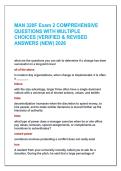
MAN 320F Exam 2 COMPREHENSIVE
QUESTIONS WITH MULTIPLE
CHOICES |VERIFIED & REVISED
ANSWERS (NEW) 2026
what are the questions you can ask to determine if a change has been
successful on a long-term level
all of the above
in modern day organizations, when change is implemented, it is often
a _______.
failure
with the size advantage, larger firms often have a single dominant
culture with a universal set of shared actions, values, and beliefs
false
decentralization increases when the discretion to spend money, to
hire people, and to make similar decisions is moved farther up the
hierarchy of authority
false
what type of power does a manager exercise when he or she offers
pay raises, bonuses, special assignments, or compliments as
incentives to subordinates?
reward power
avoidance involves pretending a conflict does not really exist
true
A student from your university recently called you to ask for a
donation. During the pitch, he said that a large percentage of
, undergrad alumni have donated, and an even larger percentage of
BHP alumni from your graduation year have donated. According to
the six principles of persuasion, which two of the following is the
caller using?
social proof
linkage
In order to judge whether a change implementation has been
successful, it is important to not only assess whether the intended
change happened, but also to assess how the change affected the
organization and the change agent.
true
the five stages of team development are forming, storming, norming,
performing, adjourning
true
to begin understanding an organization's culture, it is often easiest to
start with which of the following?
stories about the organization
often, the language of a subculture, and its ritual and rites, emerge
from the group as a form of jargon.
true
Which of the following characteristics of a change leader is/are
related to successful implementation of change?
all the answer choices are correct
An essential criterion of a true team is that the members feel
'collectively accountable' for what they accomplish.
true
team performance is not in danger of suffering when:
goals are well designed
Team cohesiveness tends to be low when members are similar in age,
attitudes, needs and backgrounds.
QUESTIONS WITH MULTIPLE
CHOICES |VERIFIED & REVISED
ANSWERS (NEW) 2026
what are the questions you can ask to determine if a change has been
successful on a long-term level
all of the above
in modern day organizations, when change is implemented, it is often
a _______.
failure
with the size advantage, larger firms often have a single dominant
culture with a universal set of shared actions, values, and beliefs
false
decentralization increases when the discretion to spend money, to
hire people, and to make similar decisions is moved farther up the
hierarchy of authority
false
what type of power does a manager exercise when he or she offers
pay raises, bonuses, special assignments, or compliments as
incentives to subordinates?
reward power
avoidance involves pretending a conflict does not really exist
true
A student from your university recently called you to ask for a
donation. During the pitch, he said that a large percentage of
, undergrad alumni have donated, and an even larger percentage of
BHP alumni from your graduation year have donated. According to
the six principles of persuasion, which two of the following is the
caller using?
social proof
linkage
In order to judge whether a change implementation has been
successful, it is important to not only assess whether the intended
change happened, but also to assess how the change affected the
organization and the change agent.
true
the five stages of team development are forming, storming, norming,
performing, adjourning
true
to begin understanding an organization's culture, it is often easiest to
start with which of the following?
stories about the organization
often, the language of a subculture, and its ritual and rites, emerge
from the group as a form of jargon.
true
Which of the following characteristics of a change leader is/are
related to successful implementation of change?
all the answer choices are correct
An essential criterion of a true team is that the members feel
'collectively accountable' for what they accomplish.
true
team performance is not in danger of suffering when:
goals are well designed
Team cohesiveness tends to be low when members are similar in age,
attitudes, needs and backgrounds.