Marketing Communication
Lecture 1
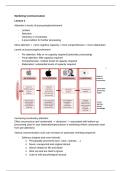
Attention is levels of processing/involvement
- Limited
- Selective
- Voluntary or involuntary
- A precondition for further processing
More attention = more cognitive capacity = more comprehension = more elaboration
Levels of processing/involvement:
- Pre-attention: little or no capacity required (automatic processing)
- Focal attention: little capacity required
- Comprehension: modest levels of capacity required
- Elaboration: substantial levels of capacity required
Increasing involuntary attention:
Often unconscious and unintended -> ‘attractors’ -> associated with bottom-up
processing (start in your elaboration/persuasion in marketing where consumers start
from pre-attention)
Various communication cues can increase an automatic orienting response:
- Saliency (original and novel stimuli):
o Perceptually prominent (size, color, contrast, …)
o Novel, unexpected and original stimuli
o Stimuli related to life and death
o Stick out and are hard to ignore
o Lead to mild psychological arousal
, o Result in focal attention to the source of stimulation
- Horizontal centrality (centrally located stimuli):
o Stimuli in the center receive more attention (and are more likely to be
chosen)
- Primacy (stimuli presented first in a list)
o In the beginning you’re more fresh and pay more attention
o We have learned that the most important things come first
- Picture superiority (pictures)
o Pictorial information receives more information than textual information
o Pictures attract attention, regardless of size
o The bigger the text, the more attention
o The bigger the brand name, the more attention
Increasing voluntary attention
(Personal interest and inattentional blindness, self-referencing, proximity)
How to increase?
- Increase self-relevance -> personal interest avoids inattentional blindness,
self-referencing, proximity…
- Curiosity -> unfinished ads, mysterious ads…
Often conscious and intended -> ‘magnetizers’ -> associated with top-down
processing
- Personal interest & inattentional blindness
o Consumers allocate more attention to information that is consistent with
their goals
o Information that is not relevant, is often ignored, and will lead to
inattentional blindness
o Banner blindness
Organic results generate more attention and traffic because they
are immediately relevant
Sponsored result often suffer from inattentional blindness
- Self referencing
o Attention increases when personalized information is used
Second person wording (‘you)
Names
- Proximity & EWOM
o Consumers pay more attention to information that is ‘close’ (in the
senses -> interest and social acquaintances )
If information comes from someone who is closer to you, you pay
more attention
o The more proximate, the more relevant, the more attention
Sensory proximity: closeness in experience
, Spatial proximity: closeness in physical space
Temporal proximity: closeness in time (if your planning to do
something soon, you pay more attention to related things)
A variety of applications:
- E(WOM) comes from people close to use (spatial and sensory proximity)
- Viral marketing is emotionally vivid (sensory proximity) and is shared via
friends
- Blogs are written by influencers that feel close (sensory proximity)
- Billboards and abri’s are prominent and often close in space
How campaigns sustain attention:
Processing ease
- Increases engagement -> the easier, the more likely that people will continue
with the task
- Generates positive affect -> fluency generally leads to positive feelings
- Increases comprehension -> the easier, the less resources are needed for
comprehension and elaboration
o Linking your appeal to what consumers already know makes it easier
for them to comprehend
o Increased by:
Concrete information is easier to process, and helps to link to
existing knowledge structures -> processing ease, concrete
information, memory traces and the associative network theory
Visual information strengthens memory traces (dual coding
theory)
Visual and verbal modalities lead to different encoding
strategies -> words are stored in verbal codes, images are
stored in visual codes, the net result is more and distinct
memory traces
Variability not only prevents boredom, but also strengthens
existing knowledge structures (encoding variability)
The more memory traces available, the easier to encode,
comprehend and retrieve -> novel (but related)
information receives an extra memory trace
Emotional language
- Not all emotions are able to sustain attention well
- Emotions that do sustain attention are associated with uncertainty (because
people will try to resolve what will happen) and arousal (because people are in
an increased state of vigilance)
, Lecture 2
Persuasion= any attempt to influence a person’s beliefs, attitudes, intentions, or
behavior
Pre-suasion = the process of making ‘recipients’ ready for a request
Attitudes = a learned predisposition to behave in a consistently favorable or
unfavorable manner with respect to a given object -> aka out likes or dislikes
- Affective: excitement of rollercoaster -> what you feel when thinking about the
efteling
- Cognitive: costs, having restaurants
- Behavioral: past experience, hearing stories
Attitude functions: our ‘likes’ and ‘dislikes’
- Provide information about the relevance of items to one’s goals (functional
theory) -> why do people like it?
o Ego defensive
- Provide a fast and automatic assessment of whether something is good or bad
(automatic evaluation)
Advertising repetition
Two-factor theory:
- Ad wear-in:
o Occurs at the first couple of exposures
o Initial attitudes are often negative because:
The message is not appreciated
People are quite defensive
o After a number of exposures attitudes become more favorable because:
People start to understand the message
Initial defensiveness dissipates
- Ad wear-out
o Occurs after a number of exposures
o Positive attitudes become more negative
Lecture 1
Attention is levels of processing/involvement
- Limited
- Selective
- Voluntary or involuntary
- A precondition for further processing
More attention = more cognitive capacity = more comprehension = more elaboration
Levels of processing/involvement:
- Pre-attention: little or no capacity required (automatic processing)
- Focal attention: little capacity required
- Comprehension: modest levels of capacity required
- Elaboration: substantial levels of capacity required
Increasing involuntary attention:
Often unconscious and unintended -> ‘attractors’ -> associated with bottom-up
processing (start in your elaboration/persuasion in marketing where consumers start
from pre-attention)
Various communication cues can increase an automatic orienting response:
- Saliency (original and novel stimuli):
o Perceptually prominent (size, color, contrast, …)
o Novel, unexpected and original stimuli
o Stimuli related to life and death
o Stick out and are hard to ignore
o Lead to mild psychological arousal
, o Result in focal attention to the source of stimulation
- Horizontal centrality (centrally located stimuli):
o Stimuli in the center receive more attention (and are more likely to be
chosen)
- Primacy (stimuli presented first in a list)
o In the beginning you’re more fresh and pay more attention
o We have learned that the most important things come first
- Picture superiority (pictures)
o Pictorial information receives more information than textual information
o Pictures attract attention, regardless of size
o The bigger the text, the more attention
o The bigger the brand name, the more attention
Increasing voluntary attention
(Personal interest and inattentional blindness, self-referencing, proximity)
How to increase?
- Increase self-relevance -> personal interest avoids inattentional blindness,
self-referencing, proximity…
- Curiosity -> unfinished ads, mysterious ads…
Often conscious and intended -> ‘magnetizers’ -> associated with top-down
processing
- Personal interest & inattentional blindness
o Consumers allocate more attention to information that is consistent with
their goals
o Information that is not relevant, is often ignored, and will lead to
inattentional blindness
o Banner blindness
Organic results generate more attention and traffic because they
are immediately relevant
Sponsored result often suffer from inattentional blindness
- Self referencing
o Attention increases when personalized information is used
Second person wording (‘you)
Names
- Proximity & EWOM
o Consumers pay more attention to information that is ‘close’ (in the
senses -> interest and social acquaintances )
If information comes from someone who is closer to you, you pay
more attention
o The more proximate, the more relevant, the more attention
Sensory proximity: closeness in experience
, Spatial proximity: closeness in physical space
Temporal proximity: closeness in time (if your planning to do
something soon, you pay more attention to related things)
A variety of applications:
- E(WOM) comes from people close to use (spatial and sensory proximity)
- Viral marketing is emotionally vivid (sensory proximity) and is shared via
friends
- Blogs are written by influencers that feel close (sensory proximity)
- Billboards and abri’s are prominent and often close in space
How campaigns sustain attention:
Processing ease
- Increases engagement -> the easier, the more likely that people will continue
with the task
- Generates positive affect -> fluency generally leads to positive feelings
- Increases comprehension -> the easier, the less resources are needed for
comprehension and elaboration
o Linking your appeal to what consumers already know makes it easier
for them to comprehend
o Increased by:
Concrete information is easier to process, and helps to link to
existing knowledge structures -> processing ease, concrete
information, memory traces and the associative network theory
Visual information strengthens memory traces (dual coding
theory)
Visual and verbal modalities lead to different encoding
strategies -> words are stored in verbal codes, images are
stored in visual codes, the net result is more and distinct
memory traces
Variability not only prevents boredom, but also strengthens
existing knowledge structures (encoding variability)
The more memory traces available, the easier to encode,
comprehend and retrieve -> novel (but related)
information receives an extra memory trace
Emotional language
- Not all emotions are able to sustain attention well
- Emotions that do sustain attention are associated with uncertainty (because
people will try to resolve what will happen) and arousal (because people are in
an increased state of vigilance)
, Lecture 2
Persuasion= any attempt to influence a person’s beliefs, attitudes, intentions, or
behavior
Pre-suasion = the process of making ‘recipients’ ready for a request
Attitudes = a learned predisposition to behave in a consistently favorable or
unfavorable manner with respect to a given object -> aka out likes or dislikes
- Affective: excitement of rollercoaster -> what you feel when thinking about the
efteling
- Cognitive: costs, having restaurants
- Behavioral: past experience, hearing stories
Attitude functions: our ‘likes’ and ‘dislikes’
- Provide information about the relevance of items to one’s goals (functional
theory) -> why do people like it?
o Ego defensive
- Provide a fast and automatic assessment of whether something is good or bad
(automatic evaluation)
Advertising repetition
Two-factor theory:
- Ad wear-in:
o Occurs at the first couple of exposures
o Initial attitudes are often negative because:
The message is not appreciated
People are quite defensive
o After a number of exposures attitudes become more favorable because:
People start to understand the message
Initial defensiveness dissipates
- Ad wear-out
o Occurs after a number of exposures
o Positive attitudes become more negative