

KENDRIYA VIDYALAYA SANGATHAN REGIONAL OFFICE LUCKNOW
SESSION ENDING EXAMINATION 2024-25
CLASS: XI SUBJECT: PHYSICS
TIME: 3 HOURS M. MARKS: 70
GENERAL INSTRUCTIONS:
(I) All the questions are compulsory
(II) There are 33 questions in the paper. Section A contains 12 MCQs and 4 Assertion-Reason
questions of 1 mark each, Section B contains 5 Short answer questions of 2 marks each,
Section C contains 7 short answer questions of 3 marks each, Section D contains 2 Case-study
Based questions of 4 marks, Section E contains 3 long answer questions of 5 marks each.
(III) There is no overall choice in the paper however an internal choice has been given in 1 question
of 2 marks, 1 question of 3 marks, 1 question of 4 marks and all the questions of 5 marks.
SECTION A
MULTIPLE CHOICE QUESTIONS (1 X 12 = 12 MARKS)
1. Out of the following pairs, which one does not have identical dimensions? (1)
(a) Moment of Inertia and moment of force
(b) Work and torque
(c) Angular momentum and Planck’s constant
(d) Impulse and momentum
2. Speeds of two identical cars are u and 4u at a specific instant. The ratio of the respective distances at (1)
which the two cars are stopped from that instant is
(a)1:1 (b) 1:4 (c) 1:8 (d) 1: 16
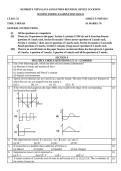
3. If the velocity-time graph has the slope AMB, what would be the shape of the corresponding (1)
acceleration-time graph?
4. The angle between vectors ⃗ A=10 i+10^ ^ ⃗
^j−5 k∧ ^
B =10 i−5 ^j+ 10 k^ is (1)
(a) 30 ͦ (b) 45 ͦ (c) 60 ͦ (d) 90 ͦ
5. If normal force is doubled, then coefficient of friction is (1)
(a) Halved (b) tripled (c) doubled (d) not changed
6. Instantaneous power can be expressed as (1)
(a) ⃗
F . ⃗v (b)1/ 2 ⃗
F . ⃗v
2
(c)⃗F.t (d)⃗
F x ⃗v
7. A system consists of 3 particles each of mass m and located at (1,1), (2,2), (3,3). The co-ordinates of (1)
the centre of mass are
, (a) (6,6) (b) (3,3) (c) (2,2) (d) (1,1)
8. The breaking force for a wire of diameter D of a material is F. The breaking force for a wire of the (1)
same material of radius D is
(a) F (b) 2F (c) F/4 (d) 4F
9. If the liquid neither rises nor falls in a capillary tube, the angle of contact is (1)
(a) 0 ͦ (b) 45 ͦ (c) 90 ͦ (d) 180 ͦ
10. The temperature gradient of 0.5 m long rod is 80 ͦ C/m. If the temperature of hotter end of the rod is (1)
30 ͦC, then the temperature of the colder end is
(a)40 ͦC (b) - 10 ͦC (c) 10 ͦC (d) 0 ͦ ͦC
11. If the gas has f degrees of freedom, ratio of specific heats of the gas is (1)
1+ f 1 f 2
(a) (b) 1 + (c) 1 + (d) 1 +
2 f 2 f
12. If a spring has time period T and is cut into 2 equal parts, then the time period of oscillation of (1)
each part will be
(a) √ 2T (b) T/ √ 2 (c) 2T (d) T/2
ASSERTION REASON QUESTIONS (QUES NO. 13-16)
Each of these questions contain two statements, Assertion and Reason. Each of these questions also
have four alternative choices, only one of which is the correct answer. You have to select one of the
codes (a), (b), (c) & (d) given below.
(a) Both Assertion and Reason are true and Reason is the correct explanation of Assertion
(b) Both Assertion and Reason are true but Reason is not the correct explanation of Assertion
(c) Assertion is true but Reason is false
(d) Both Assertion and Reason are false
13. ASSERTION: The speed of a body in uniform circular motion is constant (1)
REASON: In uniform circular motion, the acceleration of the body is constant.
14. ASSERTION: Impulsive force is large and acts for a short time. (1)
REASON: Finite change in momentum should be produced by the force.
15. ASSERTION: Surface tension decreases with increase in temperature. (1)
REASON: On increasing temperature, kinetic energy increases and inter-molecular forces decrease.
16. ASSERTION: In an adiabatic compression, the internal energy and temperature of the system gets (1)
decreased.
REASON: Adiabatic compression is a slow process.
SECTION B (TWO MARKS QUESTIONS) 2 X 5 = 10 MARKS
17. Write the expressions for the acceleration due to gravity ‘g’ (2)
(i) at a height h (h >> R), where R is the radius of the Earth and
(ii) depth d from the Earth’s surface
Also, show the variation graphically.
( Assume Earth to be a sphere of uniform density).
18. If momentum[P], area [A] and time [T] are taken as fundamental quantities, then find the (2)
dimensional formula for coefficient of viscosity in terms of P,A & T.
19. The displacement x of a particle varies with time t as x = 4t2 - 15t + 25. Find the instantaneous (2)
velocity and acceleration of the particle at t = 0 s. What can you infer about the acceleration of the
particle?
OR
Prove s = ut + 1/2 at2 graphically
20. Will two spheres of equal masses and radii, one solid and the other hollow have equal moments of (2)
inertia? Give reason
21. At what temperature is the rms velocity of hydrogen molecule equal to that of an oxygen molecule at (2)
47 ͦC?
SECTION C (THREE MARKS QUESTIONS) 3 X 7 = 21 MARKS
SESSION ENDING EXAMINATION 2024-25
CLASS: XI SUBJECT: PHYSICS
TIME: 3 HOURS M. MARKS: 70
GENERAL INSTRUCTIONS:
(I) All the questions are compulsory
(II) There are 33 questions in the paper. Section A contains 12 MCQs and 4 Assertion-Reason
questions of 1 mark each, Section B contains 5 Short answer questions of 2 marks each,
Section C contains 7 short answer questions of 3 marks each, Section D contains 2 Case-study
Based questions of 4 marks, Section E contains 3 long answer questions of 5 marks each.
(III) There is no overall choice in the paper however an internal choice has been given in 1 question
of 2 marks, 1 question of 3 marks, 1 question of 4 marks and all the questions of 5 marks.
SECTION A
MULTIPLE CHOICE QUESTIONS (1 X 12 = 12 MARKS)
1. Out of the following pairs, which one does not have identical dimensions? (1)
(a) Moment of Inertia and moment of force
(b) Work and torque
(c) Angular momentum and Planck’s constant
(d) Impulse and momentum
2. Speeds of two identical cars are u and 4u at a specific instant. The ratio of the respective distances at (1)
which the two cars are stopped from that instant is
(a)1:1 (b) 1:4 (c) 1:8 (d) 1: 16
3. If the velocity-time graph has the slope AMB, what would be the shape of the corresponding (1)
acceleration-time graph?
4. The angle between vectors ⃗ A=10 i+10^ ^ ⃗
^j−5 k∧ ^
B =10 i−5 ^j+ 10 k^ is (1)
(a) 30 ͦ (b) 45 ͦ (c) 60 ͦ (d) 90 ͦ
5. If normal force is doubled, then coefficient of friction is (1)
(a) Halved (b) tripled (c) doubled (d) not changed
6. Instantaneous power can be expressed as (1)
(a) ⃗
F . ⃗v (b)1/ 2 ⃗
F . ⃗v
2
(c)⃗F.t (d)⃗
F x ⃗v
7. A system consists of 3 particles each of mass m and located at (1,1), (2,2), (3,3). The co-ordinates of (1)
the centre of mass are
, (a) (6,6) (b) (3,3) (c) (2,2) (d) (1,1)
8. The breaking force for a wire of diameter D of a material is F. The breaking force for a wire of the (1)
same material of radius D is
(a) F (b) 2F (c) F/4 (d) 4F
9. If the liquid neither rises nor falls in a capillary tube, the angle of contact is (1)
(a) 0 ͦ (b) 45 ͦ (c) 90 ͦ (d) 180 ͦ
10. The temperature gradient of 0.5 m long rod is 80 ͦ C/m. If the temperature of hotter end of the rod is (1)
30 ͦC, then the temperature of the colder end is
(a)40 ͦC (b) - 10 ͦC (c) 10 ͦC (d) 0 ͦ ͦC
11. If the gas has f degrees of freedom, ratio of specific heats of the gas is (1)
1+ f 1 f 2
(a) (b) 1 + (c) 1 + (d) 1 +
2 f 2 f
12. If a spring has time period T and is cut into 2 equal parts, then the time period of oscillation of (1)
each part will be
(a) √ 2T (b) T/ √ 2 (c) 2T (d) T/2
ASSERTION REASON QUESTIONS (QUES NO. 13-16)
Each of these questions contain two statements, Assertion and Reason. Each of these questions also
have four alternative choices, only one of which is the correct answer. You have to select one of the
codes (a), (b), (c) & (d) given below.
(a) Both Assertion and Reason are true and Reason is the correct explanation of Assertion
(b) Both Assertion and Reason are true but Reason is not the correct explanation of Assertion
(c) Assertion is true but Reason is false
(d) Both Assertion and Reason are false
13. ASSERTION: The speed of a body in uniform circular motion is constant (1)
REASON: In uniform circular motion, the acceleration of the body is constant.
14. ASSERTION: Impulsive force is large and acts for a short time. (1)
REASON: Finite change in momentum should be produced by the force.
15. ASSERTION: Surface tension decreases with increase in temperature. (1)
REASON: On increasing temperature, kinetic energy increases and inter-molecular forces decrease.
16. ASSERTION: In an adiabatic compression, the internal energy and temperature of the system gets (1)
decreased.
REASON: Adiabatic compression is a slow process.
SECTION B (TWO MARKS QUESTIONS) 2 X 5 = 10 MARKS
17. Write the expressions for the acceleration due to gravity ‘g’ (2)
(i) at a height h (h >> R), where R is the radius of the Earth and
(ii) depth d from the Earth’s surface
Also, show the variation graphically.
( Assume Earth to be a sphere of uniform density).
18. If momentum[P], area [A] and time [T] are taken as fundamental quantities, then find the (2)
dimensional formula for coefficient of viscosity in terms of P,A & T.
19. The displacement x of a particle varies with time t as x = 4t2 - 15t + 25. Find the instantaneous (2)
velocity and acceleration of the particle at t = 0 s. What can you infer about the acceleration of the
particle?
OR
Prove s = ut + 1/2 at2 graphically
20. Will two spheres of equal masses and radii, one solid and the other hollow have equal moments of (2)
inertia? Give reason
21. At what temperature is the rms velocity of hydrogen molecule equal to that of an oxygen molecule at (2)
47 ͦC?
SECTION C (THREE MARKS QUESTIONS) 3 X 7 = 21 MARKS


