

NURS 303: Medsurg Exam 2 – Questions With
Verified Solutions
Save
Terms in this set (110)
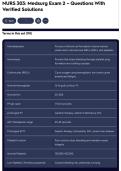
Hematopoiesis Process of blood cell formation in bone marrow
where stem cells become RBCs, WBCs, and platelets.
Hemostasis Process that stops bleeding through platelet plug
formation and clotting cascade.
Erythrocytes (RBCs) Carry oxygen using hemoglobin; low levels cause
anemia and fatigue.
Normal Hemoglobin 12-16 g/dL (critical <7).
Normal Hct 35-50%
PT lab vaule 11-13.5 seconds
prolonged PT warfarin therapy, vitamin K deficiency, DIC
aPTT therapeutic range 25-35 seconds
Prolonged aPTT heparin therapy, hemophilia, DIC, severe liver disease
Platelet Function Form clots to stop bleeding and maintain vessel
integrity.
Normal Platelets 150,000-400,000.
Low Platelets (Thrombocytopenia) Causes bleeding risk, petechiae, bruising.
, White Blood Cells (WBCs) Fight infection and support immune response.
Normal WBC 5,000-11,000.
High WBC causes Infection, inflammation, leukemia.
Low WBC causes Chemo, autoimmune disease, bone marrow
suppression.
Neutrophils Fight bacterial infections; increase with bacterial
infection.
Lymphocytes Fight viral infections.
Monocytes Remove damaged cells and debris.
Eosinophils Respond to allergies and parasites.
Basophils Release histamine in allergic reactions.
Blood Transfusion Step 1 Verify order, consent, and blood type with 2 nurses.
Blood Transfusion Step 2 Obtain baseline vitals and start with normal saline
tubing.
Blood Transfusion First 15 Minutes Stay with patient and monitor closely for reaction.
Transfusion Reaction Signs (first 15 Fever, chills, back pain, SOB, itching, hypotension,
min) tachycardia.
If Transfusion Reaction Occurs Stop transfusion, keep IV with saline, notify provider,
check vitals.
Most Dangerous Transfusion Reaction Acute hemolytic reaction.
TACO Fluid overload during transfusion causing SOB and
crackles.
Verified Solutions
Save
Terms in this set (110)
Hematopoiesis Process of blood cell formation in bone marrow
where stem cells become RBCs, WBCs, and platelets.
Hemostasis Process that stops bleeding through platelet plug
formation and clotting cascade.
Erythrocytes (RBCs) Carry oxygen using hemoglobin; low levels cause
anemia and fatigue.
Normal Hemoglobin 12-16 g/dL (critical <7).
Normal Hct 35-50%
PT lab vaule 11-13.5 seconds
prolonged PT warfarin therapy, vitamin K deficiency, DIC
aPTT therapeutic range 25-35 seconds
Prolonged aPTT heparin therapy, hemophilia, DIC, severe liver disease
Platelet Function Form clots to stop bleeding and maintain vessel
integrity.
Normal Platelets 150,000-400,000.
Low Platelets (Thrombocytopenia) Causes bleeding risk, petechiae, bruising.
, White Blood Cells (WBCs) Fight infection and support immune response.
Normal WBC 5,000-11,000.
High WBC causes Infection, inflammation, leukemia.
Low WBC causes Chemo, autoimmune disease, bone marrow
suppression.
Neutrophils Fight bacterial infections; increase with bacterial
infection.
Lymphocytes Fight viral infections.
Monocytes Remove damaged cells and debris.
Eosinophils Respond to allergies and parasites.
Basophils Release histamine in allergic reactions.
Blood Transfusion Step 1 Verify order, consent, and blood type with 2 nurses.
Blood Transfusion Step 2 Obtain baseline vitals and start with normal saline
tubing.
Blood Transfusion First 15 Minutes Stay with patient and monitor closely for reaction.
Transfusion Reaction Signs (first 15 Fever, chills, back pain, SOB, itching, hypotension,
min) tachycardia.
If Transfusion Reaction Occurs Stop transfusion, keep IV with saline, notify provider,
check vitals.
Most Dangerous Transfusion Reaction Acute hemolytic reaction.
TACO Fluid overload during transfusion causing SOB and
crackles.


