

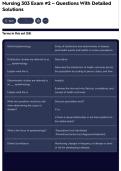
Nursing 303 Exam #2 – Questions With Detailed
Solutions
Save
Terms in this set (55)
Define Epidemiology Study of distribution and determinants of disease
(and health events and health) in human populations
Distribution: studies are referred to as Descriptive
_____ epidemiology.
Describes the distribution of health outcomes across
Explain what this is. the population according to person, place, and time
Determinants: studies are referred to Analytic
as _____ epidemiology.
Examines the how and why (factors, correlations, and
Explain what this is. causes) of health outcomes.
What two questions would you ask Does an association exist?
when determining the cause of
disease? If so...
Is there a casual relationship or are there patterns to
the relationships?
What is the focus of epidemiology? -Populations (not individuals)
-Prevention/control (not diagnosis/treatment)
Define Surveillance Monitoring changes in frequency of disease or level
of risk for developing a disease.
, Passive vs. Active Surveillance Passive: surveyor is dependent on health care
providers self-reporting incidence of a disease; most
commonly used
Active: project staff must go into community and
identify cases of a particular disease
Define Incidence Rate Number of NEW CASES of a disease that occur
during a specified time period
Define Prevalence Number of cases of disease present in the
population at a specified time
When are mortality rates a good Good: case fatality is high and duration of disease is
measure of incidence? Bad? short
Bad: disease is not fatal or mild
What is the epidemiology triangle? Model used to pinpoint outbreaks of infectious
diseases
Points of triangle are: host, agent, environment
Center of triangle is what epidemiologists work
against: time
What does social epidemiology How much of the incidence of the disease is due to
examine? genetic factors, how much is environmental, and will
the interaction between the two increase or
decrease the incidence of disease
What is the ecologic model? Model that encompasses determinants at many
levels.
Multiple causation is the principle of contemporary
epidemiology
Solutions
Save
Terms in this set (55)
Define Epidemiology Study of distribution and determinants of disease
(and health events and health) in human populations
Distribution: studies are referred to as Descriptive
_____ epidemiology.
Describes the distribution of health outcomes across
Explain what this is. the population according to person, place, and time
Determinants: studies are referred to Analytic
as _____ epidemiology.
Examines the how and why (factors, correlations, and
Explain what this is. causes) of health outcomes.
What two questions would you ask Does an association exist?
when determining the cause of
disease? If so...
Is there a casual relationship or are there patterns to
the relationships?
What is the focus of epidemiology? -Populations (not individuals)
-Prevention/control (not diagnosis/treatment)
Define Surveillance Monitoring changes in frequency of disease or level
of risk for developing a disease.
, Passive vs. Active Surveillance Passive: surveyor is dependent on health care
providers self-reporting incidence of a disease; most
commonly used
Active: project staff must go into community and
identify cases of a particular disease
Define Incidence Rate Number of NEW CASES of a disease that occur
during a specified time period
Define Prevalence Number of cases of disease present in the
population at a specified time
When are mortality rates a good Good: case fatality is high and duration of disease is
measure of incidence? Bad? short
Bad: disease is not fatal or mild
What is the epidemiology triangle? Model used to pinpoint outbreaks of infectious
diseases
Points of triangle are: host, agent, environment
Center of triangle is what epidemiologists work
against: time
What does social epidemiology How much of the incidence of the disease is due to
examine? genetic factors, how much is environmental, and will
the interaction between the two increase or
decrease the incidence of disease
What is the ecologic model? Model that encompasses determinants at many
levels.
Multiple causation is the principle of contemporary
epidemiology


