

NUR 303 Vital Signs in Nursing – Questions With
Comprehensive Solutions
Save
Terms in this set (89)
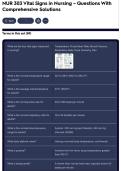
What are the key vital signs measured Temperature, Pulse/Heart Rate, Blood Pressure,
in nursing? Respiratory Rate, Pulse Oximetry, Pain
What is the normal temperature range 36° to 38°C (96.8° to 100.4°F)
for adults?
What is the average oral temperature 37°C (98.6°F)
for adults?
What is the normal pulse rate for 60 to 100 beats per minute
adults?
What is the normal respiratory rate for 12 to 20 breaths per minute
adults?
What is the normal blood pressure Systolic <120 mm Hg and Diastolic <80 mm Hg
range for adults? (Normal: 120/80)
What does afebrile mean? Having a normal body temperature; not feverish.
What is pyrexia? Another term for fever; body temperature greater
than 100.4°F.
What is bradycardia? A slower than normal heart rate, typically below 60
beats per minute.
, What is tachycardia? A faster than normal heart rate, typically above 100
beats per minute.
What is hypertension? High blood pressure, typically defined as systolic ≥
130 mm Hg or diastolic ≥ 80 mm Hg.
What is hypotension? Low blood pressure, typically defined as systolic <90
mm Hg.
What is the role of the hypothalamus It acts as the body's thermostat, regulating heat
in thermoregulation? production and loss.
What is conduction in terms of heat The transfer of heat from one object to another
loss? through direct contact.
What is convection in terms of heat The transfer of heat away from the body by air
loss? movement.
What is evaporation in terms of heat The process of heat loss when a liquid is converted
loss? to a gas, such as perspiration.
What is heat exhaustion? A condition caused by excessive heat exposure,
leading to profuse sweating and loss of water and
electrolytes.
Comprehensive Solutions
Save
Terms in this set (89)
What are the key vital signs measured Temperature, Pulse/Heart Rate, Blood Pressure,
in nursing? Respiratory Rate, Pulse Oximetry, Pain
What is the normal temperature range 36° to 38°C (96.8° to 100.4°F)
for adults?
What is the average oral temperature 37°C (98.6°F)
for adults?
What is the normal pulse rate for 60 to 100 beats per minute
adults?
What is the normal respiratory rate for 12 to 20 breaths per minute
adults?
What is the normal blood pressure Systolic <120 mm Hg and Diastolic <80 mm Hg
range for adults? (Normal: 120/80)
What does afebrile mean? Having a normal body temperature; not feverish.
What is pyrexia? Another term for fever; body temperature greater
than 100.4°F.
What is bradycardia? A slower than normal heart rate, typically below 60
beats per minute.
, What is tachycardia? A faster than normal heart rate, typically above 100
beats per minute.
What is hypertension? High blood pressure, typically defined as systolic ≥
130 mm Hg or diastolic ≥ 80 mm Hg.
What is hypotension? Low blood pressure, typically defined as systolic <90
mm Hg.
What is the role of the hypothalamus It acts as the body's thermostat, regulating heat
in thermoregulation? production and loss.
What is conduction in terms of heat The transfer of heat from one object to another
loss? through direct contact.
What is convection in terms of heat The transfer of heat away from the body by air
loss? movement.
What is evaporation in terms of heat The process of heat loss when a liquid is converted
loss? to a gas, such as perspiration.
What is heat exhaustion? A condition caused by excessive heat exposure,
leading to profuse sweating and loss of water and
electrolytes.


