

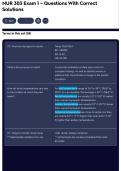
NUR 303 Exam 1 – Questions With Correct
Solutions
Save
Terms in this set (55)
27 - Normal vital signs for adults Temp: 96.8-100.4
BP: <120/80
RR: 12-20
HR: 60-100
What is the purpose of vitals? To provide a baseline of data upon which to
compare findings. As well as identify trends or
patterns that cna indicate a change in the client's
condition.
How do body temperatures vary due An oral temperature range of 36° to 38° C (96.8° to
to the location at which they are 100.4° F) is acceptable. The average is 37° C (98.6° F).
taken? Rectal temperatures are usually 0.5° C (0.9° F) higher
than oral and tympanic temperatures.
Axillary temperatures are usually 0.5° C (0.9° F) lower
than oral and tympanic temperatures.
Temporal temperatures are close to rectal, but they
are nearly 0.5° C (1° F) higher than oral, and 1° C (2°
F) higher than axillary temperatures.
27 - Ways to monitor body temp Oral, rectal, axillary, temporal
***Appropriate situations for use ** rectal temps are usually considered the most
accurate
, 27 - Nursing actions for various - encourage sips of cool fluids
abnormal body temp - remove excess clothing
At risk Populations - administer medications as ordered (antipyretics to
reduce fever/ antibiotics to fight infection if present)
- place client in a cooler environment
- give a tepid bath
- ice packs : groin, neck, armpits
At risk : babies, elderly, immunocompromised
27 - Complications related to Possible causes:
abnormal cardiac readings - exercise
***tachycardia - anxiety
- certain medications
- caffeine and nicotine
- abnormality in the electrical system of the heart
- hyperthyroidism
- high temp/ fever
- Hypovolemia, shock, heart failure, hemorrhage
- acute pain
27 - Complications related to Possible causes:
abnormal cardiac readings - expected in physically fit induviduals
***bradycardia - congenital cardiac abnormalities
- heart failure
- heart muscle damage
- hypothyroidism
- hypothermia
- chronic severe pain
27 - Nursing intervention for abnormal Monitor for pain, anxiety, restlessness, and
cardiac readings manifestations of low cardiac output (fatigue,
***tachycardia dizziness, hypotension, chest pain, low oxygen
saturation).
Monitor for potential adverse effects of medications.
Protect the client from injury.
Solutions
Save
Terms in this set (55)
27 - Normal vital signs for adults Temp: 96.8-100.4
BP: <120/80
RR: 12-20
HR: 60-100
What is the purpose of vitals? To provide a baseline of data upon which to
compare findings. As well as identify trends or
patterns that cna indicate a change in the client's
condition.
How do body temperatures vary due An oral temperature range of 36° to 38° C (96.8° to
to the location at which they are 100.4° F) is acceptable. The average is 37° C (98.6° F).
taken? Rectal temperatures are usually 0.5° C (0.9° F) higher
than oral and tympanic temperatures.
Axillary temperatures are usually 0.5° C (0.9° F) lower
than oral and tympanic temperatures.
Temporal temperatures are close to rectal, but they
are nearly 0.5° C (1° F) higher than oral, and 1° C (2°
F) higher than axillary temperatures.
27 - Ways to monitor body temp Oral, rectal, axillary, temporal
***Appropriate situations for use ** rectal temps are usually considered the most
accurate
, 27 - Nursing actions for various - encourage sips of cool fluids
abnormal body temp - remove excess clothing
At risk Populations - administer medications as ordered (antipyretics to
reduce fever/ antibiotics to fight infection if present)
- place client in a cooler environment
- give a tepid bath
- ice packs : groin, neck, armpits
At risk : babies, elderly, immunocompromised
27 - Complications related to Possible causes:
abnormal cardiac readings - exercise
***tachycardia - anxiety
- certain medications
- caffeine and nicotine
- abnormality in the electrical system of the heart
- hyperthyroidism
- high temp/ fever
- Hypovolemia, shock, heart failure, hemorrhage
- acute pain
27 - Complications related to Possible causes:
abnormal cardiac readings - expected in physically fit induviduals
***bradycardia - congenital cardiac abnormalities
- heart failure
- heart muscle damage
- hypothyroidism
- hypothermia
- chronic severe pain
27 - Nursing intervention for abnormal Monitor for pain, anxiety, restlessness, and
cardiac readings manifestations of low cardiac output (fatigue,
***tachycardia dizziness, hypotension, chest pain, low oxygen
saturation).
Monitor for potential adverse effects of medications.
Protect the client from injury.


