

Written by students who passed Immediately available after payment Read online or as PDF Wrong document? Swap it for free 4.6 TrustPilot
logo-home
Document preview thumbnail
Preview 2 out of 7 pages
Exam (elaborations)

CHEM103/ CHEM 103 Module 5 – General Chemistry I with Lab | Portage Learning | Latest Exam Questions & Answers | Verified Study Material | Grade A

Document preview thumbnail
Preview 2 out of 7 pages

CHEM103/ CHEM 103 Module 5 – General Chemistry I with Lab | Portage Learning | 2026 2027 Latest Exam Questions & Answers | Verified Study Material | Grade A 2026 / 2027 Academic Year Q: ionic bonds Answer two oppositely charged ions (2Na + Cl₂ = 2Na⁺+2Cl⁻) Q: metals tend to ______ electrons Answer lose Q: nonmetals tend to ______ electrons Answer gain Q: covalent bonds Answer share at least one pair of electrons so both atoms have 8 valence electrons Q: 2 types of covalent bonds Answer polar, nonpolar Q: polar covalent bond Answer unequal sharing of electrons, difference in electronegativity 0.5-1.6 Q: nonpolar covalent bond Answer electrons are shared equally, electronegativity difference less than 0.5 Q: ionic bond Answer electronegativity difference greater than 1.6 Q: number of valence electrons = Answer element's group number Q: lewis structures of molecules steps Answer 1. find total # of valence electrons 2. place least negative atom in the center (H always on outside) 3. place pair of electrons between each element 4. position the rest of electrons Q: in lewis structures of polyatomic ions, the ______ is included Answer charge Q: tetrahedral electron geometry Answer surrounded by 4 groups of electrons Q: triangular planar electron geometry Answer surrounded by 3 groups of electrons Q: linear molecular electron geometry Answer surrounded by 2 groups of electrons Q: molecular shapes Answer - tetrahedral: 4 outer atoms - triangular pyramid: 3 outer atoms - bent: 2 outer atoms Q: polar molecules have ______ Answer + and - charged centers Q: nonpolar molecules have ______ Answer no charged regions due to either: absence of polar bonds or equal distribution of electrons in polar bonds (symmetrical) Q: μ is ______ Answer measure/expression of the polarity of a molecule Q: nonpolar μ = Answer 0 Q: polar μ = Answer greater than 0 Q: symmetrical shapes = Answer tetrahedral, linear, triangular planar Q: nonmetals ____ electrons because of LOWER electronegativity Answer gain Q: metals ____ electrons because of HIGHER electronegativity Answer lose Q: polar bonds electronegativity difference Answer 0.5-1.6 Q: NONpolar bonds electronegativity difference Answer 0.5 Q: What atom goes in the center of Lewis structures? Answer LEAST electronegative atom Q: O prefers (lewis structures) Answer 2 bonds and 2 lone pairs Q: N prefers Answer 3 bonds and 1 lone pair Q: tetrahedral geometry Answer central atom with 4 surrounding electron groups Q: central atom with 3 surrounding electron groups Answer triangular planar Q: central atom with 2 surrounding groups of electrons Answer linear Q: hybridization Answer groups of electrons minus 1 Q: ionic bond Answer metal and nonmetal Q: soluble in water Answer ionic or polar Q: Boiling point ranking: Answer 1. metallic or ionic (highest) 2. H-bonding 3. polar 4. non polar (lowest)

Content preview

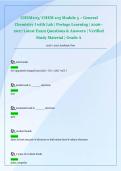
CHEM103/ CHEM 103 Module 5 – General
Chemistry I with Lab | Portage Learning | 2026–
2027 Latest Exam Questions & Answers | Verified
Study Material | Grade A
Academic Year


Q: ionic bonds
Answer
two oppositely charged ions (2Na + Cl₂ = 2Na⁺+2Cl⁻)


Q: metals tend to ______ electrons
Answer
lose


Q: nonmetals tend to ______ electrons
Answer
gain


Q: covalent bonds
Answer
share at least one pair of electrons so both atoms have 8 valence electrons


Q: 2 types of covalent bonds
Answer
polar, nonpolar

, Q: polar covalent bond
Answer
unequal sharing of electrons, difference in electronegativity 0.5-1.6


Q: nonpolar covalent bond
Answer
electrons are shared equally, electronegativity difference less than 0.5


Q: ionic bond
Answer
electronegativity difference greater than 1.6


Q: number of valence electrons =
Answer
element's group number


Q: lewis structures of molecules steps
Answer
1. find total # of valence electrons
2. place least negative atom in the center (H always on outside)
3. place pair of electrons between each element
4. position the rest of electrons


Document information

Uploaded on
March 13, 2026
Number of pages
7
Written in
2025/2026
Type
Exam (elaborations)
Contains
Questions & answers
$10.69

Wrong document? Swap it for free Within 14 days of purchase and before downloading, you can choose a different document. You can simply spend the amount again.
Written by students who passed
Immediately available after payment
Read online or as PDF

Seller avatar
Reputation scores are based on the amount of documents a seller has sold for a fee and the reviews they have received for those documents. There are three levels: Bronze, Silver and Gold. The better the reputation, the more your can rely on the quality of the sellers work.
ProfGoodlucK
4.0
(18)
Sold
144
Followers
52
Items
2768
Last sold
1 week ago


Why students choose Stuvia

Created by fellow students, verified by reviews

Quality you can trust: written by students who passed their tests and reviewed by others who've used these notes.

Didn't get what you expected? Choose another document

No worries! You can instantly pick a different document that better fits what you're looking for.

Pay as you like, start learning right away

No subscription, no commitments. Pay the way you're used to via credit card and download your PDF document instantly.

Student with book image

“Bought, downloaded, and aced it. It really can be that simple.”

Alisha Student

Working on your references?

Create accurate citations in APA, MLA and Harvard with our free citation generator.

Working on your references?

Frequently asked questions
