Edrftgyihu jiuh
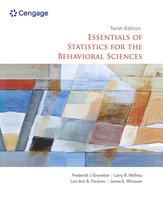
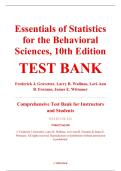
Essentials of Statistics
for the Behavioral
ST
Sciences, 10th Edition
UV
TEST BANK
IA
_A
Frederick J. Gravetter, Larry B. Wallnau, Lori-Ann
B. Forzano, James E. Witnauer
PP
Comprehensive Test Bank for Instructors
RO
and Students
||| ||| || ||| || | || ||| | || ||| |
VE
9780357365298
© Frederick J. Gravetter, Larry B. Wallnau, Lori-Ann B. Forzano & James E.
D?
Witnauer. All rights reserved. Reproduction or distribution without permission
is prohibited.
© MEDGEEK
, TABLE OF CONTENTS
Test Bank – Essentials of Statistics for the Behavioral Sciences (10th Edition)
Authors: Frederick J Gravetter, Larry B. Wallnau, Lori-Ann B. Forzano, and James E. Witnauer
ISBN: 9780357365298
ST
PART I: DESCRIPTIVE STATISTICS
Chapter 1: Introduction to Statistics
Chapter 2: Frequency Distributions
UV
Chapter 3: Central Tendency
Chapter 4: Variability
PART II: PROBABILITY AND THE FOUNDATIONS OF INFERENTIAL STATISTICS
Chapter 5: z-Scores: Location of Scores and Standardized Distributions
IA
Chapter 6: Probability
Chapter 7: Probability and Samples: The Distribution of Sample Means
Chapter 8: Introduction to Hypothesis Testing
_A
PART III: INFERENCES ABOUT MEANS AND PROPORTIONS
Chapter 9: Introduction to the t Statistic
Chapter 10: The t Test for Two Independent Samples
Chapter 11: The t Test for Two Related Samples
PP
PART IV: ANALYSIS OF VARIANCE
Chapter 12: Introduction to Analysis of Variance
Chapter 13: Two-Factor Analysis of Variance
RO
PART V: CORRELATIONS AND NONPARAMETRIC TESTS
Chapter 14: Correlation and Regression
Chapter 15: The Chi-Square Statistic: Tests for Goodness of Fit and Independence
VE
D?
, TEST BANK FOR
Essentials Of Statistics For The Behavioral Sciences 10th Edition Frederick J Gravetter,
Larry B. Wallnau, Lori Ann B. Forzano, James E. Witnauer
Chapter 01
ST
1. A researcher uses an anonymous survey to investigate the television-viewing habits of 100 American adolescents. The
researcher plans to make an inference about the television-viewing habits of all American adolescents based on the results
of the survey. The entire group of American adolescents is an example of a _____.
a. sample
UV
b. statistic
c. population
d. parameter
ANSWER: c
DIFFICULTY: Apply
IA
REFERENCES: 1.1 Statistics, Science, and Observations
KEYWORDS: Bloom’s: Apply
_A
2. A researcher uses an anonymous survey to investigate the social media habits of American college students. Based on
the set of 300 surveys that were completed and returned, the researcher finds that students spend an average of 2 hours
each day using social media. The set of 300 students who returned surveys is an example of a _____.
a. parameter
b. statistic
PP
c. population
d. sample
ANSWER: d
DIFFICULTY: Apply
RO
REFERENCES: 1.1 Statistics, Science, and Observations
KEYWORDS: Bloom’s: Apply
3. In order for a researcher to obtain a random sample, they need to specifically do which of the following things?
a. rule out confounding variables
VE
b. ensure that each person in the population has an equal chance of being selected for the sample
c. make certain that results are valid
d. make sure that each participant has an equal chance of being assigned to each experimental condition
ANSWER: b
D?
DIFFICULTY: Understand
REFERENCES: 1.1 Statistics, Science, and Observations
KEYWORDS: Bloom’s: Understand
4. In contrast to a datum, which of the following descriptions is most consistent with the concept of data?
a. the mean average of 15 participants’ individual scores on a problem-solving task
b. the percentile that the score of 1 participant on a problem-solving task falls into
Copyright Cengage Learning. Powered by Cognero. Page 1
, c. the individual scores of 15 participants on a problem-solving task
d. the individual score of 1 participant on a problem-solving task
ANSWER: c
DIFFICULTY: Analyze
REFERENCES: 1.1 Statistics, Science, and Observations
KEYWORDS: Bloom’s: Analyze
ST
5. A researcher is curious about the average monthly car insurance bill for high school students in the state of Florida. If
this average could be obtained, it would be an example of a _____.
a. parameter
b. statistic
UV
c. population
d. sample
ANSWER: a
DIFFICULTY: Apply
REFERENCES: 1.1 Statistics, Science, and Observations
IA
KEYWORDS: Bloom’s: Apply
6. Which statement below regarding populations is true?
_A
a. Populations typically are small in size.
b. Populations cannot consist of non-human animal research subjects.
c. The experimental research method should be used to examine populations.
d. It usually is challenging to obtain data from every person in a population.
PP
ANSWER: d
DIFFICULTY: Understand
REFERENCES: 1.1 Statistics, Science, and Observations
KEYWORDS: Bloom’s: Understand
RO
7. The relationship between a statistic and a sample is the same as the relationship between _____.
a. a sample and a population
b. a statistic and a parameter
c. a parameter and a population
d. descriptive and inferential statistics
VE
ANSWER: c
DIFFICULTY: Understand
REFERENCES: 1.1 Statistics, Science, and Observations
KEYWORDS: Bloom’s: Understand
D?
8. Organizing a set of scores in a table or computing an average to summarize a data set is an example of using ______.
a. parameters
b. random sampling
c. descriptive statistics
d. inferential statistics
Copyright Cengage Learning. Powered by Cognero. Page 2
Essentials of Statistics
for the Behavioral
ST
Sciences, 10th Edition
UV
TEST BANK
IA
_A
Frederick J. Gravetter, Larry B. Wallnau, Lori-Ann
B. Forzano, James E. Witnauer
PP
Comprehensive Test Bank for Instructors
RO
and Students
||| ||| || ||| || | || ||| | || ||| |
VE
9780357365298
© Frederick J. Gravetter, Larry B. Wallnau, Lori-Ann B. Forzano & James E.
D?
Witnauer. All rights reserved. Reproduction or distribution without permission
is prohibited.
© MEDGEEK
, TABLE OF CONTENTS
Test Bank – Essentials of Statistics for the Behavioral Sciences (10th Edition)
Authors: Frederick J Gravetter, Larry B. Wallnau, Lori-Ann B. Forzano, and James E. Witnauer
ISBN: 9780357365298
ST
PART I: DESCRIPTIVE STATISTICS
Chapter 1: Introduction to Statistics
Chapter 2: Frequency Distributions
UV
Chapter 3: Central Tendency
Chapter 4: Variability
PART II: PROBABILITY AND THE FOUNDATIONS OF INFERENTIAL STATISTICS
Chapter 5: z-Scores: Location of Scores and Standardized Distributions
IA
Chapter 6: Probability
Chapter 7: Probability and Samples: The Distribution of Sample Means
Chapter 8: Introduction to Hypothesis Testing
_A
PART III: INFERENCES ABOUT MEANS AND PROPORTIONS
Chapter 9: Introduction to the t Statistic
Chapter 10: The t Test for Two Independent Samples
Chapter 11: The t Test for Two Related Samples
PP
PART IV: ANALYSIS OF VARIANCE
Chapter 12: Introduction to Analysis of Variance
Chapter 13: Two-Factor Analysis of Variance
RO
PART V: CORRELATIONS AND NONPARAMETRIC TESTS
Chapter 14: Correlation and Regression
Chapter 15: The Chi-Square Statistic: Tests for Goodness of Fit and Independence
VE
D?
, TEST BANK FOR
Essentials Of Statistics For The Behavioral Sciences 10th Edition Frederick J Gravetter,
Larry B. Wallnau, Lori Ann B. Forzano, James E. Witnauer
Chapter 01
ST
1. A researcher uses an anonymous survey to investigate the television-viewing habits of 100 American adolescents. The
researcher plans to make an inference about the television-viewing habits of all American adolescents based on the results
of the survey. The entire group of American adolescents is an example of a _____.
a. sample
UV
b. statistic
c. population
d. parameter
ANSWER: c
DIFFICULTY: Apply
IA
REFERENCES: 1.1 Statistics, Science, and Observations
KEYWORDS: Bloom’s: Apply
_A
2. A researcher uses an anonymous survey to investigate the social media habits of American college students. Based on
the set of 300 surveys that were completed and returned, the researcher finds that students spend an average of 2 hours
each day using social media. The set of 300 students who returned surveys is an example of a _____.
a. parameter
b. statistic
PP
c. population
d. sample
ANSWER: d
DIFFICULTY: Apply
RO
REFERENCES: 1.1 Statistics, Science, and Observations
KEYWORDS: Bloom’s: Apply
3. In order for a researcher to obtain a random sample, they need to specifically do which of the following things?
a. rule out confounding variables
VE
b. ensure that each person in the population has an equal chance of being selected for the sample
c. make certain that results are valid
d. make sure that each participant has an equal chance of being assigned to each experimental condition
ANSWER: b
D?
DIFFICULTY: Understand
REFERENCES: 1.1 Statistics, Science, and Observations
KEYWORDS: Bloom’s: Understand
4. In contrast to a datum, which of the following descriptions is most consistent with the concept of data?
a. the mean average of 15 participants’ individual scores on a problem-solving task
b. the percentile that the score of 1 participant on a problem-solving task falls into
Copyright Cengage Learning. Powered by Cognero. Page 1
, c. the individual scores of 15 participants on a problem-solving task
d. the individual score of 1 participant on a problem-solving task
ANSWER: c
DIFFICULTY: Analyze
REFERENCES: 1.1 Statistics, Science, and Observations
KEYWORDS: Bloom’s: Analyze
ST
5. A researcher is curious about the average monthly car insurance bill for high school students in the state of Florida. If
this average could be obtained, it would be an example of a _____.
a. parameter
b. statistic
UV
c. population
d. sample
ANSWER: a
DIFFICULTY: Apply
REFERENCES: 1.1 Statistics, Science, and Observations
IA
KEYWORDS: Bloom’s: Apply
6. Which statement below regarding populations is true?
_A
a. Populations typically are small in size.
b. Populations cannot consist of non-human animal research subjects.
c. The experimental research method should be used to examine populations.
d. It usually is challenging to obtain data from every person in a population.
PP
ANSWER: d
DIFFICULTY: Understand
REFERENCES: 1.1 Statistics, Science, and Observations
KEYWORDS: Bloom’s: Understand
RO
7. The relationship between a statistic and a sample is the same as the relationship between _____.
a. a sample and a population
b. a statistic and a parameter
c. a parameter and a population
d. descriptive and inferential statistics
VE
ANSWER: c
DIFFICULTY: Understand
REFERENCES: 1.1 Statistics, Science, and Observations
KEYWORDS: Bloom’s: Understand
D?
8. Organizing a set of scores in a table or computing an average to summarize a data set is an example of using ______.
a. parameters
b. random sampling
c. descriptive statistics
d. inferential statistics
Copyright Cengage Learning. Powered by Cognero. Page 2