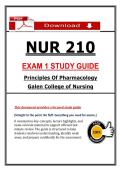
NUR 210
EXAM 1 STUDY GUIDE
Principles Of Pharmacology
Galen College of Nursing
This document provides a focused study guide
(Straight to the point. No fluff. Everything you need for exams.)
It summarizes key concepts, lecture highlights, and
exam-relevant material to support efficient last-
minute review. The guide is structured to help
students reinforce understanding, identify weak
areas, and prepare confidently for the assessment.
, PHARMACOLOGY UNIT 1 NOTES
Pharmacodynamics – how does it work on you?
Pharmacokinetics – how does it move through you?
Pharmacokinetic Phases:
o 1. Absorption – through GI tract into vascular
o 2. Distribution – via bloodstream to organs/receptors/extremities
o 3. Metabolism – hepatic/splenic
o 4. Excretion – renal
ANTIPSYCHOTICS AND ANXIOLYTICS
Typical and Atypical
PEARL: Acetylcholine has grossly inhibitory effects on movement, and dopamine has grossly
excitatory effects on movement.
Treatment for Psychosis
o Psychosis S/S
Loss of perception of reality
Hallucinations +
Delusions +
Catatonia -
Anhedonia –
Self-care deficit –
Social withdrawal -
Positive – exaggeration of normal function
Negative – loss of normal function
Atypical Antipsychotics
o Newer
o Fewer side effects
o Decreased dopamine and serotonin
o Increased cost
o EPS
o Aripiprazole, Zyprexa, etc.
Typical Antipsychotics
o Extrapyramidal symptoms
o Been in use longer
o Decrease dopamine
o Inexpensive
o More side effects/adverse reactions
o Can cause metabolic syndrome - high cholesterol, high bp, high bg
o Haloperidol, Geodon
, Haloperidol (Haldol)
Antipsychotic (butyrophenone)
o Action: block dopamine receptors
o Use: treat psychosis, ADHD, Tourette’s
o Side effects: drowsiness, headaches, photosensitivity, urinary retention,
orthostatic hypotension, sexual dysfunction
o Adverse reactions: tachycardia, EPS, NMS, blood dyscrasias
o Contraindications: narrow-angle glaucoma, CNS depression, severe renal,
hepatic, cardiac disease, Parkinson’s disease, blood dyscrasias
o Interactions: increased sedation with alcohol, CNS depressants
Aripiprazole (Abilify)
Atypical antipsychotic (quinolonone)
o Action: blocks serotonin and dopaminergic receptors
o Use: positive and negative psychotic symptoms
o Side Effects: orthostatic hypotension, drowsiness, headache, tremor,
constipation, cough
o Adverse Reactions: EPS, NMS,
o Contraindications: dysrhythmias, blood dyscrasias, liver damage, diabetes,
Parkinson’s
o Interactions: increases the effect of hypertensives, diabetic drugs, other
antipsychotics, grapefruit juice, St. John’s Wort
NEUROLEPTIC MALIGNANT SYNDROME (NMS)
**Autonomic nervous system instability d/t prolonged antagonism of dopamine
receptors**
o S/S: Diaphoresis, labile bp, tachypnea, flushing, pallor, incontinence, AMS,
muscle rigidity, rhabdomyolysis, respiratory failure, hyperthermia
o Agitation and exhaustion of predisposing factors
o Potentially fatal
o TREATMENT:
Hydration, Behr hugger, discontinuation of antipsychotic
BLOOD DYSCRASIAS
- Imbalance of WBC, RBC, other blood products (ex. leukopenia, neutropenia,
thrombocytopenia)
- CBC and CMP can detect these
EXAM 1 STUDY GUIDE
Principles Of Pharmacology
Galen College of Nursing
This document provides a focused study guide
(Straight to the point. No fluff. Everything you need for exams.)
It summarizes key concepts, lecture highlights, and
exam-relevant material to support efficient last-
minute review. The guide is structured to help
students reinforce understanding, identify weak
areas, and prepare confidently for the assessment.
, PHARMACOLOGY UNIT 1 NOTES
Pharmacodynamics – how does it work on you?
Pharmacokinetics – how does it move through you?
Pharmacokinetic Phases:
o 1. Absorption – through GI tract into vascular
o 2. Distribution – via bloodstream to organs/receptors/extremities
o 3. Metabolism – hepatic/splenic
o 4. Excretion – renal
ANTIPSYCHOTICS AND ANXIOLYTICS
Typical and Atypical
PEARL: Acetylcholine has grossly inhibitory effects on movement, and dopamine has grossly
excitatory effects on movement.
Treatment for Psychosis
o Psychosis S/S
Loss of perception of reality
Hallucinations +
Delusions +
Catatonia -
Anhedonia –
Self-care deficit –
Social withdrawal -
Positive – exaggeration of normal function
Negative – loss of normal function
Atypical Antipsychotics
o Newer
o Fewer side effects
o Decreased dopamine and serotonin
o Increased cost
o EPS
o Aripiprazole, Zyprexa, etc.
Typical Antipsychotics
o Extrapyramidal symptoms
o Been in use longer
o Decrease dopamine
o Inexpensive
o More side effects/adverse reactions
o Can cause metabolic syndrome - high cholesterol, high bp, high bg
o Haloperidol, Geodon
, Haloperidol (Haldol)
Antipsychotic (butyrophenone)
o Action: block dopamine receptors
o Use: treat psychosis, ADHD, Tourette’s
o Side effects: drowsiness, headaches, photosensitivity, urinary retention,
orthostatic hypotension, sexual dysfunction
o Adverse reactions: tachycardia, EPS, NMS, blood dyscrasias
o Contraindications: narrow-angle glaucoma, CNS depression, severe renal,
hepatic, cardiac disease, Parkinson’s disease, blood dyscrasias
o Interactions: increased sedation with alcohol, CNS depressants
Aripiprazole (Abilify)
Atypical antipsychotic (quinolonone)
o Action: blocks serotonin and dopaminergic receptors
o Use: positive and negative psychotic symptoms
o Side Effects: orthostatic hypotension, drowsiness, headache, tremor,
constipation, cough
o Adverse Reactions: EPS, NMS,
o Contraindications: dysrhythmias, blood dyscrasias, liver damage, diabetes,
Parkinson’s
o Interactions: increases the effect of hypertensives, diabetic drugs, other
antipsychotics, grapefruit juice, St. John’s Wort
NEUROLEPTIC MALIGNANT SYNDROME (NMS)
**Autonomic nervous system instability d/t prolonged antagonism of dopamine
receptors**
o S/S: Diaphoresis, labile bp, tachypnea, flushing, pallor, incontinence, AMS,
muscle rigidity, rhabdomyolysis, respiratory failure, hyperthermia
o Agitation and exhaustion of predisposing factors
o Potentially fatal
o TREATMENT:
Hydration, Behr hugger, discontinuation of antipsychotic
BLOOD DYSCRASIAS
- Imbalance of WBC, RBC, other blood products (ex. leukopenia, neutropenia,
thrombocytopenia)
- CBC and CMP can detect these