1|Page
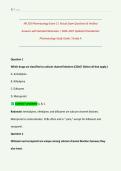
NR 293 Pharmacology Exam 2 | Actual Exam Questions & Verified
Answers with Detailed Rationales | 2026–2027 Updated Chamberlain
Pharmacology Study Guide | Grade A
Question 1
Which drugs are classified as calcium channel blockers (CCBs)? (Select all that apply.)
A. Amlodipine
B. Nifedipine
C. Diltiazem
D. Metoprolol
CORRECT ANSWER: A, B, C
Rationale: Amlodipine, nifedipine, and diltiazem are calcium channel blockers.
Metoprolol is a beta-blocker. CCBs often end in "-pine," except for diltiazem and
verapamil.
Question 2
Diltiazem and verapamil are unique among calcium channel blockers because they
also treat:
,2|Page
A. Hypertension only
B. Angina pectoris
C. Cardiac dysrhythmias (e.g., atrial fibrillation, atrial flutter, SVT)
D. Peripheral edema
CORRECT ANSWER: C. Cardiac dysrhythmias (e.g., atrial fibrillation, atrial flutter,
SVT)
Rationale: Unlike dihydropyridine CCBs (like amlodipine and nifedipine), diltiazem and
verapamil have significant effects on the cardiac conduction system and are used to
treat supraventricular tachyarrhythmias.
Question 3
Calcium channel blockers like amlodipine and nifedipine are primarily used to treat:
(Select all that apply.)
A. Hypertension
B. Angina pectoris
C. Atrial fibrillation
D. Supraventricular tachycardia
CORRECT ANSWER: A and B
Rationale: Dihydropyridine CCBs (amlodipine, nifedipine) are potent vasodilators and
,3|Page
are primarily used for hypertension and angina. They are not typically used for
arrhythmias.
Question 4
Potential complications associated with nifedipine include: (Select all that apply.)
A. Reflex tachycardia
B. Orthostatic hypotension
C. Peripheral edema
D. Bradycardia
CORRECT ANSWER: A, B, C
Rationale: Nifedipine can cause reflex tachycardia (due to vasodilation), orthostatic
hypotension, and peripheral edema. Bradycardia is more associated with non-
dihydropyridines like diltiazem and verapamil.
Question 5
Nifedipine is contraindicated in patients with:
A. Hypertension
B. Angina
C. Cardiogenic shock
D. Peripheral edema
CORRECT ANSWER: C. Cardiogenic shock
, 4|Page
Rationale: Nifedipine is a vasodilator and can worsen hypotension and cardiac output;
therefore, it is contraindicated in cardiogenic shock.
Question 6
Nifedipine should be used cautiously in patients with which cardiac conditions? (Select
all that apply.)
A. Acute myocardial infarction (MI)
B. Unstable angina
C. Aortic stenosis
D. Atrial fibrillation
CORRECT ANSWER: A, B, C
Rationale: Nifedipine should be used cautiously in patients with acute MI, unstable
angina, and aortic stenosis due to its potent vasodilatory effects and potential to worsen
these conditions.
Question 7
If a patient on nifedipine develops reflex tachycardia, which drug class might be
administered to manage this effect?
A. ACE inhibitors
B. Beta-blockers (e.g., metoprolol)
C. ARBs
NR 293 Pharmacology Exam 2 | Actual Exam Questions & Verified
Answers with Detailed Rationales | 2026–2027 Updated Chamberlain
Pharmacology Study Guide | Grade A
Question 1
Which drugs are classified as calcium channel blockers (CCBs)? (Select all that apply.)
A. Amlodipine
B. Nifedipine
C. Diltiazem
D. Metoprolol
CORRECT ANSWER: A, B, C
Rationale: Amlodipine, nifedipine, and diltiazem are calcium channel blockers.
Metoprolol is a beta-blocker. CCBs often end in "-pine," except for diltiazem and
verapamil.
Question 2
Diltiazem and verapamil are unique among calcium channel blockers because they
also treat:
,2|Page
A. Hypertension only
B. Angina pectoris
C. Cardiac dysrhythmias (e.g., atrial fibrillation, atrial flutter, SVT)
D. Peripheral edema
CORRECT ANSWER: C. Cardiac dysrhythmias (e.g., atrial fibrillation, atrial flutter,
SVT)
Rationale: Unlike dihydropyridine CCBs (like amlodipine and nifedipine), diltiazem and
verapamil have significant effects on the cardiac conduction system and are used to
treat supraventricular tachyarrhythmias.
Question 3
Calcium channel blockers like amlodipine and nifedipine are primarily used to treat:
(Select all that apply.)
A. Hypertension
B. Angina pectoris
C. Atrial fibrillation
D. Supraventricular tachycardia
CORRECT ANSWER: A and B
Rationale: Dihydropyridine CCBs (amlodipine, nifedipine) are potent vasodilators and
,3|Page
are primarily used for hypertension and angina. They are not typically used for
arrhythmias.
Question 4
Potential complications associated with nifedipine include: (Select all that apply.)
A. Reflex tachycardia
B. Orthostatic hypotension
C. Peripheral edema
D. Bradycardia
CORRECT ANSWER: A, B, C
Rationale: Nifedipine can cause reflex tachycardia (due to vasodilation), orthostatic
hypotension, and peripheral edema. Bradycardia is more associated with non-
dihydropyridines like diltiazem and verapamil.
Question 5
Nifedipine is contraindicated in patients with:
A. Hypertension
B. Angina
C. Cardiogenic shock
D. Peripheral edema
CORRECT ANSWER: C. Cardiogenic shock
, 4|Page
Rationale: Nifedipine is a vasodilator and can worsen hypotension and cardiac output;
therefore, it is contraindicated in cardiogenic shock.
Question 6
Nifedipine should be used cautiously in patients with which cardiac conditions? (Select
all that apply.)
A. Acute myocardial infarction (MI)
B. Unstable angina
C. Aortic stenosis
D. Atrial fibrillation
CORRECT ANSWER: A, B, C
Rationale: Nifedipine should be used cautiously in patients with acute MI, unstable
angina, and aortic stenosis due to its potent vasodilatory effects and potential to worsen
these conditions.
Question 7
If a patient on nifedipine develops reflex tachycardia, which drug class might be
administered to manage this effect?
A. ACE inhibitors
B. Beta-blockers (e.g., metoprolol)
C. ARBs