Edrftgyihu jiuh
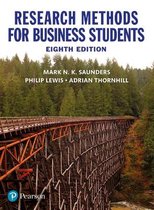
Research Methods
for Business Students,
ST
8th Edition
UV
SOLUTIONS
IA
_A
MANUAL
PP
Mark N.K. Saunders, Philip Lewis, Adrian Thornhill
RO
Comprehensive Solutions Manual for Instructors
and Students
VE
||| ||| || ||| || | || ||| | || ||| |
9781292208787
D?
© Mark N.K. Saunders, Philip Lewis & Adrian Thornhill. All rights
reserved. Reproduction or distribution without permission is
prohibited.
© MEDGEEK
, TABLE OF CONTENTS
Solutions Manual – Research Methods for Business Students (8th Edition)
Authors: Mark N.K. Saunders, Philip Lewis, and Adrian Thornhill
ISBN: 9781292208787
ST
PART I: PREPARATION AND FOUNDATIONS
Chapter 1: Business and management research, reflective diaries and the purpose of this book
Chapter 2: Choosing a research topic and developing your research proposal
UV
Chapter 3: Critically reviewing the literature
PART II: RESEARCH PHILOSOPHY AND DESIGN
Chapter 4: Understanding research philosophy and approaches to theory development
Chapter 5: Formulating the research design
IA
Chapter 6: Negotiating access and research ethics
PART III: DATA COLLECTION STRATEGIES
_A
Chapter 7: Selecting samples
Chapter 8: Utilising secondary data
Chapter 9: Collecting data through observation
Chapter 10: Collecting primary data using research interviews and research diaries
Chapter 11: Collecting primary data using questionnaires
PP
PART IV: ANALYSIS AND REPORTING
Chapter 12: Analysing data quantitatively
Chapter 13: Analysing data qualitatively
RO
Chapter 14: Writing and presenting your project report
VE
D?
, INTRODUCTION
An overview of the instructors’ manual
ST
This instructors’ manual provides commentary for the eighth edition of the textbook Research
Methods for Business Students. The commentary is on a chapter by chapter basis and includes:
• chapter learning outcomes;
• summary of the content;
UV
• comments on likely student reactions and possible use of materials;
• ideas for students’ preparatory work;
• suggestions for delivery in the classroom;
IA
• ideas for students’ follow-up work.
In addition, we have included a copy of a research project assignment, a group research project
poster assignment and a copy of a dissertation proposal assignment as appendices.
_A
Research Methods for Business – an overview of the eighth edition
Pedagogic features
The over-riding purpose of Research Methods for Business Students is to help undergraduate and
PP
postgraduate students and students on professional courses to undertake research. Each chapter
deals with a part of the research process and discusses the ideas, techniques and methods using as
little jargon as is possible. Tables, checklists and diagrams are used to aid this discussion. Where
new terms are introduced for the first time, they are shown in bold, and a definition or explanation
follows shortly afterwards. They are also listed with a brief definition in the glossary. The
application of appropriate information technology is considered, in most instances as an integral
RO
part of the text. Chapters have been cross-referenced as appropriate, and an index is provided to
help students find their way around the book.
Focus on student research boxes are included within the text of each chapter. These are based
on actual research projects, undertaken by students, in which points made in the text are
illustrated. In many instances, these worked examples illustrate possible pitfalls students may
come across while undertaking their research. Where a pitfall has been illustrated, it will, it is
VE
hoped, help your students avoid making the same mistake. Further illustrations are provided by
focus on management research and research in the news boxes.
Focus on management research boxes discuss recent research in business and management.
These are normally derived from refereed academic journal articles, and students are likely to be
D?
able to download the actual articles from online databases at their university.
Focus on research in the news boxes provide topical news articles that illustrate pertinent
research-related issues. All these will help students to understand the technique or idea and to
assess its suitability or appropriateness to their research. Boxed checklists provide students with
further focussed guidance for their own research.
5
© Pearson Education Limited 2019
, Saunders, Research Methods for Business Students, 8e, Instructor’s Manual
A summary of key points at the end of each chapter can be used by students before and after
reading the chapter to ensure that they have digested the main points.
Self-check questions enable students to check they have understood the chapter. These can all be
answered without recourse to other (external) resources. Answers are provided to all the self-
check questions at the end of each chapter.
ST
Review and discuss questions follow the self-check questions. These suggest a variety of
activities students can undertake to help them further develop their knowledge and understanding
of the material in the chapter, often involving discussion with a friend.
UV
Self-test multiple choice questions and true/false questions for each chapter are available on this
book’s companion website.
All chapters include a section towards the end titled “Progressing your research project” that can
be undertaken as part of the student’s research project. These are presented in sufficient detail to
enable them to focus on the techniques that are most appropriate to his or her research. By
completing all these sections, the student will have also completed his or her project report.
IA
Each chapter is also accompanied by references, further reading and a case study.
Further reading is included for two distinct reasons:
to direct students to other work on the ideas contained within the chapter;
_A
to direct students to further examples of research where the ideas contained in the chapter
have been used.
Case studies at the end of each chapter are all new to the eighth edition. They have been drawn from
a variety of business and management research scenarios and have been based on the case study’s
PP
authors’ students’ experiences when undertaking a research project. They have been written to
highlight real issues that occur when undertaking business and management research. To help focus
students’ thoughts or discussion on some of the pertinent issues, each case is followed by evaluative
questions, answers to which are provided on the Instructors’ Companion Web Site. A case study
follows every chapter. A further 75 case studies from earlier editions of the book are available on
the Students’ Companion Web Site; answers to these cases are provided on the Instructors’
RO
Companion Web Site. A complete list of these cases is provided in Appendix 4.
Contents
Chapter 1 outlines the nature of research and, more specifically, of business and management
research. The basic versus applied research and relevance debates are considered and advice
VE
offered regarding keeping a reflective diary or notebook. The chapter concludes with an overview
of the purpose and structure of the book.
Chapter 2 is written to assist students in the generation of ideas, which will help them to choose
a suitable research topic, and offers advice on what makes a good research topic. If your students
have already been given a research topic, perhaps by an organisation or tutor, they will need to
D?
refine it into one that is feasible and should still therefore read this chapter. After their idea has
been generated and refined, the chapter discusses how to turn this idea into clear research
question(s) and objectives. (Research questions and objectives are referred to throughout the
book.) Finally, the chapter provides advice on how to write a research proposal.
6
© Pearson Education Limited 2019
Research Methods
for Business Students,
ST
8th Edition
UV
SOLUTIONS
IA
_A
MANUAL
PP
Mark N.K. Saunders, Philip Lewis, Adrian Thornhill
RO
Comprehensive Solutions Manual for Instructors
and Students
VE
||| ||| || ||| || | || ||| | || ||| |
9781292208787
D?
© Mark N.K. Saunders, Philip Lewis & Adrian Thornhill. All rights
reserved. Reproduction or distribution without permission is
prohibited.
© MEDGEEK
, TABLE OF CONTENTS
Solutions Manual – Research Methods for Business Students (8th Edition)
Authors: Mark N.K. Saunders, Philip Lewis, and Adrian Thornhill
ISBN: 9781292208787
ST
PART I: PREPARATION AND FOUNDATIONS
Chapter 1: Business and management research, reflective diaries and the purpose of this book
Chapter 2: Choosing a research topic and developing your research proposal
UV
Chapter 3: Critically reviewing the literature
PART II: RESEARCH PHILOSOPHY AND DESIGN
Chapter 4: Understanding research philosophy and approaches to theory development
Chapter 5: Formulating the research design
IA
Chapter 6: Negotiating access and research ethics
PART III: DATA COLLECTION STRATEGIES
_A
Chapter 7: Selecting samples
Chapter 8: Utilising secondary data
Chapter 9: Collecting data through observation
Chapter 10: Collecting primary data using research interviews and research diaries
Chapter 11: Collecting primary data using questionnaires
PP
PART IV: ANALYSIS AND REPORTING
Chapter 12: Analysing data quantitatively
Chapter 13: Analysing data qualitatively
RO
Chapter 14: Writing and presenting your project report
VE
D?
, INTRODUCTION
An overview of the instructors’ manual
ST
This instructors’ manual provides commentary for the eighth edition of the textbook Research
Methods for Business Students. The commentary is on a chapter by chapter basis and includes:
• chapter learning outcomes;
• summary of the content;
UV
• comments on likely student reactions and possible use of materials;
• ideas for students’ preparatory work;
• suggestions for delivery in the classroom;
IA
• ideas for students’ follow-up work.
In addition, we have included a copy of a research project assignment, a group research project
poster assignment and a copy of a dissertation proposal assignment as appendices.
_A
Research Methods for Business – an overview of the eighth edition
Pedagogic features
The over-riding purpose of Research Methods for Business Students is to help undergraduate and
PP
postgraduate students and students on professional courses to undertake research. Each chapter
deals with a part of the research process and discusses the ideas, techniques and methods using as
little jargon as is possible. Tables, checklists and diagrams are used to aid this discussion. Where
new terms are introduced for the first time, they are shown in bold, and a definition or explanation
follows shortly afterwards. They are also listed with a brief definition in the glossary. The
application of appropriate information technology is considered, in most instances as an integral
RO
part of the text. Chapters have been cross-referenced as appropriate, and an index is provided to
help students find their way around the book.
Focus on student research boxes are included within the text of each chapter. These are based
on actual research projects, undertaken by students, in which points made in the text are
illustrated. In many instances, these worked examples illustrate possible pitfalls students may
come across while undertaking their research. Where a pitfall has been illustrated, it will, it is
VE
hoped, help your students avoid making the same mistake. Further illustrations are provided by
focus on management research and research in the news boxes.
Focus on management research boxes discuss recent research in business and management.
These are normally derived from refereed academic journal articles, and students are likely to be
D?
able to download the actual articles from online databases at their university.
Focus on research in the news boxes provide topical news articles that illustrate pertinent
research-related issues. All these will help students to understand the technique or idea and to
assess its suitability or appropriateness to their research. Boxed checklists provide students with
further focussed guidance for their own research.
5
© Pearson Education Limited 2019
, Saunders, Research Methods for Business Students, 8e, Instructor’s Manual
A summary of key points at the end of each chapter can be used by students before and after
reading the chapter to ensure that they have digested the main points.
Self-check questions enable students to check they have understood the chapter. These can all be
answered without recourse to other (external) resources. Answers are provided to all the self-
check questions at the end of each chapter.
ST
Review and discuss questions follow the self-check questions. These suggest a variety of
activities students can undertake to help them further develop their knowledge and understanding
of the material in the chapter, often involving discussion with a friend.
UV
Self-test multiple choice questions and true/false questions for each chapter are available on this
book’s companion website.
All chapters include a section towards the end titled “Progressing your research project” that can
be undertaken as part of the student’s research project. These are presented in sufficient detail to
enable them to focus on the techniques that are most appropriate to his or her research. By
completing all these sections, the student will have also completed his or her project report.
IA
Each chapter is also accompanied by references, further reading and a case study.
Further reading is included for two distinct reasons:
to direct students to other work on the ideas contained within the chapter;
_A
to direct students to further examples of research where the ideas contained in the chapter
have been used.
Case studies at the end of each chapter are all new to the eighth edition. They have been drawn from
a variety of business and management research scenarios and have been based on the case study’s
PP
authors’ students’ experiences when undertaking a research project. They have been written to
highlight real issues that occur when undertaking business and management research. To help focus
students’ thoughts or discussion on some of the pertinent issues, each case is followed by evaluative
questions, answers to which are provided on the Instructors’ Companion Web Site. A case study
follows every chapter. A further 75 case studies from earlier editions of the book are available on
the Students’ Companion Web Site; answers to these cases are provided on the Instructors’
RO
Companion Web Site. A complete list of these cases is provided in Appendix 4.
Contents
Chapter 1 outlines the nature of research and, more specifically, of business and management
research. The basic versus applied research and relevance debates are considered and advice
VE
offered regarding keeping a reflective diary or notebook. The chapter concludes with an overview
of the purpose and structure of the book.
Chapter 2 is written to assist students in the generation of ideas, which will help them to choose
a suitable research topic, and offers advice on what makes a good research topic. If your students
have already been given a research topic, perhaps by an organisation or tutor, they will need to
D?
refine it into one that is feasible and should still therefore read this chapter. After their idea has
been generated and refined, the chapter discusses how to turn this idea into clear research
question(s) and objectives. (Research questions and objectives are referred to throughout the
book.) Finally, the chapter provides advice on how to write a research proposal.
6
© Pearson Education Limited 2019