

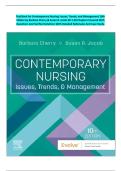
Test Bank for Contemporary Nursing: Issues, Trends, and Management 10th
Edition by Barbara Cherry & Susan R. Jacob All 1-28 Chapters Covered With
Questions And Verified Solutions With Detailed Rationales And Case Study.
, TABLE OF CONTENT
UNIT 1 The Development of Nursing
1. The Evolution of Professional Nursing
2. The Contemporary Image of Professional Nursing
3. The Influence of Contemporary Trends and Issues on Nursing Education
4. Nursing Licensure and Certification
5. Theories of Nursing Practice
6. Nursing Research and Evidence-Based Practice
Unit 2 Current Issues in Health Care
7. Paying for Health Care in America: Rising Costs and Challenges
8. Legal Issues in Nursing and Health Care
9. Ethical and Bioethical Issues in Nursing and Health Care
10. Cultural Competency, Person-Centered Care, and Social Issues in Nursing and Health Care
11. Complementary and Alternative Healing
12. Palliative Care
13. Workplace Advocacy for a Professional Nursing Practice Environment
14. Collective Bargaining and Unions in Today’s Workplace
15. Information Technology in the Clinical Setting
16. Emergency Preparedness and Response for Today’s World
Unit 3 Leadership and Management in Nursing
17. Nursing Leadership and Management: The Foundations
18. Budgeting Basics for Nurses
19. Effective Communication and Conflict Resolution
,20. Effective Delegation and Supervision
21. Staffing and Nursing Care Delivery Models
22. Quality Improvement and Patient Safety
23. Health Policy and Politics: Get Involved!
24. Clinical Judgment
Unit 4 Career Management
25. Making the Transition from Student to Professional Nurse
26. Managing Time: The Path to High Self-Performance
27. Job Search: Finding Your Match
28. The NCLEX-RN® Examination
Chapter 1: The Evolution of Professional Nursing
Question 1
Which historical figure is widely considered the founder of modern nursing?
A. Clara Barton
B. Dorothea Dix
C. Florence Nightingale
D. Mary Eliza Mahoney
Answer: C. Florence Nightingale
Rationale: Florence Nightingale is recognized as the founder of modern nursing because she
introduced sanitation practices, evidence-based observations, and professional training for nurses
during the Crimean War.
Question 2
The primary focus of nursing care during ancient civilizations was:
, A. Scientific research
B. Spiritual healing and basic care
C. Surgical procedures
D. Advanced pharmacology
Answer: B. Spiritual healing and basic care
Rationale: In ancient times, illness was often believed to be caused by spiritual forces. Care was
provided mainly through religious practices and basic caregiving.
Question 3
Which organization played a major role in establishing nursing standards and education in the United
States?
A. American Medical Association
B. American Nurses Association
C. World Health Organization
D. Centers for Disease Control
Answer: B. American Nurses Association
Rationale: The American Nurses Association (ANA) helps establish professional standards, promotes
nurses’ rights, and advances nursing practice.
Question 4
The Crimean War was significant to nursing history because it:
A. Introduced antibiotics
B. Led to Nightingale’s reforms in sanitation and patient care
C. Created the first hospital in the world
D. Eliminated infectious diseases
Answer: B. Led to Nightingale’s reforms in sanitation and patient care
Rationale: Nightingale implemented sanitation, proper ventilation, and hygiene practices, which
significantly reduced mortality rates.
Question 5
Which factor most influenced the development of nursing as a profession?
A. Religious traditions
B. Medical technological advances
C. Formal nursing education programs
D. Military training
Answer: C. Formal nursing education programs
Edition by Barbara Cherry & Susan R. Jacob All 1-28 Chapters Covered With
Questions And Verified Solutions With Detailed Rationales And Case Study.
, TABLE OF CONTENT
UNIT 1 The Development of Nursing
1. The Evolution of Professional Nursing
2. The Contemporary Image of Professional Nursing
3. The Influence of Contemporary Trends and Issues on Nursing Education
4. Nursing Licensure and Certification
5. Theories of Nursing Practice
6. Nursing Research and Evidence-Based Practice
Unit 2 Current Issues in Health Care
7. Paying for Health Care in America: Rising Costs and Challenges
8. Legal Issues in Nursing and Health Care
9. Ethical and Bioethical Issues in Nursing and Health Care
10. Cultural Competency, Person-Centered Care, and Social Issues in Nursing and Health Care
11. Complementary and Alternative Healing
12. Palliative Care
13. Workplace Advocacy for a Professional Nursing Practice Environment
14. Collective Bargaining and Unions in Today’s Workplace
15. Information Technology in the Clinical Setting
16. Emergency Preparedness and Response for Today’s World
Unit 3 Leadership and Management in Nursing
17. Nursing Leadership and Management: The Foundations
18. Budgeting Basics for Nurses
19. Effective Communication and Conflict Resolution
,20. Effective Delegation and Supervision
21. Staffing and Nursing Care Delivery Models
22. Quality Improvement and Patient Safety
23. Health Policy and Politics: Get Involved!
24. Clinical Judgment
Unit 4 Career Management
25. Making the Transition from Student to Professional Nurse
26. Managing Time: The Path to High Self-Performance
27. Job Search: Finding Your Match
28. The NCLEX-RN® Examination
Chapter 1: The Evolution of Professional Nursing
Question 1
Which historical figure is widely considered the founder of modern nursing?
A. Clara Barton
B. Dorothea Dix
C. Florence Nightingale
D. Mary Eliza Mahoney
Answer: C. Florence Nightingale
Rationale: Florence Nightingale is recognized as the founder of modern nursing because she
introduced sanitation practices, evidence-based observations, and professional training for nurses
during the Crimean War.
Question 2
The primary focus of nursing care during ancient civilizations was:
, A. Scientific research
B. Spiritual healing and basic care
C. Surgical procedures
D. Advanced pharmacology
Answer: B. Spiritual healing and basic care
Rationale: In ancient times, illness was often believed to be caused by spiritual forces. Care was
provided mainly through religious practices and basic caregiving.
Question 3
Which organization played a major role in establishing nursing standards and education in the United
States?
A. American Medical Association
B. American Nurses Association
C. World Health Organization
D. Centers for Disease Control
Answer: B. American Nurses Association
Rationale: The American Nurses Association (ANA) helps establish professional standards, promotes
nurses’ rights, and advances nursing practice.
Question 4
The Crimean War was significant to nursing history because it:
A. Introduced antibiotics
B. Led to Nightingale’s reforms in sanitation and patient care
C. Created the first hospital in the world
D. Eliminated infectious diseases
Answer: B. Led to Nightingale’s reforms in sanitation and patient care
Rationale: Nightingale implemented sanitation, proper ventilation, and hygiene practices, which
significantly reduced mortality rates.
Question 5
Which factor most influenced the development of nursing as a profession?
A. Religious traditions
B. Medical technological advances
C. Formal nursing education programs
D. Military training
Answer: C. Formal nursing education programs


