

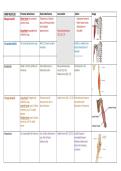
ARM MUSCLES Proximal attachment Distal attachment Innervation Action Image
Biceps brachii Short head: tip coracoid Tuberosity of radius + - Supinates forearm
process scap. fascia of fomuscrearm - Short head resists
(via bicipital dislocation of
Long head: supraglenoid aponeurosis) Musculocutaneous shoulder
tubercle scap. (C5, C6, C7)
Coracobrachialis Tip coracoid process scap. Mid. 1/3 med. Surface - Help flex + adduct arm
humerus - Resists dislocation of
shoulder
Brachialis Distal ½ of ant. Surface of Coronoid process + Musculocutaneous - Flex forearm in all
humerus tuberosity ulna nerve (C5, C6) positions
Radial nerve (C5, C7)
Triceps brachii Long head: infraglenoid Proximal end of Radial nerve (C6, C7, C8)
- Chief extensor forearm
tubercle scap. olecranon of ulna + - Lon head resists
Lateral head: post. Surface fascia forearm dislocation of humerus
humerus, sup. To radial
groove
Medial head: post. Surface
humerus, inf. To radial
nerve
Anconeus Lat. epicondyle of humerus Lat. Surface olecranon + Radial nerve (C7, C8, T1)
- Assists triceps in
sup. Part of post. extending forearm
Surface ulna - Stabilizes elbow joint
- Abduct ulna during
pronation
, ANT. COMPARTMENT forearm Proximal attachment Distal attachment Innervation Action Image
Superficial layer
Pronator teres
Ulnar head Coronoid process - Pronate + flex forearm (at
Humeral head elbow)
Mid. Convexity of lat.
Surface radius
Flexor carpi radials (FCR) Base 2nd metacarpal - Flexes + abducta hand (at wrist)
Median nerve
(C6, C7)
Medial epicondyle
humerus
Palmaris longus Distal ½ flexor retinaculum Median nerve - Flexes hand (at wrist)
+ apex of palmer (C7, C8) - Tenses palmar aponeurosis
aponeurosis
Flexor carpi ulnaris (FCU)
Humeral head Pisiform, hook hamate, 5th Ulnar nerve (C7, C8)- Flexes + adducts hand (at wrist)
Ulnar head Olecranon + post. Border metacarpal
ulna (via aponeurosis)
Intermediate layer
Flexor digitorum superficialis (FDS)
Humero-ulnar head Med. Epicondyle - Flex mid. Phalanges at prox.
(common flexor origin + Interphalangeal joints of mid. 4
coronoid process) digits
Radial head Sup. ½ of ant. Border Shaft of mid. Phalanges of Median nerve
med. 4 digits (C7, C8, T1)
Biceps brachii Short head: tip coracoid Tuberosity of radius + - Supinates forearm
process scap. fascia of fomuscrearm - Short head resists
(via bicipital dislocation of
Long head: supraglenoid aponeurosis) Musculocutaneous shoulder
tubercle scap. (C5, C6, C7)
Coracobrachialis Tip coracoid process scap. Mid. 1/3 med. Surface - Help flex + adduct arm
humerus - Resists dislocation of
shoulder
Brachialis Distal ½ of ant. Surface of Coronoid process + Musculocutaneous - Flex forearm in all
humerus tuberosity ulna nerve (C5, C6) positions
Radial nerve (C5, C7)
Triceps brachii Long head: infraglenoid Proximal end of Radial nerve (C6, C7, C8)
- Chief extensor forearm
tubercle scap. olecranon of ulna + - Lon head resists
Lateral head: post. Surface fascia forearm dislocation of humerus
humerus, sup. To radial
groove
Medial head: post. Surface
humerus, inf. To radial
nerve
Anconeus Lat. epicondyle of humerus Lat. Surface olecranon + Radial nerve (C7, C8, T1)
- Assists triceps in
sup. Part of post. extending forearm
Surface ulna - Stabilizes elbow joint
- Abduct ulna during
pronation
, ANT. COMPARTMENT forearm Proximal attachment Distal attachment Innervation Action Image
Superficial layer
Pronator teres
Ulnar head Coronoid process - Pronate + flex forearm (at
Humeral head elbow)
Mid. Convexity of lat.
Surface radius
Flexor carpi radials (FCR) Base 2nd metacarpal - Flexes + abducta hand (at wrist)
Median nerve
(C6, C7)
Medial epicondyle
humerus
Palmaris longus Distal ½ flexor retinaculum Median nerve - Flexes hand (at wrist)
+ apex of palmer (C7, C8) - Tenses palmar aponeurosis
aponeurosis
Flexor carpi ulnaris (FCU)
Humeral head Pisiform, hook hamate, 5th Ulnar nerve (C7, C8)- Flexes + adducts hand (at wrist)
Ulnar head Olecranon + post. Border metacarpal
ulna (via aponeurosis)
Intermediate layer
Flexor digitorum superficialis (FDS)
Humero-ulnar head Med. Epicondyle - Flex mid. Phalanges at prox.
(common flexor origin + Interphalangeal joints of mid. 4
coronoid process) digits
Radial head Sup. ½ of ant. Border Shaft of mid. Phalanges of Median nerve
med. 4 digits (C7, C8, T1)


