
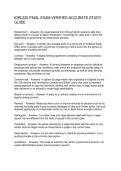
IDRL320 FINAL EXAM VERIFIED ACCURATE STUDY
GUIDE
Employment - Answers -An organizational form through which a person sells their
labour power to a buyer of labour (employer) in exchange for value and in which the
relationship is governed by an employment contract.
Gig work - Answers -A worker who accepts work on a job-by-job or freelance basis.
Often short in duration with no promise of ongoing or future work from the person or
organization providing the work.
Contract - Answers -A legally binding agreement consisting of reciprocal promises
between two or more parties.
Employment contract - Answers -A contract between an employer and an individual
employee that defines the conditions under which the employee will provide labour in
the employer will provide monetary benefits and exchange, as well as other benefits,
sometimes. May be written or oral.
Common law - Answers -A system of judge made rules originating in England around
the 12th century and inherited by Canada as a British colony that uses a precedent
based approach to case law decisions, dealing with similar facts or legal issues guide
later decisions in an attempt to create legal predictability.
Breach of contract - Answers -A party to a contract violates one or more terms of a
legally binding contract.
Remedy - Answers -Means by which court or tribunal enforces its decision such as by
ordering the guilty party to pay monetary damages or take such further action, the court
deemed appropriate to compensate victims for lost or deter future wrongful conduct.
Distinguish - Answers -To explain how prior legal decision dealt with facts or legal
issues that are different from the facts or issues in the current case.
Precedent - Answers -An earlier decision by a judge that dealt with the same or very
similar facts and legal issues as those before a judge in the current case.
Stare decisis - Answers -A Latin term meaning to 'stand by previous decision'; it is a
guiding principle in the common law regime.
Jurisdiction - Answers -The scope of authority over which a government accord or an
expert administrative power has the power to govern.
, Binding precedent/ binding decision - Answers -An earlier decision by a court of higher
ranking dealing with the same legal issue in a case that comes before a lower court,
judge the lower court judges required to apply the same reasoning and legal test
applied by the higher court.
Tort - Answers -A type of wrongful act done by one person to another or another
property that judges have recognized as legally actionable.
Statute - Answers -A law or legislation produced by a government that includes rules
that regulate the conduct of business and people.
Injunction - Answers -Illegal order issued by a judge, prohibiting a person from
engaging in a particular course of action, such as breaching a contract, committing a
tort or violating a statute.
Regulation - Answers -A government made detailed rule introduced as a supplement to
and pursuant to authority created in a statute.
Protective standards regulation - Answers -A government regulation designed primarily
to protect employees by imposing mandatory standards, such as minimum contract
requirements and safety rules.
Expert administrative tribunal - Answers -A decision-making body created by a
government statute and given responsibility for interpreting and enforcing one of our
statutes, and any regulations pursuant to that statute.
Judicial review - Answers -The process through which a decision of an expert
administrative tribunal is appealed to a court on the basis that the tribunal exceeded its
authority or jurisdiction as defined in the statute that created it or that the tribunal
decision was wrong.
Strike - Answers -Legislation can assign a particular definition to the word strike in
Canada. Strikes are usually defined to include both one collective refusal by employees
to perform work and two deliberate collective slow down by workers designed to restrict
the output of an employer.
Collective agreement - Answers -Contract between an employer and a trade union that
sets out the conditions of employment for a group of employees.
Interest arbitration - Answers -An individual or three person expert arbitration board
tasked with writing the terms of a collective agreement when the union and employer
are unable to reach agreement through voluntary collective bargaining.
Labour arbitration - Answers -An individual three person expert arbitration panel
appointed to decision disputes over the application and interpretation of collective
agreements.
GUIDE
Employment - Answers -An organizational form through which a person sells their
labour power to a buyer of labour (employer) in exchange for value and in which the
relationship is governed by an employment contract.
Gig work - Answers -A worker who accepts work on a job-by-job or freelance basis.
Often short in duration with no promise of ongoing or future work from the person or
organization providing the work.
Contract - Answers -A legally binding agreement consisting of reciprocal promises
between two or more parties.
Employment contract - Answers -A contract between an employer and an individual
employee that defines the conditions under which the employee will provide labour in
the employer will provide monetary benefits and exchange, as well as other benefits,
sometimes. May be written or oral.
Common law - Answers -A system of judge made rules originating in England around
the 12th century and inherited by Canada as a British colony that uses a precedent
based approach to case law decisions, dealing with similar facts or legal issues guide
later decisions in an attempt to create legal predictability.
Breach of contract - Answers -A party to a contract violates one or more terms of a
legally binding contract.
Remedy - Answers -Means by which court or tribunal enforces its decision such as by
ordering the guilty party to pay monetary damages or take such further action, the court
deemed appropriate to compensate victims for lost or deter future wrongful conduct.
Distinguish - Answers -To explain how prior legal decision dealt with facts or legal
issues that are different from the facts or issues in the current case.
Precedent - Answers -An earlier decision by a judge that dealt with the same or very
similar facts and legal issues as those before a judge in the current case.
Stare decisis - Answers -A Latin term meaning to 'stand by previous decision'; it is a
guiding principle in the common law regime.
Jurisdiction - Answers -The scope of authority over which a government accord or an
expert administrative power has the power to govern.
, Binding precedent/ binding decision - Answers -An earlier decision by a court of higher
ranking dealing with the same legal issue in a case that comes before a lower court,
judge the lower court judges required to apply the same reasoning and legal test
applied by the higher court.
Tort - Answers -A type of wrongful act done by one person to another or another
property that judges have recognized as legally actionable.
Statute - Answers -A law or legislation produced by a government that includes rules
that regulate the conduct of business and people.
Injunction - Answers -Illegal order issued by a judge, prohibiting a person from
engaging in a particular course of action, such as breaching a contract, committing a
tort or violating a statute.
Regulation - Answers -A government made detailed rule introduced as a supplement to
and pursuant to authority created in a statute.
Protective standards regulation - Answers -A government regulation designed primarily
to protect employees by imposing mandatory standards, such as minimum contract
requirements and safety rules.
Expert administrative tribunal - Answers -A decision-making body created by a
government statute and given responsibility for interpreting and enforcing one of our
statutes, and any regulations pursuant to that statute.
Judicial review - Answers -The process through which a decision of an expert
administrative tribunal is appealed to a court on the basis that the tribunal exceeded its
authority or jurisdiction as defined in the statute that created it or that the tribunal
decision was wrong.
Strike - Answers -Legislation can assign a particular definition to the word strike in
Canada. Strikes are usually defined to include both one collective refusal by employees
to perform work and two deliberate collective slow down by workers designed to restrict
the output of an employer.
Collective agreement - Answers -Contract between an employer and a trade union that
sets out the conditions of employment for a group of employees.
Interest arbitration - Answers -An individual or three person expert arbitration board
tasked with writing the terms of a collective agreement when the union and employer
are unable to reach agreement through voluntary collective bargaining.
Labour arbitration - Answers -An individual three person expert arbitration panel
appointed to decision disputes over the application and interpretation of collective
agreements.


