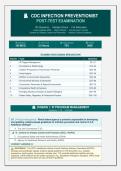
🏥 CDC INFECTION PREVENTIONIST
POST-TEST EXAMINATION
100 Questions · Multiple-Choice · Full Rationales
Latest Update 2026 · Most Difficult · Actual Exam Format
Centers for Disease Control and Prevention · Infection Control Guidelines
📋 Questions ⏱ Time Limit 🎯 Passing Score 📅 Version
100 MCQ 3.5 Hours 75% 2026
EXAMINATION DOMAIN BREAKDOWN
Domain Topic Questions
1 IP Program Management Q1–12
2 Surveillance & Epidemiology Q13–24
3 Isolation Precautions & Transmission Prevention Q25–36
4 Hand Hygiene Q37–44
5 MDROs & Antimicrobial Stewardship Q45–56
6 Environmental Services & Disinfection Q57–66
7 Construction, Renovation & Special Environments Q67–72
8 Occupational Health & Exposure Q73–80
9 Emerging Infectious Diseases & Special Pathogens Q81–90
10 Patient Safety, Regulatory & Professional Practice Q91–100
🏢 DOMAIN 1: IP PROGRAM MANAGEMENT
Questions 1–12 · 12 Points
Q1 [IP Program Management] Which federal agency is primarily responsible for developing
and updating evidence-based guidelines for infection prevention and control in U.S.
healthcare settings?
A. The Joint Commission (TJC)
✔ B. Centers for Disease Control and Prevention (CDC) / HICPAC
C. Occupational Safety and Health Administration (OSHA)
D. Agency for Healthcare Research and Quality (AHRQ)
CORRECT ANSWER: B
📖 RATIONALE: The CDC's Healthcare Infection Control Practices Advisory Committee (HICPAC)
develops and periodically updates evidence-based guidelines for HAI prevention (e.g., isolation
precautions, hand hygiene, intravascular catheter care). TJC accredits healthcare facilities and sets
standards. OSHA enforces worker safety regulations (e.g., Bloodborne Pathogens Standard). AHRQ funds
patient safety research but does not issue clinical IP guidelines.
,Q2 [IP Program Management] According to the APIC Competency Model, which component
is considered the foundational core of infection prevention practice?
A. Leadership and program management
B. Epidemiology and surveillance
✔ C. Infectious disease processes
D. Direct patient care and clinical practice
CORRECT ANSWER: C
📖 RATIONALE: APIC's IP Competency Model places 'Infectious Disease Processes' as the
foundational domain — a fundamental understanding of microbiology, pathogenesis, transmission, and the
host-pathogen interaction underpins all other IP activities. Epidemiology and surveillance, program
management, and direct practice are built upon this core scientific foundation.
Q3 [IP Program Management] An Infection Preventionist is developing a business case for a
new environmental disinfection technology. Which type of data is MOST compelling to
hospital administration?
A. Peer-reviewed microbiological efficacy studies
✔ B. Return on investment (ROI) and cost-benefit analysis including reduced HAI costs
C. Joint Commission accreditation requirements
D. Staff satisfaction surveys about current disinfection methods
CORRECT ANSWER: B
📖 RATIONALE: Hospital administrators make resource allocation decisions primarily based on financial
impact. A well-constructed ROI/cost-benefit analysis quantifying avoided HAI costs (increased LOS,
attributable mortality, legal liability, CMS penalties/non-reimbursement) is the most persuasive tool. While
scientific evidence supports efficacy, translating this into financial terms is critical for administrative buy-in.
Q4 [IP Program Management] A hospital's CLABSI rate is 2.1 per 1,000 central line days,
compared to the NHSN national benchmark of 0.8. The IP conducts a process review and
finds inconsistent use of the central line bundle. What is the FIRST step in the
improvement process?
A. Implement mandatory re-education for all nurses immediately
✔ B. Perform a root cause analysis to identify specific gaps in bundle compliance
C. Report the findings to the state health department
D. Increase surveillance frequency to weekly
CORRECT ANSWER: B
📖 RATIONALE: Before implementing interventions, a systematic root cause analysis (RCA) is
necessary to identify WHY the gap exists (knowledge deficit, workflow barriers, supply issues, culture,
supervision gaps). Jumping to education without understanding root causes often fails. The PDSA/PDCA
cycle begins with thorough problem analysis. After identifying root causes, targeted interventions (which
may include education) can be designed and implemented.
Q5 [IP Program Management] The IP program should report HAI rates and outcome data to
which groups? (Select the BEST answer.)
, A. Only to the Infection Control Committee
B. Only to hospital administration and board
✔ C. To all relevant stakeholders: clinical staff, administration, governing board, and
publicly (where required)
D. Only to frontline staff performing the procedures
CORRECT ANSWER: C
📖 RATIONALE: Effective IP programs use a multi-directional communication strategy: frontline staff
need performance feedback to change practice; administration and the governing board require oversight
data for accountability; quality/patient safety committees need trend data; and public reporting (e.g., CMS
Hospital Compare, state health departments) is mandated for certain HAIs (CLABSI, CAUTI, SSI, MRSA,
C. diff). Transparency drives improvement at all levels.
Q6 [IP Program Management] Under the CMS Conditions of Participation (CoP) for infection
control, hospitals are required to:
A. Have a dedicated full-time IP for every 100 occupied beds
✔ B. Maintain an active infection control program with policies, surveillance, and outbreak
response capability
C. Submit weekly HAI reports to CMS
D. Perform environmental cultures monthly in all patient care areas
CORRECT ANSWER: B
📖 RATIONALE: CMS CoP (42 CFR §482.42) requires hospitals to maintain an active infection control
program that addresses prevention, investigation, control, and reporting of infections. There is no CMS
mandate for a specific IP-to-bed ratio (though APIC recommends 1 IP per 100–120 occupied beds as a
guideline). Weekly CMS submissions and routine environmental cultures are not CMS requirements.
Q7 [IP Program Management] Which accrediting body developed the 'National Patient Safety
Goals' (NPSGs), several of which directly address infection prevention?
A. Centers for Disease Control and Prevention (CDC)
✔ B. The Joint Commission (TJC)
C. The Institute for Healthcare Improvement (IHI)
D. Association for Professionals in Infection Control (APIC)
CORRECT ANSWER: B
📖 RATIONALE: The Joint Commission issues National Patient Safety Goals annually. Infection-related
NPSGs include NPSG.07.01.01 (hand hygiene compliance), NPSG.07.03.01 (MRSA prevention),
NPSG.07.04.01 (CLABSI prevention), NPSG.07.05.01 (SSI prevention), and NPSG.07.06.01 (CAUTI
prevention). TJC surveys use these as part of accreditation. CDC provides the clinical guidelines; IHI
promotes improvement science; APIC provides professional development.
Q8 [IP Program Management] The IP is asked to evaluate a new antiseptic hand rub product
for formulary addition. Which organization provides the primary regulatory framework for
approving healthcare antiseptic agents in the U.S.?
A. EPA (Environmental Protection Agency)
B. CDC/HICPAC
, ✔ C. FDA (Food and Drug Administration)
D. OSHA
CORRECT ANSWER: C
📖 RATIONALE: The FDA regulates healthcare antiseptics (hand rubs, surgical scrubs) as Over-The-
Counter (OTC) Drug Products or NDA products — requiring evidence of safety and efficacy before
marketing. The EPA regulates disinfectants and sterilants used on environmental surfaces and medical
devices (not hand antiseptics). OSHA regulates exposure control plans. CDC provides guidance on hand
hygiene practices. The IP must ensure new products meet FDA regulatory standards.
Q9 [IP Program Management] A newly hired IP is developing the annual IP work plan. Which
of the following should drive the priorities for the plan?
A. The previous IP's work plan
B. The most recent APIC curriculum guide
✔ C. A risk assessment of the organization's patient population, services, and HAI data
D. The accreditation survey findings from 3 years ago
CORRECT ANSWER: C
📖 RATIONALE: The annual IP risk assessment (IPRA) is the foundation of the IP work plan. It
systematically evaluates the organization's risk based on: geographic location (endemic organisms),
patient population vulnerability, services offered (transplant, NICU, oncology), HAI surveillance data,
regulatory requirements, and outbreak history. This risk-stratified approach ensures resources are directed
to the highest-priority areas. APIC's 'APIC Text' and NHSN data support but do not replace individualized
risk assessment.
Q10 [IP Program Management] Which performance improvement model is MOST widely
used in healthcare quality and infection prevention initiatives?
A. Six Sigma DMAIC
✔ B. Plan-Do-Study-Act (PDSA) cycle
C. Lean manufacturing principles
D. Root Cause Analysis (RCA)
CORRECT ANSWER: B
📖 RATIONALE: The PDSA (Plan-Do-Study-Act) cycle, based on Shewhart/Deming's model, is the most
widely used PI framework in healthcare IP. It involves: PLAN (identify the problem, develop a change
theory), DO (implement on a small scale), STUDY (analyze data, compare to baseline), ACT (adopt,
adapt, or abandon the change). Six Sigma and Lean are also used but less universally. RCA is a reactive
problem-solving tool, not a proactive improvement model.
Q11 [IP Program Management] An IP notices that post-operative SSI rates have increased
over the past 3 months in orthopedic procedures. After conducting surveillance, the IP
suspects a cluster. What is the CORRECT sequence of steps?
A. Report to state health department → Notify administration → Begin surveillance
✔ B. Confirm the cluster exists → Identify cases → Formulate hypothesis → Test
hypothesis → Implement and evaluate control measures
C. Implement contact precautions facility-wide → Conduct environmental cultures → Report to
CDC
POST-TEST EXAMINATION
100 Questions · Multiple-Choice · Full Rationales
Latest Update 2026 · Most Difficult · Actual Exam Format
Centers for Disease Control and Prevention · Infection Control Guidelines
📋 Questions ⏱ Time Limit 🎯 Passing Score 📅 Version
100 MCQ 3.5 Hours 75% 2026
EXAMINATION DOMAIN BREAKDOWN
Domain Topic Questions
1 IP Program Management Q1–12
2 Surveillance & Epidemiology Q13–24
3 Isolation Precautions & Transmission Prevention Q25–36
4 Hand Hygiene Q37–44
5 MDROs & Antimicrobial Stewardship Q45–56
6 Environmental Services & Disinfection Q57–66
7 Construction, Renovation & Special Environments Q67–72
8 Occupational Health & Exposure Q73–80
9 Emerging Infectious Diseases & Special Pathogens Q81–90
10 Patient Safety, Regulatory & Professional Practice Q91–100
🏢 DOMAIN 1: IP PROGRAM MANAGEMENT
Questions 1–12 · 12 Points
Q1 [IP Program Management] Which federal agency is primarily responsible for developing
and updating evidence-based guidelines for infection prevention and control in U.S.
healthcare settings?
A. The Joint Commission (TJC)
✔ B. Centers for Disease Control and Prevention (CDC) / HICPAC
C. Occupational Safety and Health Administration (OSHA)
D. Agency for Healthcare Research and Quality (AHRQ)
CORRECT ANSWER: B
📖 RATIONALE: The CDC's Healthcare Infection Control Practices Advisory Committee (HICPAC)
develops and periodically updates evidence-based guidelines for HAI prevention (e.g., isolation
precautions, hand hygiene, intravascular catheter care). TJC accredits healthcare facilities and sets
standards. OSHA enforces worker safety regulations (e.g., Bloodborne Pathogens Standard). AHRQ funds
patient safety research but does not issue clinical IP guidelines.
,Q2 [IP Program Management] According to the APIC Competency Model, which component
is considered the foundational core of infection prevention practice?
A. Leadership and program management
B. Epidemiology and surveillance
✔ C. Infectious disease processes
D. Direct patient care and clinical practice
CORRECT ANSWER: C
📖 RATIONALE: APIC's IP Competency Model places 'Infectious Disease Processes' as the
foundational domain — a fundamental understanding of microbiology, pathogenesis, transmission, and the
host-pathogen interaction underpins all other IP activities. Epidemiology and surveillance, program
management, and direct practice are built upon this core scientific foundation.
Q3 [IP Program Management] An Infection Preventionist is developing a business case for a
new environmental disinfection technology. Which type of data is MOST compelling to
hospital administration?
A. Peer-reviewed microbiological efficacy studies
✔ B. Return on investment (ROI) and cost-benefit analysis including reduced HAI costs
C. Joint Commission accreditation requirements
D. Staff satisfaction surveys about current disinfection methods
CORRECT ANSWER: B
📖 RATIONALE: Hospital administrators make resource allocation decisions primarily based on financial
impact. A well-constructed ROI/cost-benefit analysis quantifying avoided HAI costs (increased LOS,
attributable mortality, legal liability, CMS penalties/non-reimbursement) is the most persuasive tool. While
scientific evidence supports efficacy, translating this into financial terms is critical for administrative buy-in.
Q4 [IP Program Management] A hospital's CLABSI rate is 2.1 per 1,000 central line days,
compared to the NHSN national benchmark of 0.8. The IP conducts a process review and
finds inconsistent use of the central line bundle. What is the FIRST step in the
improvement process?
A. Implement mandatory re-education for all nurses immediately
✔ B. Perform a root cause analysis to identify specific gaps in bundle compliance
C. Report the findings to the state health department
D. Increase surveillance frequency to weekly
CORRECT ANSWER: B
📖 RATIONALE: Before implementing interventions, a systematic root cause analysis (RCA) is
necessary to identify WHY the gap exists (knowledge deficit, workflow barriers, supply issues, culture,
supervision gaps). Jumping to education without understanding root causes often fails. The PDSA/PDCA
cycle begins with thorough problem analysis. After identifying root causes, targeted interventions (which
may include education) can be designed and implemented.
Q5 [IP Program Management] The IP program should report HAI rates and outcome data to
which groups? (Select the BEST answer.)
, A. Only to the Infection Control Committee
B. Only to hospital administration and board
✔ C. To all relevant stakeholders: clinical staff, administration, governing board, and
publicly (where required)
D. Only to frontline staff performing the procedures
CORRECT ANSWER: C
📖 RATIONALE: Effective IP programs use a multi-directional communication strategy: frontline staff
need performance feedback to change practice; administration and the governing board require oversight
data for accountability; quality/patient safety committees need trend data; and public reporting (e.g., CMS
Hospital Compare, state health departments) is mandated for certain HAIs (CLABSI, CAUTI, SSI, MRSA,
C. diff). Transparency drives improvement at all levels.
Q6 [IP Program Management] Under the CMS Conditions of Participation (CoP) for infection
control, hospitals are required to:
A. Have a dedicated full-time IP for every 100 occupied beds
✔ B. Maintain an active infection control program with policies, surveillance, and outbreak
response capability
C. Submit weekly HAI reports to CMS
D. Perform environmental cultures monthly in all patient care areas
CORRECT ANSWER: B
📖 RATIONALE: CMS CoP (42 CFR §482.42) requires hospitals to maintain an active infection control
program that addresses prevention, investigation, control, and reporting of infections. There is no CMS
mandate for a specific IP-to-bed ratio (though APIC recommends 1 IP per 100–120 occupied beds as a
guideline). Weekly CMS submissions and routine environmental cultures are not CMS requirements.
Q7 [IP Program Management] Which accrediting body developed the 'National Patient Safety
Goals' (NPSGs), several of which directly address infection prevention?
A. Centers for Disease Control and Prevention (CDC)
✔ B. The Joint Commission (TJC)
C. The Institute for Healthcare Improvement (IHI)
D. Association for Professionals in Infection Control (APIC)
CORRECT ANSWER: B
📖 RATIONALE: The Joint Commission issues National Patient Safety Goals annually. Infection-related
NPSGs include NPSG.07.01.01 (hand hygiene compliance), NPSG.07.03.01 (MRSA prevention),
NPSG.07.04.01 (CLABSI prevention), NPSG.07.05.01 (SSI prevention), and NPSG.07.06.01 (CAUTI
prevention). TJC surveys use these as part of accreditation. CDC provides the clinical guidelines; IHI
promotes improvement science; APIC provides professional development.
Q8 [IP Program Management] The IP is asked to evaluate a new antiseptic hand rub product
for formulary addition. Which organization provides the primary regulatory framework for
approving healthcare antiseptic agents in the U.S.?
A. EPA (Environmental Protection Agency)
B. CDC/HICPAC
, ✔ C. FDA (Food and Drug Administration)
D. OSHA
CORRECT ANSWER: C
📖 RATIONALE: The FDA regulates healthcare antiseptics (hand rubs, surgical scrubs) as Over-The-
Counter (OTC) Drug Products or NDA products — requiring evidence of safety and efficacy before
marketing. The EPA regulates disinfectants and sterilants used on environmental surfaces and medical
devices (not hand antiseptics). OSHA regulates exposure control plans. CDC provides guidance on hand
hygiene practices. The IP must ensure new products meet FDA regulatory standards.
Q9 [IP Program Management] A newly hired IP is developing the annual IP work plan. Which
of the following should drive the priorities for the plan?
A. The previous IP's work plan
B. The most recent APIC curriculum guide
✔ C. A risk assessment of the organization's patient population, services, and HAI data
D. The accreditation survey findings from 3 years ago
CORRECT ANSWER: C
📖 RATIONALE: The annual IP risk assessment (IPRA) is the foundation of the IP work plan. It
systematically evaluates the organization's risk based on: geographic location (endemic organisms),
patient population vulnerability, services offered (transplant, NICU, oncology), HAI surveillance data,
regulatory requirements, and outbreak history. This risk-stratified approach ensures resources are directed
to the highest-priority areas. APIC's 'APIC Text' and NHSN data support but do not replace individualized
risk assessment.
Q10 [IP Program Management] Which performance improvement model is MOST widely
used in healthcare quality and infection prevention initiatives?
A. Six Sigma DMAIC
✔ B. Plan-Do-Study-Act (PDSA) cycle
C. Lean manufacturing principles
D. Root Cause Analysis (RCA)
CORRECT ANSWER: B
📖 RATIONALE: The PDSA (Plan-Do-Study-Act) cycle, based on Shewhart/Deming's model, is the most
widely used PI framework in healthcare IP. It involves: PLAN (identify the problem, develop a change
theory), DO (implement on a small scale), STUDY (analyze data, compare to baseline), ACT (adopt,
adapt, or abandon the change). Six Sigma and Lean are also used but less universally. RCA is a reactive
problem-solving tool, not a proactive improvement model.
Q11 [IP Program Management] An IP notices that post-operative SSI rates have increased
over the past 3 months in orthopedic procedures. After conducting surveillance, the IP
suspects a cluster. What is the CORRECT sequence of steps?
A. Report to state health department → Notify administration → Begin surveillance
✔ B. Confirm the cluster exists → Identify cases → Formulate hypothesis → Test
hypothesis → Implement and evaluate control measures
C. Implement contact precautions facility-wide → Conduct environmental cultures → Report to
CDC