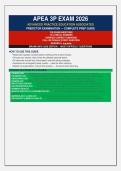
APEA 3P EXAM 2026
ADVANCED PRACTICE EDUCATION ASSOCIATES
PREDICTOR EXAMINATION — COMPLETE PREP GUIDE
130 EXAM QUESTIONS
10 CLINICAL DOMAINS
VERIFIED CORRECT ANSWERS
FULL RATIONALE EVERY QUESTION
GRADED A ★★★★★
BRAND NEW 2026 EDITION | MOST DIFFICULT QUESTIONS
HOW TO USE THIS GUIDE
• Read each question carefully before looking at the answer choices.
• Choose your answer, then review the detailed rationale below.
• All rationales include key clinical pearls and test-taking strategies.
• Questions are arranged by body system — ideal for block studying.
• Master the explanations, not just the answers — the exam tests reasoning.
CONTENT SECTIONS AT A GLANCE
CARDIOLOGY — Heart Disease • Arrhythmias • Valvular Disease • Heart Failure • Vascular Emergencies
PULMONOLOGY — Obstructive/Restrictive Lung Disease • Pneumonia • PE • Pleural Disorders • Sleep Apnea
ENDOCRINOLOGY — Diabetes • Thyroid • Adrenal • Pituitary • Parathyroid • Metabolic Emergencies
NEUROLOGY — Stroke • TIA • Seizures • Dementia • Movement Disorders • Headache • NMJ Disease
INFECTIOUS DISEASE — Bacterial/Viral Infections • STIs • Opportunistic Infections • Sepsis • Antimicrobials
GASTROENTEROLOGY — GI Bleeding • Liver Disease • IBD • PUD • Colorectal Cancer • Pancreatic Disease
WOMEN'S HEALTH — Obstetrics • Gynecology • Contraception • Menopause • Breast & Cervical Health
MUSCULOSKELETAL & RHEUMATOLOGY — Arthritis • Crystal Arthropathy • Autoimmune Disease • Myopathy •
Osteoporosis
NEPHROLOGY & UROLOGY — AKI • CKD • Electrolytes • Stones • BPH • Urinary Incontinence • Oncology
PSYCHIATRY & MENTAL HEALTH — Mood Disorders • Psychosis • Anxiety • Substance Use • Somatoform •
Emergencies
, CARDIOLOGY
Questions 1–18 | Heart Disease • Arrhythmias • Valvular Disease • Heart Failure • Vascular Emergencies
Q1 CARDIOLOGY
A 58-year-old male presents with crushing substernal chest pain radiating to the left jaw,
diaphoresis, and nausea for 45 minutes. ECG shows ST-segment elevation ≥1 mm in leads II, III, and
aVF. Which immediate intervention is MOST appropriate?
A) Administer IV heparin and admit for observation
✔ B) Perform emergent percutaneous coronary intervention (PCI) within 90 minutes
C) Start thrombolytics and discharge with cardiology follow-up
D) Obtain cardiac biomarkers and repeat ECG in 6 hours
✔ CORRECT ANSWER: B) Perform emergent percutaneous coronary intervention (PCI) within 90 minutes
📝 RATIONALE & CLINICAL PEARLS
This presentation is classic inferior STEMI (ST elevation in II, III, aVF indicates RCA occlusion). Current
ACC/AHA guidelines mandate primary PCI as the preferred reperfusion strategy with a door-to-balloon time goal
of ≤90 minutes. Thrombolytics are reserved for settings where timely PCI is unavailable. Observation alone is
inappropriate for STEMI.
Q2 CARDIOLOGY
A 65-year-old female with HTN and DM2 presents with exertional dyspnea and bilateral ankle edema.
Echo shows EF of 35%. BNP is 820 pg/mL. Which medication combination is MOST evidence-based
for this condition?
✔ A) ACE inhibitor + beta-blocker + aldosterone antagonist
B) Calcium channel blocker + diuretic + ARB
C) Digoxin + hydralazine + nitrate
D) ARB + calcium channel blocker + beta-blocker
✔ CORRECT ANSWER: A) ACE inhibitor + beta-blocker + aldosterone antagonist
📝 RATIONALE & CLINICAL PEARLS
This patient has HFrEF (EF ≤40%). The cornerstone pharmacotherapy per ACC/AHA guidelines is the
combination of an ACE inhibitor (or ARB/ARNI), evidence-based beta-blocker (carvedilol, metoprolol succinate,
bisoprolol), and aldosterone antagonist (spironolactone/eplerenone) to reduce mortality and hospitalizations.
CCBs are not recommended for HFrEF due to negative inotropic effects.
Q3 CARDIOLOGY
A 72-year-old patient is on warfarin for atrial fibrillation with a CHA₂DS₂-VASc score of 4. His INR
today is 1.4. Which is the BEST next step?
A) Continue same warfarin dose; recheck INR in 4 weeks
✔ B) Increase warfarin dose and recheck INR in 1 week
C) Switch immediately to aspirin 325 mg daily
D) Stop warfarin and start rivaroxaban without a bridging period
✔ CORRECT ANSWER: B) Increase warfarin dose and recheck INR in 1 week
📝 RATIONALE & CLINICAL PEARLS
The therapeutic INR range for atrial fibrillation is 2.0–3.0. An INR of 1.4 is subtherapeutic, increasing stroke risk.
The warfarin dose should be increased with a follow-up INR in 1 week. Switching to aspirin is inferior to
anticoagulation for AF stroke prevention. DOACs are appropriate alternatives but switching mid-management
requires a structured transition, not direct substitution at a subtherapeutic INR.
Q4 CARDIOLOGY
A 55-year-old male smoker presents with severe 'tearing' chest pain radiating to the back between
the scapulae. BP is 190/110 in the right arm and 160/90 in the left arm. CXR shows widened
mediastinum. What is the MOST likely diagnosis?
A) Acute anterior STEMI
B) Pulmonary embolism
✔ C) Aortic dissection
D) Spontaneous pneumothorax
✔ CORRECT ANSWER: C) Aortic dissection
📝 RATIONALE & CLINICAL PEARLS
, Aortic dissection classically presents with abrupt-onset, tearing/ripping chest pain radiating to the back,
asymmetric blood pressures between arms (>20 mmHg difference), and widened mediastinum on CXR.
Hypertension is the #1 risk factor. Immediate CT angiography of the chest is indicated. Type A (ascending)
requires emergent surgery; Type B (descending) is managed medically with IV antihypertensives (labetalol,
esmolol).
Q5 CARDIOLOGY
A patient with newly diagnosed Stage 1 hypertension (BP 135/85) and no other cardiovascular risk
factors. Lifestyle modifications have been tried for 3 months with no improvement. What is the
FIRST-LINE pharmacological agent?
A) Beta-blocker (metoprolol)
✔ B) ACE inhibitor or ARB (if diabetic/CKD) or thiazide diuretic or CCB
C) Alpha-blocker (doxazosin)
D) Direct vasodilator (hydralazine)
✔ CORRECT ANSWER: B) ACE inhibitor or ARB (if diabetic/CKD) or thiazide diuretic or CCB
📝 RATIONALE & CLINICAL PEARLS
Per JNC-8 and ACC/AHA 2017 guidelines, first-line antihypertensive options for most patients include thiazide
diuretics, ACE inhibitors, ARBs, or CCBs. ACE inhibitors/ARBs are specifically preferred in patients with CKD or
diabetes for additional renoprotection. Beta-blockers are not first-line for uncomplicated hypertension. Alpha-
blockers and direct vasodilators are reserved for resistant cases.
Q6 CARDIOLOGY
A 68-year-old female presents with sudden-onset palpitations, dyspnea, and an irregularly irregular
pulse. ECG shows no distinct P waves, irregular R-R intervals, and a ventricular rate of 138 bpm. She
is hemodynamically stable. What is the FIRST priority?
A) Immediate synchronized cardioversion
✔ B) Rate control with IV diltiazem or metoprolol
C) Administer adenosine 6 mg IV push
D) Initiate therapeutic hypothermia
✔ CORRECT ANSWER: B) Rate control with IV diltiazem or metoprolol
📝 RATIONALE & CLINICAL PEARLS
This is new-onset atrial fibrillation with rapid ventricular response. For hemodynamically stable patients, rate
control (goal <110 bpm at rest) is the immediate priority using IV diltiazem or beta-blockers. Cardioversion is
considered for unstable patients or after anticoagulation if AF >48 hours. Adenosine terminates AV nodal re-entry
tachycardia (AVNRT), not AF.
Q7 CARDIOLOGY
A 45-year-old male with hyperlipidemia has LDL of 178 mg/dL after 3 months of diet modification. His
10-year ASCVD risk is 8%. Which medication is MOST appropriate?
A) Fibrate (fenofibrate)
✔ B) High-intensity statin (atorvastatin 40–80 mg)
C) Niacin monotherapy
D) Bile acid sequestrant (cholestyramine)
✔ CORRECT ANSWER: B) High-intensity statin (atorvastatin 40–80 mg)
📝 RATIONALE & CLINICAL PEARLS
Per ACC/AHA 2018 cholesterol guidelines, patients with borderline risk (7.5–20% 10-year ASCVD risk) and LDL
≥70 mg/dL benefit from statin therapy. A 10-year risk of 8% combined with LDL of 178 mg/dL warrants initiation of
a moderate-to-high intensity statin. Statins are the first-line pharmacologic treatment. Fibrates primarily lower
triglycerides. Niacin monotherapy has fallen out of favor due to lack of cardiovascular benefit in combination
trials.
Q8 CARDIOLOGY
Which finding on physical examination is MOST consistent with cardiac tamponade?
A) Wide pulse pressure
B) Loud S3 gallop
✔ C) Pulsus paradoxus >10 mmHg
D) Systolic ejection murmur at the aortic area
✔ CORRECT ANSWER: C) Pulsus paradoxus >10 mmHg
📝 RATIONALE & CLINICAL PEARLS
, Cardiac tamponade is defined by Beck's triad: hypotension, distended neck veins, and muffled heart sounds.
Pulsus paradoxus (>10 mmHg drop in SBP with inspiration) is a hallmark finding due to pericardial fluid
compressing the right heart, increasing RV filling with inspiration at the expense of LV output. Wide pulse
pressure suggests aortic regurgitation. S3 gallop indicates heart failure.
Q9 CARDIOLOGY
A 70-year-old male with a history of MI 5 years ago presents with increasing exertional dyspnea.
Echo shows EF of 60% with LV hypertrophy and diastolic dysfunction. BNP is 380 pg/mL. Diagnosis?
A) HFrEF
✔ B) HFpEF (Heart Failure with Preserved Ejection Fraction)
C) Dilated cardiomyopathy
D) Constrictive pericarditis
✔ CORRECT ANSWER: B) HFpEF (Heart Failure with Preserved Ejection Fraction)
📝 RATIONALE & CLINICAL PEARLS
HFpEF (formerly called diastolic heart failure) is characterized by symptoms of HF, elevated BNP, preserved EF
(≥50%), and evidence of diastolic dysfunction (impaired LV relaxation, LVH). Risk factors include hypertension,
DM, obesity, and age. Treatment focuses on symptom management (diuretics), controlling heart rate, and
managing underlying conditions. SGLT2 inhibitors (empagliflozin, dapagliflozin) are now approved for HFpEF.
Q10 CARDIOLOGY
A 30-year-old female presents with sharp, pleuritic chest pain that worsens when lying flat and
improves when leaning forward. Low-grade fever is present. ECG shows diffuse ST elevation in a
saddle-shaped pattern with PR depression. Diagnosis?
A) Acute MI
B) Pleuritis
✔ C) Acute pericarditis
D) Pulmonary embolism
✔ CORRECT ANSWER: C) Acute pericarditis
📝 RATIONALE & CLINICAL PEARLS
Acute pericarditis presents with sharp pleuritic chest pain that worsens supine and improves leaning forward
(pericardial friction rub position). ECG findings are pathognomonic: diffuse saddle-shaped ST elevation and PR
segment depression in multiple leads (unlike MI which has focal changes). Most common cause is viral
(Coxsackie B). Treatment: NSAIDs + colchicine. Restrict strenuous activity for 3 months.
Q11 CARDIOLOGY
Which of the following murmur characteristics is MOST consistent with aortic stenosis?
A) Holosystolic murmur at the apex radiating to the axilla
B) Early diastolic decrescendo murmur at the left sternal border
✔ C) Harsh systolic ejection murmur at the right upper sternal border radiating to the carotids
D) Mid-systolic click followed by a late systolic murmur
✔ CORRECT ANSWER: C) Harsh systolic ejection murmur at the right upper sternal border radiating to the
carotids
📝 RATIONALE & CLINICAL PEARLS
Aortic stenosis produces a harsh, crescendo-decrescendo systolic ejection murmur heard best at the right upper
sternal border (2nd RICS), classically radiating to the carotid arteries. Associated findings: slow-rising (pulsus
parvus et tardus) carotid pulse, decreased S2. Option A = mitral regurgitation. Option B = aortic regurgitation.
Option D = mitral valve prolapse.
Q12 CARDIOLOGY
A 52-year-old male with T2DM and CKD Stage 3 has BP of 148/92 on no medications. Which
antihypertensive provides BOTH BP control AND renoprotection?
A) Amlodipine
B) Hydrochlorothiazide
✔ C) Lisinopril
D) Metoprolol
✔ CORRECT ANSWER: C) Lisinopril
📝 RATIONALE & CLINICAL PEARLS
ACE inhibitors (and ARBs) are first-line antihypertensives for patients with diabetes and/or CKD because they
reduce intraglomerular pressure by dilating the efferent arteriole, thereby slowing CKD progression and reducing
ADVANCED PRACTICE EDUCATION ASSOCIATES
PREDICTOR EXAMINATION — COMPLETE PREP GUIDE
130 EXAM QUESTIONS
10 CLINICAL DOMAINS
VERIFIED CORRECT ANSWERS
FULL RATIONALE EVERY QUESTION
GRADED A ★★★★★
BRAND NEW 2026 EDITION | MOST DIFFICULT QUESTIONS
HOW TO USE THIS GUIDE
• Read each question carefully before looking at the answer choices.
• Choose your answer, then review the detailed rationale below.
• All rationales include key clinical pearls and test-taking strategies.
• Questions are arranged by body system — ideal for block studying.
• Master the explanations, not just the answers — the exam tests reasoning.
CONTENT SECTIONS AT A GLANCE
CARDIOLOGY — Heart Disease • Arrhythmias • Valvular Disease • Heart Failure • Vascular Emergencies
PULMONOLOGY — Obstructive/Restrictive Lung Disease • Pneumonia • PE • Pleural Disorders • Sleep Apnea
ENDOCRINOLOGY — Diabetes • Thyroid • Adrenal • Pituitary • Parathyroid • Metabolic Emergencies
NEUROLOGY — Stroke • TIA • Seizures • Dementia • Movement Disorders • Headache • NMJ Disease
INFECTIOUS DISEASE — Bacterial/Viral Infections • STIs • Opportunistic Infections • Sepsis • Antimicrobials
GASTROENTEROLOGY — GI Bleeding • Liver Disease • IBD • PUD • Colorectal Cancer • Pancreatic Disease
WOMEN'S HEALTH — Obstetrics • Gynecology • Contraception • Menopause • Breast & Cervical Health
MUSCULOSKELETAL & RHEUMATOLOGY — Arthritis • Crystal Arthropathy • Autoimmune Disease • Myopathy •
Osteoporosis
NEPHROLOGY & UROLOGY — AKI • CKD • Electrolytes • Stones • BPH • Urinary Incontinence • Oncology
PSYCHIATRY & MENTAL HEALTH — Mood Disorders • Psychosis • Anxiety • Substance Use • Somatoform •
Emergencies
, CARDIOLOGY
Questions 1–18 | Heart Disease • Arrhythmias • Valvular Disease • Heart Failure • Vascular Emergencies
Q1 CARDIOLOGY
A 58-year-old male presents with crushing substernal chest pain radiating to the left jaw,
diaphoresis, and nausea for 45 minutes. ECG shows ST-segment elevation ≥1 mm in leads II, III, and
aVF. Which immediate intervention is MOST appropriate?
A) Administer IV heparin and admit for observation
✔ B) Perform emergent percutaneous coronary intervention (PCI) within 90 minutes
C) Start thrombolytics and discharge with cardiology follow-up
D) Obtain cardiac biomarkers and repeat ECG in 6 hours
✔ CORRECT ANSWER: B) Perform emergent percutaneous coronary intervention (PCI) within 90 minutes
📝 RATIONALE & CLINICAL PEARLS
This presentation is classic inferior STEMI (ST elevation in II, III, aVF indicates RCA occlusion). Current
ACC/AHA guidelines mandate primary PCI as the preferred reperfusion strategy with a door-to-balloon time goal
of ≤90 minutes. Thrombolytics are reserved for settings where timely PCI is unavailable. Observation alone is
inappropriate for STEMI.
Q2 CARDIOLOGY
A 65-year-old female with HTN and DM2 presents with exertional dyspnea and bilateral ankle edema.
Echo shows EF of 35%. BNP is 820 pg/mL. Which medication combination is MOST evidence-based
for this condition?
✔ A) ACE inhibitor + beta-blocker + aldosterone antagonist
B) Calcium channel blocker + diuretic + ARB
C) Digoxin + hydralazine + nitrate
D) ARB + calcium channel blocker + beta-blocker
✔ CORRECT ANSWER: A) ACE inhibitor + beta-blocker + aldosterone antagonist
📝 RATIONALE & CLINICAL PEARLS
This patient has HFrEF (EF ≤40%). The cornerstone pharmacotherapy per ACC/AHA guidelines is the
combination of an ACE inhibitor (or ARB/ARNI), evidence-based beta-blocker (carvedilol, metoprolol succinate,
bisoprolol), and aldosterone antagonist (spironolactone/eplerenone) to reduce mortality and hospitalizations.
CCBs are not recommended for HFrEF due to negative inotropic effects.
Q3 CARDIOLOGY
A 72-year-old patient is on warfarin for atrial fibrillation with a CHA₂DS₂-VASc score of 4. His INR
today is 1.4. Which is the BEST next step?
A) Continue same warfarin dose; recheck INR in 4 weeks
✔ B) Increase warfarin dose and recheck INR in 1 week
C) Switch immediately to aspirin 325 mg daily
D) Stop warfarin and start rivaroxaban without a bridging period
✔ CORRECT ANSWER: B) Increase warfarin dose and recheck INR in 1 week
📝 RATIONALE & CLINICAL PEARLS
The therapeutic INR range for atrial fibrillation is 2.0–3.0. An INR of 1.4 is subtherapeutic, increasing stroke risk.
The warfarin dose should be increased with a follow-up INR in 1 week. Switching to aspirin is inferior to
anticoagulation for AF stroke prevention. DOACs are appropriate alternatives but switching mid-management
requires a structured transition, not direct substitution at a subtherapeutic INR.
Q4 CARDIOLOGY
A 55-year-old male smoker presents with severe 'tearing' chest pain radiating to the back between
the scapulae. BP is 190/110 in the right arm and 160/90 in the left arm. CXR shows widened
mediastinum. What is the MOST likely diagnosis?
A) Acute anterior STEMI
B) Pulmonary embolism
✔ C) Aortic dissection
D) Spontaneous pneumothorax
✔ CORRECT ANSWER: C) Aortic dissection
📝 RATIONALE & CLINICAL PEARLS
, Aortic dissection classically presents with abrupt-onset, tearing/ripping chest pain radiating to the back,
asymmetric blood pressures between arms (>20 mmHg difference), and widened mediastinum on CXR.
Hypertension is the #1 risk factor. Immediate CT angiography of the chest is indicated. Type A (ascending)
requires emergent surgery; Type B (descending) is managed medically with IV antihypertensives (labetalol,
esmolol).
Q5 CARDIOLOGY
A patient with newly diagnosed Stage 1 hypertension (BP 135/85) and no other cardiovascular risk
factors. Lifestyle modifications have been tried for 3 months with no improvement. What is the
FIRST-LINE pharmacological agent?
A) Beta-blocker (metoprolol)
✔ B) ACE inhibitor or ARB (if diabetic/CKD) or thiazide diuretic or CCB
C) Alpha-blocker (doxazosin)
D) Direct vasodilator (hydralazine)
✔ CORRECT ANSWER: B) ACE inhibitor or ARB (if diabetic/CKD) or thiazide diuretic or CCB
📝 RATIONALE & CLINICAL PEARLS
Per JNC-8 and ACC/AHA 2017 guidelines, first-line antihypertensive options for most patients include thiazide
diuretics, ACE inhibitors, ARBs, or CCBs. ACE inhibitors/ARBs are specifically preferred in patients with CKD or
diabetes for additional renoprotection. Beta-blockers are not first-line for uncomplicated hypertension. Alpha-
blockers and direct vasodilators are reserved for resistant cases.
Q6 CARDIOLOGY
A 68-year-old female presents with sudden-onset palpitations, dyspnea, and an irregularly irregular
pulse. ECG shows no distinct P waves, irregular R-R intervals, and a ventricular rate of 138 bpm. She
is hemodynamically stable. What is the FIRST priority?
A) Immediate synchronized cardioversion
✔ B) Rate control with IV diltiazem or metoprolol
C) Administer adenosine 6 mg IV push
D) Initiate therapeutic hypothermia
✔ CORRECT ANSWER: B) Rate control with IV diltiazem or metoprolol
📝 RATIONALE & CLINICAL PEARLS
This is new-onset atrial fibrillation with rapid ventricular response. For hemodynamically stable patients, rate
control (goal <110 bpm at rest) is the immediate priority using IV diltiazem or beta-blockers. Cardioversion is
considered for unstable patients or after anticoagulation if AF >48 hours. Adenosine terminates AV nodal re-entry
tachycardia (AVNRT), not AF.
Q7 CARDIOLOGY
A 45-year-old male with hyperlipidemia has LDL of 178 mg/dL after 3 months of diet modification. His
10-year ASCVD risk is 8%. Which medication is MOST appropriate?
A) Fibrate (fenofibrate)
✔ B) High-intensity statin (atorvastatin 40–80 mg)
C) Niacin monotherapy
D) Bile acid sequestrant (cholestyramine)
✔ CORRECT ANSWER: B) High-intensity statin (atorvastatin 40–80 mg)
📝 RATIONALE & CLINICAL PEARLS
Per ACC/AHA 2018 cholesterol guidelines, patients with borderline risk (7.5–20% 10-year ASCVD risk) and LDL
≥70 mg/dL benefit from statin therapy. A 10-year risk of 8% combined with LDL of 178 mg/dL warrants initiation of
a moderate-to-high intensity statin. Statins are the first-line pharmacologic treatment. Fibrates primarily lower
triglycerides. Niacin monotherapy has fallen out of favor due to lack of cardiovascular benefit in combination
trials.
Q8 CARDIOLOGY
Which finding on physical examination is MOST consistent with cardiac tamponade?
A) Wide pulse pressure
B) Loud S3 gallop
✔ C) Pulsus paradoxus >10 mmHg
D) Systolic ejection murmur at the aortic area
✔ CORRECT ANSWER: C) Pulsus paradoxus >10 mmHg
📝 RATIONALE & CLINICAL PEARLS
, Cardiac tamponade is defined by Beck's triad: hypotension, distended neck veins, and muffled heart sounds.
Pulsus paradoxus (>10 mmHg drop in SBP with inspiration) is a hallmark finding due to pericardial fluid
compressing the right heart, increasing RV filling with inspiration at the expense of LV output. Wide pulse
pressure suggests aortic regurgitation. S3 gallop indicates heart failure.
Q9 CARDIOLOGY
A 70-year-old male with a history of MI 5 years ago presents with increasing exertional dyspnea.
Echo shows EF of 60% with LV hypertrophy and diastolic dysfunction. BNP is 380 pg/mL. Diagnosis?
A) HFrEF
✔ B) HFpEF (Heart Failure with Preserved Ejection Fraction)
C) Dilated cardiomyopathy
D) Constrictive pericarditis
✔ CORRECT ANSWER: B) HFpEF (Heart Failure with Preserved Ejection Fraction)
📝 RATIONALE & CLINICAL PEARLS
HFpEF (formerly called diastolic heart failure) is characterized by symptoms of HF, elevated BNP, preserved EF
(≥50%), and evidence of diastolic dysfunction (impaired LV relaxation, LVH). Risk factors include hypertension,
DM, obesity, and age. Treatment focuses on symptom management (diuretics), controlling heart rate, and
managing underlying conditions. SGLT2 inhibitors (empagliflozin, dapagliflozin) are now approved for HFpEF.
Q10 CARDIOLOGY
A 30-year-old female presents with sharp, pleuritic chest pain that worsens when lying flat and
improves when leaning forward. Low-grade fever is present. ECG shows diffuse ST elevation in a
saddle-shaped pattern with PR depression. Diagnosis?
A) Acute MI
B) Pleuritis
✔ C) Acute pericarditis
D) Pulmonary embolism
✔ CORRECT ANSWER: C) Acute pericarditis
📝 RATIONALE & CLINICAL PEARLS
Acute pericarditis presents with sharp pleuritic chest pain that worsens supine and improves leaning forward
(pericardial friction rub position). ECG findings are pathognomonic: diffuse saddle-shaped ST elevation and PR
segment depression in multiple leads (unlike MI which has focal changes). Most common cause is viral
(Coxsackie B). Treatment: NSAIDs + colchicine. Restrict strenuous activity for 3 months.
Q11 CARDIOLOGY
Which of the following murmur characteristics is MOST consistent with aortic stenosis?
A) Holosystolic murmur at the apex radiating to the axilla
B) Early diastolic decrescendo murmur at the left sternal border
✔ C) Harsh systolic ejection murmur at the right upper sternal border radiating to the carotids
D) Mid-systolic click followed by a late systolic murmur
✔ CORRECT ANSWER: C) Harsh systolic ejection murmur at the right upper sternal border radiating to the
carotids
📝 RATIONALE & CLINICAL PEARLS
Aortic stenosis produces a harsh, crescendo-decrescendo systolic ejection murmur heard best at the right upper
sternal border (2nd RICS), classically radiating to the carotid arteries. Associated findings: slow-rising (pulsus
parvus et tardus) carotid pulse, decreased S2. Option A = mitral regurgitation. Option B = aortic regurgitation.
Option D = mitral valve prolapse.
Q12 CARDIOLOGY
A 52-year-old male with T2DM and CKD Stage 3 has BP of 148/92 on no medications. Which
antihypertensive provides BOTH BP control AND renoprotection?
A) Amlodipine
B) Hydrochlorothiazide
✔ C) Lisinopril
D) Metoprolol
✔ CORRECT ANSWER: C) Lisinopril
📝 RATIONALE & CLINICAL PEARLS
ACE inhibitors (and ARBs) are first-line antihypertensives for patients with diabetes and/or CKD because they
reduce intraglomerular pressure by dilating the efferent arteriole, thereby slowing CKD progression and reducing