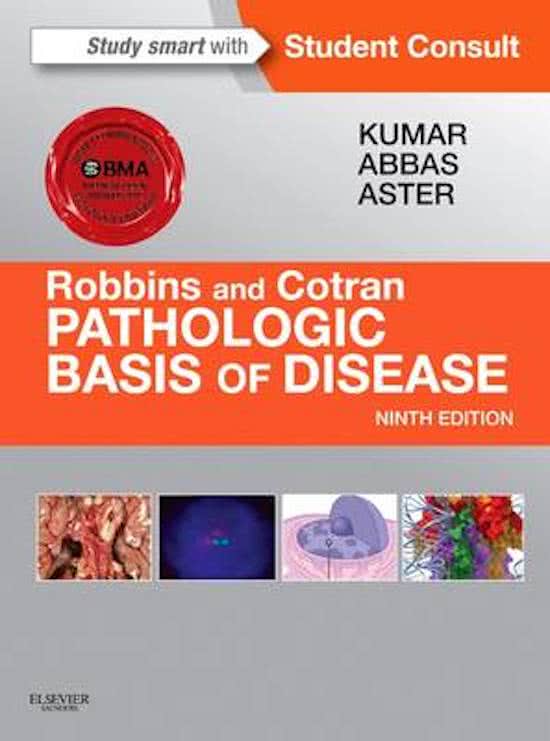
Robbins & Cotran Pathologic Basis of Disease (Robbins
Pathology) 9th Edition
by Vinay Kumar, Abul K. Abbas, Jon C. Aster - TEST BANK WITH
CORRECT ANSWERS- ALL CHAPTERS COVERED 1-29
,Table of Contents
General Pathology ..................................................................................................................................................................... 3
Chapter 01: The Cell As A Unit Of Health And Disease ........................................................................................................ 3
Chapter 02: Cellular Responses To Stress And Toxic Insults: Adaptation, Injury, And Death ............................................ 7
Chapter 03: Inflammation And Repair ............................................................................................................................... 12
Chapter 04: Hemodynamic Disorders, Thromboembolic Disease, And Shock .................................................................. 16
Chapter 05: Genetic Disorders ............................................................................................................................................ 20
Chapter 06: Diseases Of The Immune System .................................................................................................................... 23
Chapter 07: Neoplasia......................................................................................................................................................... 46
Chapter 08: Infectious Diseases .......................................................................................................................................... 50
Chapter 09: Environmental And Nutritional Diseases....................................................................................................... 54
Chapter 10: Diseases Of Infancy And Childhood ................................................................................................................ 57
Systemic Pathology: Diseases of Organ Systems ................................................................................................................... 60
Chapter 11: Blood Vessels ................................................................................................................................................... 60
Chapter 12: The Heart ........................................................................................................................................................ 62
Chapter 13: Diseases Of White Blood Cells, Lymph Nodes, Spleen, And Thymus .............................................................. 67
Chapter 14: Red Blood Cell And Bleeding Disorders .......................................................................................................... 89
Chapter 15: The Lung.......................................................................................................................................................... 92
Chapter 16: Head And Neck ................................................................................................................................................ 97
Chapter 17: The Gastrointestinal Tract ........................................................................................................................... 111
Chapter 18: Liver And Gallbladder ................................................................................................................................... 118
........................................................................................................................................................................................... 122
Chapter 19: The Pancreas ................................................................................................................................................. 155
Chapter 20: The Kidney..................................................................................................................................................... 165
Chapter 21: The Lower Urinary Tract And Male Genital System .................................................................................... 201
Chapter 22: The Female Genital Tract ............................................................................................................................. 212
Chapter 23: The Breast ..................................................................................................................................................... 238
Chapter 24: The Endocrine System................................................................................................................................... 255
Chapter 25: The Skin ......................................................................................................................................................... 274
Chapter 26: Bones, Joints, And Soft Tissue Tumors ......................................................................................................... 286
Chapter 27: Peripheral Nerves And Skeletal Muscles ...................................................................................................... 311
Chapter 28: The Central Nervous System ......................................................................................................................... 318
Chapter 29: The Eye .......................................................................................................................................................... 352
,Robbins And Cotran Pathologic Basis Of Disease 9th Edition Kumar
General Pathology
Chapter 01: The Cell As A Unit Of Health And Disease
MULTIPLE CHOICE
Which Statement Regarding The Sodium-Potassium Pump Is Correct?
A. The Cell's Plasma Membrane Is More Soluble To Sodium Ions Than Potassium Ions.
B. The Concentration Of Sodium Ions Should Be Higher Inside The Cell Compartment.
C. The Concentration Of Potassium Ions Should Be Higher Outside The Cell Compartment.
D. The Active Transport Involves Pumping Out Three Sodium Ions And Pumping In Two Potassium Ions.
ANSWER: D. The Active Transport Involves Pumping Out Three Sodium Ions And Pumping In Two Potassium Ions.
In Active Transport, For Every Three Sodium Ions Pumped Out, Two Potassium Ions Are Pumped In.
In The Absence Of Oxygen, Which Cellular Function Creates The Same Amount Of Energy As Is Created In The Presence
Of Oxygen?
A. Dissipation Of Pyruvic Acid
B. Initiation Of The Citric Acid Cycle
C. Activation Of Acetyl-Coenzyme A
D. Creation Of Acidosis Via Lactic Acid
ANSWER: B. Initiation Of The Citric Acid Cycle
In The Absence Of Oxygen, Pyretic Acid Is Converted Into Acetyl-Coenzyme A, Which Triggers A Series Of Reactions
Known As The Krebs Cycle, Also Called The Citric Acid Cycle.
How Many Adenosine Triphosphates (Atps) Are Produced In Aerobic Energy Metabolism?
A. 2
B. 3
C. 34
D. 53
ANSWER: C. 34
The Process Of Aerobic Energy Requires Oxygen And Provides The Maximum Amount Of Energy For Cellular Function.
The Process Yields 34 Atps.
Which Cell Organelles Differ In Their Number According To The Cell's Energy Needs?
A. Ribosomes
B. Mitochondria
C. Ribonucleic Acids
D. Deoxyribonucleic Acids
ANSWER: B. Mitochondria
Cell Types Differ In Their Number Of Mitochondria According To Their Energy Needs. For Example, Muscle Cells Have
Abundant Mitochondria Because They Require A High Amount Of Energy To Function, Whereas Bone Cells Have Fewer
Mitochondria.
Which Option Best Supports The Reason More Energy Is Produced When A Person Is Exercising?
A. Exercise Causes An Increase In The Synthesis Of Protein.
B. There Is An Increase In The Production Of Pyruvic Acid In The Cells.
C. The Conversion Of Pyruvic Acid To Lactic Acid Is Increased By Exercise.
D. Muscle Cells Have More Mitochondria To Meet Energy Demands.
ANSWER: D. Muscle Cells Have More Mitochondria To Meet Energy Demands.
, Exercise Stimulates Mitochondria Found In The Muscle Cells To Create Energy. This Process Is Supported By The
Increased Number Of Mitochondria Found In Muscle Cells.
When Does Ribosomal Protein Synthesis Cease?
A. During Endoplasmic Reticulum Stress
B. During The Synthesis Of Adenosine Triphosphate (ATP)
C. During A Severe Hypoxic State
D. During The Processing Of Prohormone
ANSWER: C. During A Severe Hypoxic State
When The Cells Are Deprived Of Adequate Oxygen Supply, The Ribosomal Protein Synthesis Ceases.
Which Cellular Organelles Are Responsible For Propelling Mucus And Inhaled Debris Out Of The Lungs?
A. Cilia
B. Microfilaments
C. Secretory Vesicles
D. Endoplasmic Reticula
ANSWER: A. Cilia
Which Are The Key Proteins In The Contractile Units Of The Muscle Cells?
A. Actin And Myosin
B. Prohormone And Tubulin
C. Tubulin And Actin
D. Myosin And Prohormone
ANSWER: A. Actin And Myosin
Which Deficiency Causes Tay-Sachs Disease?
A. Proteasome
B. Peroxisome
C. Macrophage
D. Lysosomal Enzymes
ANSWER: D. Lysosomal Enzymes
Lysosomes Contain Digestive Enzymes Such As Lysozyme, Proteases, And Lipases To Degrade The Ingested Foreign
Substances And Cellular Debris. Tay-Sachs Disease Is A Rare Genetic Disorder That Is Caused By The Deficiency Of
Lysosomal Enzymes. It Results Because Of The Buildup Of Lipids In The Brain And Spinal Cord.
Which Is A Characteristic Of Adrenoleukodystrophy?
A. Accumulation Of Ganglioside
B. Cessation Of Ribosomal Protein Synthesis
C. Acceleration Of Cellular Proteasome Activity
D. Accumulation Of Long-Chain Fatty Acids In The Nervous System
ANSWER: D. Accumulation Of Long-Chain Fatty Acids In The Nervous System
Adrenoleukodystrophy Is Associated With Dysfunction Of The Peroxisomes. The Disease Is Characterized By The
Accumulation Of Long-Chain Fatty Acids In The Nervous System. The Disease Causes The Deterioration Of The Nervous
System And Eventually Leads To Death.
Which Statement Regarding Endoplasmic Reticulum (ER) Stress Is Correct?
A. During ER Stress, Proteins Are Rapidly Degraded.
B. During ER Stress, Lipids Cannot Travel To Their Proper Intracellular Locations.
C. During ER Stress, Long-Chain Fatty Acids Accumulate In The Nervous System.
D. During ER Stress, Nondegraded Substances Accumulate In The Cells.
Pathology) 9th Edition
by Vinay Kumar, Abul K. Abbas, Jon C. Aster - TEST BANK WITH
CORRECT ANSWERS- ALL CHAPTERS COVERED 1-29
,Table of Contents
General Pathology ..................................................................................................................................................................... 3
Chapter 01: The Cell As A Unit Of Health And Disease ........................................................................................................ 3
Chapter 02: Cellular Responses To Stress And Toxic Insults: Adaptation, Injury, And Death ............................................ 7
Chapter 03: Inflammation And Repair ............................................................................................................................... 12
Chapter 04: Hemodynamic Disorders, Thromboembolic Disease, And Shock .................................................................. 16
Chapter 05: Genetic Disorders ............................................................................................................................................ 20
Chapter 06: Diseases Of The Immune System .................................................................................................................... 23
Chapter 07: Neoplasia......................................................................................................................................................... 46
Chapter 08: Infectious Diseases .......................................................................................................................................... 50
Chapter 09: Environmental And Nutritional Diseases....................................................................................................... 54
Chapter 10: Diseases Of Infancy And Childhood ................................................................................................................ 57
Systemic Pathology: Diseases of Organ Systems ................................................................................................................... 60
Chapter 11: Blood Vessels ................................................................................................................................................... 60
Chapter 12: The Heart ........................................................................................................................................................ 62
Chapter 13: Diseases Of White Blood Cells, Lymph Nodes, Spleen, And Thymus .............................................................. 67
Chapter 14: Red Blood Cell And Bleeding Disorders .......................................................................................................... 89
Chapter 15: The Lung.......................................................................................................................................................... 92
Chapter 16: Head And Neck ................................................................................................................................................ 97
Chapter 17: The Gastrointestinal Tract ........................................................................................................................... 111
Chapter 18: Liver And Gallbladder ................................................................................................................................... 118
........................................................................................................................................................................................... 122
Chapter 19: The Pancreas ................................................................................................................................................. 155
Chapter 20: The Kidney..................................................................................................................................................... 165
Chapter 21: The Lower Urinary Tract And Male Genital System .................................................................................... 201
Chapter 22: The Female Genital Tract ............................................................................................................................. 212
Chapter 23: The Breast ..................................................................................................................................................... 238
Chapter 24: The Endocrine System................................................................................................................................... 255
Chapter 25: The Skin ......................................................................................................................................................... 274
Chapter 26: Bones, Joints, And Soft Tissue Tumors ......................................................................................................... 286
Chapter 27: Peripheral Nerves And Skeletal Muscles ...................................................................................................... 311
Chapter 28: The Central Nervous System ......................................................................................................................... 318
Chapter 29: The Eye .......................................................................................................................................................... 352
,Robbins And Cotran Pathologic Basis Of Disease 9th Edition Kumar
General Pathology
Chapter 01: The Cell As A Unit Of Health And Disease
MULTIPLE CHOICE
Which Statement Regarding The Sodium-Potassium Pump Is Correct?
A. The Cell's Plasma Membrane Is More Soluble To Sodium Ions Than Potassium Ions.
B. The Concentration Of Sodium Ions Should Be Higher Inside The Cell Compartment.
C. The Concentration Of Potassium Ions Should Be Higher Outside The Cell Compartment.
D. The Active Transport Involves Pumping Out Three Sodium Ions And Pumping In Two Potassium Ions.
ANSWER: D. The Active Transport Involves Pumping Out Three Sodium Ions And Pumping In Two Potassium Ions.
In Active Transport, For Every Three Sodium Ions Pumped Out, Two Potassium Ions Are Pumped In.
In The Absence Of Oxygen, Which Cellular Function Creates The Same Amount Of Energy As Is Created In The Presence
Of Oxygen?
A. Dissipation Of Pyruvic Acid
B. Initiation Of The Citric Acid Cycle
C. Activation Of Acetyl-Coenzyme A
D. Creation Of Acidosis Via Lactic Acid
ANSWER: B. Initiation Of The Citric Acid Cycle
In The Absence Of Oxygen, Pyretic Acid Is Converted Into Acetyl-Coenzyme A, Which Triggers A Series Of Reactions
Known As The Krebs Cycle, Also Called The Citric Acid Cycle.
How Many Adenosine Triphosphates (Atps) Are Produced In Aerobic Energy Metabolism?
A. 2
B. 3
C. 34
D. 53
ANSWER: C. 34
The Process Of Aerobic Energy Requires Oxygen And Provides The Maximum Amount Of Energy For Cellular Function.
The Process Yields 34 Atps.
Which Cell Organelles Differ In Their Number According To The Cell's Energy Needs?
A. Ribosomes
B. Mitochondria
C. Ribonucleic Acids
D. Deoxyribonucleic Acids
ANSWER: B. Mitochondria
Cell Types Differ In Their Number Of Mitochondria According To Their Energy Needs. For Example, Muscle Cells Have
Abundant Mitochondria Because They Require A High Amount Of Energy To Function, Whereas Bone Cells Have Fewer
Mitochondria.
Which Option Best Supports The Reason More Energy Is Produced When A Person Is Exercising?
A. Exercise Causes An Increase In The Synthesis Of Protein.
B. There Is An Increase In The Production Of Pyruvic Acid In The Cells.
C. The Conversion Of Pyruvic Acid To Lactic Acid Is Increased By Exercise.
D. Muscle Cells Have More Mitochondria To Meet Energy Demands.
ANSWER: D. Muscle Cells Have More Mitochondria To Meet Energy Demands.
, Exercise Stimulates Mitochondria Found In The Muscle Cells To Create Energy. This Process Is Supported By The
Increased Number Of Mitochondria Found In Muscle Cells.
When Does Ribosomal Protein Synthesis Cease?
A. During Endoplasmic Reticulum Stress
B. During The Synthesis Of Adenosine Triphosphate (ATP)
C. During A Severe Hypoxic State
D. During The Processing Of Prohormone
ANSWER: C. During A Severe Hypoxic State
When The Cells Are Deprived Of Adequate Oxygen Supply, The Ribosomal Protein Synthesis Ceases.
Which Cellular Organelles Are Responsible For Propelling Mucus And Inhaled Debris Out Of The Lungs?
A. Cilia
B. Microfilaments
C. Secretory Vesicles
D. Endoplasmic Reticula
ANSWER: A. Cilia
Which Are The Key Proteins In The Contractile Units Of The Muscle Cells?
A. Actin And Myosin
B. Prohormone And Tubulin
C. Tubulin And Actin
D. Myosin And Prohormone
ANSWER: A. Actin And Myosin
Which Deficiency Causes Tay-Sachs Disease?
A. Proteasome
B. Peroxisome
C. Macrophage
D. Lysosomal Enzymes
ANSWER: D. Lysosomal Enzymes
Lysosomes Contain Digestive Enzymes Such As Lysozyme, Proteases, And Lipases To Degrade The Ingested Foreign
Substances And Cellular Debris. Tay-Sachs Disease Is A Rare Genetic Disorder That Is Caused By The Deficiency Of
Lysosomal Enzymes. It Results Because Of The Buildup Of Lipids In The Brain And Spinal Cord.
Which Is A Characteristic Of Adrenoleukodystrophy?
A. Accumulation Of Ganglioside
B. Cessation Of Ribosomal Protein Synthesis
C. Acceleration Of Cellular Proteasome Activity
D. Accumulation Of Long-Chain Fatty Acids In The Nervous System
ANSWER: D. Accumulation Of Long-Chain Fatty Acids In The Nervous System
Adrenoleukodystrophy Is Associated With Dysfunction Of The Peroxisomes. The Disease Is Characterized By The
Accumulation Of Long-Chain Fatty Acids In The Nervous System. The Disease Causes The Deterioration Of The Nervous
System And Eventually Leads To Death.
Which Statement Regarding Endoplasmic Reticulum (ER) Stress Is Correct?
A. During ER Stress, Proteins Are Rapidly Degraded.
B. During ER Stress, Lipids Cannot Travel To Their Proper Intracellular Locations.
C. During ER Stress, Long-Chain Fatty Acids Accumulate In The Nervous System.
D. During ER Stress, Nondegraded Substances Accumulate In The Cells.