

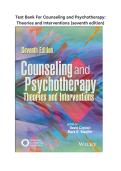
Test Bank For Counseling and Psychotherapy:
Theories and Interventions (seventh edition)
,Part 1: Foundations for Individual Counseling and
Psychotherapy
● Chapter 1: Helping Relationships and Theoretical Foundations for
Counseling and Psychotherapy
● Chapter 2: Multicultural and Social Justice Counseling Through
Relational-Cultural Theory
Part 2: Theories of Counseling and Psychotherapy
● Chapter 3: Psychodynamic Theories: Psychoanalysis and Beyond
● Chapter 4: Jungian Analytical Theory
● Chapter 5: Adlerian Theory
● Chapter 6: Existential Theory
● Chapter 7: Person-Centered Theory
● Chapter 8: Gestalt Theory
● Chapter 9: Cognitive Behavioral Theories
● Chapter 10: Third-Wave Cognitive Behavioral Theories With
Mindfulness-Based Interventions
● Chapter 11: Rational Emotive Behavior Therapy
● Chapter 12: Reality Therapy/Choice Theory
● Chapter 13: Family Theory
● Chapter 14: Feminist Theory
● Chapter 15: Constructivist Theories: Solution-Focused and Narrative
Therapies
● Chapter 16: Integrating Theories: Emotion-Focused Therapy
● Chapter 17: Using Creative Approaches in the Context of Counseling
and Psychotherapy
,Chapter 1: Helping Relationships and Theoretical Foundations for
Counseling and Psychotherapy
1. A counselor-in-training is conducting an initial intake. According to the developmental
stages of the helping relationship, which task is most appropriate for Stage 1: Relationship
Development?
A. Exploring the emotional and cognitive dynamics of the client in depth.
B. Facilitating the trial of new behaviors inside and outside of sessions.
C. Informing the client about conditions such as confidentiality and roles.
D. Reevaluating previously determined goals based on clinical insights.
Correct Answer: C
Rationale: Stage 1 focuses on the initial meeting, rapport building, and providing the
client with necessary information regarding the conditions of counseling, such as
confidentiality and the respective roles of the counselor and client.
2. During a session, a client describes a traumatic event with a flat affect. The counselor
responds by identifying a feeling that is "buried" or "hidden" beneath the surface of the
client's disclosure. This is an example of which level of empathy?
A. Primary empathic understanding
B. Advanced empathic understanding
C. Respect and positive regard
D. Cultural humility
Correct Answer: B
Rationale: Advanced empathic understanding involves the counselor's ability to
identify and communicate feelings and meanings that are buried or beyond the
client's immediate reach, often addressing covert expressions rather than overt
ones.
3. Which of the following best describes the "Zero-Inference Rule" in the context of
establishing a helping relationship as defined by Rogers?
A. The counselor must never infer the client's cultural background.
B. The intent of promoting growth, development, and improved coping.
, C. The assumption that the counselor is the expert in the relationship.
D. The requirement to use only evidence-based manualized treatments.
Correct Answer: B
Rationale: Rogers defined the helping relationship as one where at least one party
intends to promote the growth, maturity, and improved functioning of the other
person.
4. A counselor is working with a client who presents a distorted and incomplete view of a
situation. The counselor uses their ability to identify figures and structures that complete
the "picture" to help the client see the situation more realistically. This core condition is
known as:
A. Genuineness
B. Concreteness
C. Immediacy
D. Warmth
Correct Answer: B
Rationale: Concreteness is the ability to help clients clarify vague issues, identify
distortions, and reduce ambiguity so they can view their situation in a more realistic
and productive fashion.
5. A counselor realizes they are feeling frustrated with a client's repetitive stories. Instead
of ignoring the feeling, the counselor addresses the "here-and-now" interaction within the
session to gain insight into the relationship. This intervention is known as:
A. Advanced empathy
B. Confrontation
C. Immediacy
D. Self-disclosure
Correct Answer: C
Rationale: Immediacy is the ability to deal with overt and covert factors operating
within the helping relationship as they occur, which helps participants gain insight
into their behavioral patterns.
Theories and Interventions (seventh edition)
,Part 1: Foundations for Individual Counseling and
Psychotherapy
● Chapter 1: Helping Relationships and Theoretical Foundations for
Counseling and Psychotherapy
● Chapter 2: Multicultural and Social Justice Counseling Through
Relational-Cultural Theory
Part 2: Theories of Counseling and Psychotherapy
● Chapter 3: Psychodynamic Theories: Psychoanalysis and Beyond
● Chapter 4: Jungian Analytical Theory
● Chapter 5: Adlerian Theory
● Chapter 6: Existential Theory
● Chapter 7: Person-Centered Theory
● Chapter 8: Gestalt Theory
● Chapter 9: Cognitive Behavioral Theories
● Chapter 10: Third-Wave Cognitive Behavioral Theories With
Mindfulness-Based Interventions
● Chapter 11: Rational Emotive Behavior Therapy
● Chapter 12: Reality Therapy/Choice Theory
● Chapter 13: Family Theory
● Chapter 14: Feminist Theory
● Chapter 15: Constructivist Theories: Solution-Focused and Narrative
Therapies
● Chapter 16: Integrating Theories: Emotion-Focused Therapy
● Chapter 17: Using Creative Approaches in the Context of Counseling
and Psychotherapy
,Chapter 1: Helping Relationships and Theoretical Foundations for
Counseling and Psychotherapy
1. A counselor-in-training is conducting an initial intake. According to the developmental
stages of the helping relationship, which task is most appropriate for Stage 1: Relationship
Development?
A. Exploring the emotional and cognitive dynamics of the client in depth.
B. Facilitating the trial of new behaviors inside and outside of sessions.
C. Informing the client about conditions such as confidentiality and roles.
D. Reevaluating previously determined goals based on clinical insights.
Correct Answer: C
Rationale: Stage 1 focuses on the initial meeting, rapport building, and providing the
client with necessary information regarding the conditions of counseling, such as
confidentiality and the respective roles of the counselor and client.
2. During a session, a client describes a traumatic event with a flat affect. The counselor
responds by identifying a feeling that is "buried" or "hidden" beneath the surface of the
client's disclosure. This is an example of which level of empathy?
A. Primary empathic understanding
B. Advanced empathic understanding
C. Respect and positive regard
D. Cultural humility
Correct Answer: B
Rationale: Advanced empathic understanding involves the counselor's ability to
identify and communicate feelings and meanings that are buried or beyond the
client's immediate reach, often addressing covert expressions rather than overt
ones.
3. Which of the following best describes the "Zero-Inference Rule" in the context of
establishing a helping relationship as defined by Rogers?
A. The counselor must never infer the client's cultural background.
B. The intent of promoting growth, development, and improved coping.
, C. The assumption that the counselor is the expert in the relationship.
D. The requirement to use only evidence-based manualized treatments.
Correct Answer: B
Rationale: Rogers defined the helping relationship as one where at least one party
intends to promote the growth, maturity, and improved functioning of the other
person.
4. A counselor is working with a client who presents a distorted and incomplete view of a
situation. The counselor uses their ability to identify figures and structures that complete
the "picture" to help the client see the situation more realistically. This core condition is
known as:
A. Genuineness
B. Concreteness
C. Immediacy
D. Warmth
Correct Answer: B
Rationale: Concreteness is the ability to help clients clarify vague issues, identify
distortions, and reduce ambiguity so they can view their situation in a more realistic
and productive fashion.
5. A counselor realizes they are feeling frustrated with a client's repetitive stories. Instead
of ignoring the feeling, the counselor addresses the "here-and-now" interaction within the
session to gain insight into the relationship. This intervention is known as:
A. Advanced empathy
B. Confrontation
C. Immediacy
D. Self-disclosure
Correct Answer: C
Rationale: Immediacy is the ability to deal with overt and covert factors operating
within the helping relationship as they occur, which helps participants gain insight
into their behavioral patterns.


