

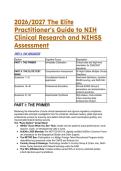
2026/2027 The Elite
Practitioner's Guide to NIH
Clinical Research and NIHSS
Assessment
PART 0: THE NAVIGATOR
Section Cognitive Focus Description
PART I: THE PRIMER Immediate Calibration Critical rules and high-level
orientation for 2026/2027
standards.
PART II: THE ELITE TEST Comprehensive Assessment 55 High-Caliber Multiple Choice
BANK Questions.
Questions 1–15 Foundational Syntax & Hard-deck definitions, baseline
Application NIHSS scoring, and 2026 NIH
policy.
Questions 16–40 Professional Simulation Clinical NIHSS Group E
parameters and administrative
protocol scenarios.
Questions 41–55 Grandmaster Synthesis High-stakes, multi-variable
crises requiring deep
professional intuition.
PART I: THE PRIMER
Mastering the intersection of acute clinical assessment and rigorous regulatory compliance
separates elite principal investigators from the untrained. Absolute mastery yields high-level
professional success by ensuring zero-defect clinical trials, exact neurological grading, and
impenetrable federal funding security.
The "Panic Button" Cheat Sheet:
● NIHSS "Score What You See" Rule: Grade only the patient's actual performance; never
assume, coach, or retrospectively alter a score.
● SciENcv 2026 Mandate: Per NOT-OD-26-018, digitally certified SciENcv Common Forms
are mandatory for the Biographical Sketch and Other Support.
● The MFTRP Ban: Participation in a Malign Foreign Talent Recruitment Program strictly
disqualifies key personnel under the CHIPS and Science Act.
● Country Group E Embargo: Technology transfer to Country Group E (Cuba, Iran, North
Korea, Syria) demands strict federal licensing under the EAR.
● The 50% Affiliates Rule: Unlisted entities owned 50% or more by restricted parties
inherit identical export prohibitions.
,PART II: THE ELITE TEST BANK
Q1: A practitioner assesses a sedated, intubated patient. Noxious stimulation elicits only
reflexive posturing. Under NIHSS Item 1a (Level of Consciousness) guidelines, what is
the correct score? A) 1 B) 2 C) 3 D) UN
● The Answer: C. 3
● Distractor Analysis: Option A applies to arousable patients. Option B requires
non-stereotyped, purposeful movement to pain. Option D is an amateur error; Item 1a is
never untestable.
● The Mentor's Analysis: Item 1a mandates a numerical score regardless of physical
barriers. A score of 3 is reserved for patients exhibiting solely reflex motor effects or total
unresponsiveness. The clinical differentiator is purposeful withdrawal versus reflexive
posturing. Precision here anchors the entire scale and dictates downstream thrombolytic
eligibility.
Q2: During NIHSS Item 1b (LOC Questions), the patient is asked their age and the current
month. The patient is globally aphasic and cannot comprehend the questions. What is
the designated score? A) 0 B) 1 C) 2 D) UN
● The Answer: C. 2
● Distractor Analysis: Option A requires two correct answers. Option B is for one correct
answer, or patients impeded by intubation/trauma. Option D is invalid for this item.
● The Mentor's Analysis: The scoring rubric explicitly dictates that aphasic and stuporous
patients who cannot comprehend the questions automatically receive a score of 2.
Professional execution relies on standardizing the penalty for severe cognitive or
language deficits to maintain inter-rater reliability across multicenter trials.
Q3: Effective January 25, 2026, the NIH implemented NOT-OD-26-018. Which platform is
strictly mandated to generate the Biographical Sketch Common Form and
Current/Pending Support? A) eRA Commons B) Grants.gov Workspace C) SciENcv D) Local
Institutional ERP
● The Answer: C. SciENcv
● Distractor Analysis: Option A is where ORCID iDs are linked, not where forms are built.
Options B and D are legacy routing methods incapable of producing the newly required
digitally certified PDFs.
● The Mentor's Analysis: The 2026 policy shift enforces standardized federal
transparency. Practitioners must recognize SciENcv is the exclusive platform for
generating, certifying, and exporting these common forms. Failure to utilize SciENcv
results in automated eRA system errors.
Q4: When testing NIHSS Item 5 (Motor Arm), the practitioner positions the patient’s
paretic arm at 90 degrees. The arm drifts down immediately and hits the bed, but the
patient exhibits clear effort against gravity. What is the correct score? A) 1 B) 2 C) 3 D) 4
● The Answer: B. 2
● Distractor Analysis: Option A implies the arm drifts but does not hit the bed within 10
seconds. Option C indicates the arm falls immediately with zero effort against gravity.
Option D is complete paralysis.
● The Mentor's Analysis: A score of 2 specifically denotes that the limb cannot maintain
the angle, hits the bed, but the patient still demonstrates some effort against gravity.
Precision in observing the struggle against gravity prevents over-scoring deficits and
, accurately categorizes upper motor neuron impairment.
Q5: Under EAR export control regulations, which of the following nations is classified as
a Country Group E destination, prohibiting standard technology transfers without a
specific license? A) China B) Russia C) Syria D) Venezuela
● The Answer: C. Syria
● Distractor Analysis: Options A, B, and D are heavily sanctioned or restricted under other
lists (e.g., D:5, OFAC), but Country Group E specifically targets state sponsors of
terrorism and comprehensive embargoes.
● The Mentor's Analysis: Country Group E represents the absolute hardline of U.S. export
controls. Clinical researchers sharing dual-use technology, data, or software with
nationals from Group E countries trigger severe federal penalties. Strict compliance
requires immediate legal partitioning of any foreign collaborations involving these states.
Q6: For a patient with a baseline amputation of the right leg at the knee, how must the
practitioner score NIHSS Item 6b (Motor Leg Right)? A) 0 B) 4 C) UN D) Score based on the
left leg
● The Answer: C. UN
● Distractor Analysis: Option A assumes normal function, which cannot be tested. Option
B penalizes the patient for a non-stroke-related deficit. Option D violates the independent
testing protocol for bilateral limbs.
● The Mentor's Analysis: "UN" (Untestable) is strictly reserved for amputations or joint
fusions that make the physical execution of the test impossible. This prevents legacy
physical disabilities from falsely inflating the acute stroke severity index.
Q7: In the 2026 SciENcv NIH Biographical Sketch Supplement, what is the strict character
limit for the Personal Statement, and can citations be included in the text? A) 2,000
characters; Citations allowed B) 3,500 characters; No citations allowed C) 5,000 characters;
Citations allowed D) No limit; No citations allowed
● The Answer: B. 3,500 characters; No citations allowed
● Distractor Analysis: Option A describes the limit for Contributions to Science. Options C
and D are fictitious limits. Citations are now strictly relegated to the "Products" section of
the Common Form.
● The Mentor's Analysis: Elite grant writing in 2026 requires understanding the exact
architecture of the SciENcv output. The Personal Statement is capped at 3,500
characters and strips out inline citations to force clarity and rely on the new centralized
Products linkage.
SciENcv 2026 Section Character/Entry Limits Citation Rules
Personal Statement 3,500 characters No citations allowed
Honors 15 entries N/A
Contributions to Science 5 entries, 2,000 chars each No citations allowed
Products 10 entries total Only standardized links
Q8: NIHSS Item 11 evaluates Extinction and Inattention. If a patient has severe bilateral
visual loss but demonstrates normal cutaneous (tactile) responses to bilateral
simultaneous stimulation, what is the score? A) 0 B) 1 C) 2 D) UN
● The Answer: A. 0
● Distractor Analysis: Option B implies an extinction is present. Option C implies profound
hemi-inattention. Option D is incorrect because tactile testing is intact and scorable.
● The Mentor's Analysis: The protocol is explicit: if the patient has a severe visual loss but
normal cutaneous responses, the score is 0. Inattention is only scored if an asymmetry in
Practitioner's Guide to NIH
Clinical Research and NIHSS
Assessment
PART 0: THE NAVIGATOR
Section Cognitive Focus Description
PART I: THE PRIMER Immediate Calibration Critical rules and high-level
orientation for 2026/2027
standards.
PART II: THE ELITE TEST Comprehensive Assessment 55 High-Caliber Multiple Choice
BANK Questions.
Questions 1–15 Foundational Syntax & Hard-deck definitions, baseline
Application NIHSS scoring, and 2026 NIH
policy.
Questions 16–40 Professional Simulation Clinical NIHSS Group E
parameters and administrative
protocol scenarios.
Questions 41–55 Grandmaster Synthesis High-stakes, multi-variable
crises requiring deep
professional intuition.
PART I: THE PRIMER
Mastering the intersection of acute clinical assessment and rigorous regulatory compliance
separates elite principal investigators from the untrained. Absolute mastery yields high-level
professional success by ensuring zero-defect clinical trials, exact neurological grading, and
impenetrable federal funding security.
The "Panic Button" Cheat Sheet:
● NIHSS "Score What You See" Rule: Grade only the patient's actual performance; never
assume, coach, or retrospectively alter a score.
● SciENcv 2026 Mandate: Per NOT-OD-26-018, digitally certified SciENcv Common Forms
are mandatory for the Biographical Sketch and Other Support.
● The MFTRP Ban: Participation in a Malign Foreign Talent Recruitment Program strictly
disqualifies key personnel under the CHIPS and Science Act.
● Country Group E Embargo: Technology transfer to Country Group E (Cuba, Iran, North
Korea, Syria) demands strict federal licensing under the EAR.
● The 50% Affiliates Rule: Unlisted entities owned 50% or more by restricted parties
inherit identical export prohibitions.
,PART II: THE ELITE TEST BANK
Q1: A practitioner assesses a sedated, intubated patient. Noxious stimulation elicits only
reflexive posturing. Under NIHSS Item 1a (Level of Consciousness) guidelines, what is
the correct score? A) 1 B) 2 C) 3 D) UN
● The Answer: C. 3
● Distractor Analysis: Option A applies to arousable patients. Option B requires
non-stereotyped, purposeful movement to pain. Option D is an amateur error; Item 1a is
never untestable.
● The Mentor's Analysis: Item 1a mandates a numerical score regardless of physical
barriers. A score of 3 is reserved for patients exhibiting solely reflex motor effects or total
unresponsiveness. The clinical differentiator is purposeful withdrawal versus reflexive
posturing. Precision here anchors the entire scale and dictates downstream thrombolytic
eligibility.
Q2: During NIHSS Item 1b (LOC Questions), the patient is asked their age and the current
month. The patient is globally aphasic and cannot comprehend the questions. What is
the designated score? A) 0 B) 1 C) 2 D) UN
● The Answer: C. 2
● Distractor Analysis: Option A requires two correct answers. Option B is for one correct
answer, or patients impeded by intubation/trauma. Option D is invalid for this item.
● The Mentor's Analysis: The scoring rubric explicitly dictates that aphasic and stuporous
patients who cannot comprehend the questions automatically receive a score of 2.
Professional execution relies on standardizing the penalty for severe cognitive or
language deficits to maintain inter-rater reliability across multicenter trials.
Q3: Effective January 25, 2026, the NIH implemented NOT-OD-26-018. Which platform is
strictly mandated to generate the Biographical Sketch Common Form and
Current/Pending Support? A) eRA Commons B) Grants.gov Workspace C) SciENcv D) Local
Institutional ERP
● The Answer: C. SciENcv
● Distractor Analysis: Option A is where ORCID iDs are linked, not where forms are built.
Options B and D are legacy routing methods incapable of producing the newly required
digitally certified PDFs.
● The Mentor's Analysis: The 2026 policy shift enforces standardized federal
transparency. Practitioners must recognize SciENcv is the exclusive platform for
generating, certifying, and exporting these common forms. Failure to utilize SciENcv
results in automated eRA system errors.
Q4: When testing NIHSS Item 5 (Motor Arm), the practitioner positions the patient’s
paretic arm at 90 degrees. The arm drifts down immediately and hits the bed, but the
patient exhibits clear effort against gravity. What is the correct score? A) 1 B) 2 C) 3 D) 4
● The Answer: B. 2
● Distractor Analysis: Option A implies the arm drifts but does not hit the bed within 10
seconds. Option C indicates the arm falls immediately with zero effort against gravity.
Option D is complete paralysis.
● The Mentor's Analysis: A score of 2 specifically denotes that the limb cannot maintain
the angle, hits the bed, but the patient still demonstrates some effort against gravity.
Precision in observing the struggle against gravity prevents over-scoring deficits and
, accurately categorizes upper motor neuron impairment.
Q5: Under EAR export control regulations, which of the following nations is classified as
a Country Group E destination, prohibiting standard technology transfers without a
specific license? A) China B) Russia C) Syria D) Venezuela
● The Answer: C. Syria
● Distractor Analysis: Options A, B, and D are heavily sanctioned or restricted under other
lists (e.g., D:5, OFAC), but Country Group E specifically targets state sponsors of
terrorism and comprehensive embargoes.
● The Mentor's Analysis: Country Group E represents the absolute hardline of U.S. export
controls. Clinical researchers sharing dual-use technology, data, or software with
nationals from Group E countries trigger severe federal penalties. Strict compliance
requires immediate legal partitioning of any foreign collaborations involving these states.
Q6: For a patient with a baseline amputation of the right leg at the knee, how must the
practitioner score NIHSS Item 6b (Motor Leg Right)? A) 0 B) 4 C) UN D) Score based on the
left leg
● The Answer: C. UN
● Distractor Analysis: Option A assumes normal function, which cannot be tested. Option
B penalizes the patient for a non-stroke-related deficit. Option D violates the independent
testing protocol for bilateral limbs.
● The Mentor's Analysis: "UN" (Untestable) is strictly reserved for amputations or joint
fusions that make the physical execution of the test impossible. This prevents legacy
physical disabilities from falsely inflating the acute stroke severity index.
Q7: In the 2026 SciENcv NIH Biographical Sketch Supplement, what is the strict character
limit for the Personal Statement, and can citations be included in the text? A) 2,000
characters; Citations allowed B) 3,500 characters; No citations allowed C) 5,000 characters;
Citations allowed D) No limit; No citations allowed
● The Answer: B. 3,500 characters; No citations allowed
● Distractor Analysis: Option A describes the limit for Contributions to Science. Options C
and D are fictitious limits. Citations are now strictly relegated to the "Products" section of
the Common Form.
● The Mentor's Analysis: Elite grant writing in 2026 requires understanding the exact
architecture of the SciENcv output. The Personal Statement is capped at 3,500
characters and strips out inline citations to force clarity and rely on the new centralized
Products linkage.
SciENcv 2026 Section Character/Entry Limits Citation Rules
Personal Statement 3,500 characters No citations allowed
Honors 15 entries N/A
Contributions to Science 5 entries, 2,000 chars each No citations allowed
Products 10 entries total Only standardized links
Q8: NIHSS Item 11 evaluates Extinction and Inattention. If a patient has severe bilateral
visual loss but demonstrates normal cutaneous (tactile) responses to bilateral
simultaneous stimulation, what is the score? A) 0 B) 1 C) 2 D) UN
● The Answer: A. 0
● Distractor Analysis: Option B implies an extinction is present. Option C implies profound
hemi-inattention. Option D is incorrect because tactile testing is intact and scorable.
● The Mentor's Analysis: The protocol is explicit: if the patient has a severe visual loss but
normal cutaneous responses, the score is 0. Inattention is only scored if an asymmetry in


