

tals of Engineering Prep with Math, Statics, Dynamics
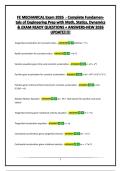
Tangential acceleration for constant radius - ANSWER a(theta) = r*a
Radial acceleration for constant radius - ANSWER -r*w^2
Velocity equation given time and constant acceleration - ANSWER v= v0 + a*t
Position give acceleration for constant acceleration - ANSWER s=s0 + v0*t +0.5*a *t^2
Position given initial and final velocity for constant acceleration - ANSWER s=s0 +
0.5(v0 + v)t
Relative Motion Equation - ANSWER Va = Vb + Va/b (works for position and accle-
ration)
Tangential velocity given rotational velocity equation - ANSWER Vt = r*w
Tangential acceleration equation - ANSWER a = rα
Centripetal acceleration given tangential velocity - ANSWER An = Vt / r
Centripetal acceleration given rotational velocity - ANSWER an = -r*w^2
1
,Work Equation - ANSWER work = force x distance
Kinetic energy equation for linear motion - ANSWER KE=1/2mv^2
Kinetic energy equation for rotational motion - ANSWER KE = 0.5*I*w^2
Potential energy formula due to gravity - ANSWER PE=mgh=W*y
Potential Energy in Linear Springs - ANSWER PE = 0.5*k*x^2
Potential Energy in Rotation Springs - ANSWER PE = 0.5 * k * (theta)^2
Kinetic Energy for Particles - ANSWER T = 0.5*m*v^2
Kinetic Energy for Rigid Bodies - ANSWER T = 0.5*m*v^2 + 0.5*I*w^2
Elastic potential energy equation - ANSWER U = 1/2 k x^2
Change in Potential Energy when Spring Length Changes - ANSWER V2 - V1 = k(s2^2 -
s1^2)/2
Work - ANSWER U = F*change in distance
Power equation - ANSWER U = power = work/time
Voltage equation - ANSWER V=IR
2
, Resistors/Springs in Series - ANSWER Add together
Resistors/Springs in Parallel - ANSWER Add inverses together
Specific volume equation - ANSWER v = 1/density
Specific Weight Equation - ANSWER y = density*gravity
Specific gravity (SG) for liquids - ANSWER SG = density of substance/density of water
Specific gravity for gas - ANSWER SG = density of gas / density of air at STP
Newtonian fluid - ANSWER Fluids for which the rate of deformation is linearly propor-
tional to the shear stress. Aka constant viscosity
Non-Newtonian Fluid - ANSWER A form of matter that will turn into a solid when pres-
sure is exerted on it, and will turn into a liquid when little or no pressure is exerted on it.
Surface Tension equation - ANSWER Sigma = F/L
Capillary rise equation - ANSWER h = 4*Sigma*cos(beta)/gamma*d =
4*Sigma*cos(beta)/density*gravity*d
Cohesion - ANSWER Attraction between molecules of the same substance
Adhesion - ANSWER An attraction between molecules of different substances
3
Tangential acceleration for constant radius - ANSWER a(theta) = r*a
Radial acceleration for constant radius - ANSWER -r*w^2
Velocity equation given time and constant acceleration - ANSWER v= v0 + a*t
Position give acceleration for constant acceleration - ANSWER s=s0 + v0*t +0.5*a *t^2
Position given initial and final velocity for constant acceleration - ANSWER s=s0 +
0.5(v0 + v)t
Relative Motion Equation - ANSWER Va = Vb + Va/b (works for position and accle-
ration)
Tangential velocity given rotational velocity equation - ANSWER Vt = r*w
Tangential acceleration equation - ANSWER a = rα
Centripetal acceleration given tangential velocity - ANSWER An = Vt / r
Centripetal acceleration given rotational velocity - ANSWER an = -r*w^2
1
,Work Equation - ANSWER work = force x distance
Kinetic energy equation for linear motion - ANSWER KE=1/2mv^2
Kinetic energy equation for rotational motion - ANSWER KE = 0.5*I*w^2
Potential energy formula due to gravity - ANSWER PE=mgh=W*y
Potential Energy in Linear Springs - ANSWER PE = 0.5*k*x^2
Potential Energy in Rotation Springs - ANSWER PE = 0.5 * k * (theta)^2
Kinetic Energy for Particles - ANSWER T = 0.5*m*v^2
Kinetic Energy for Rigid Bodies - ANSWER T = 0.5*m*v^2 + 0.5*I*w^2
Elastic potential energy equation - ANSWER U = 1/2 k x^2
Change in Potential Energy when Spring Length Changes - ANSWER V2 - V1 = k(s2^2 -
s1^2)/2
Work - ANSWER U = F*change in distance
Power equation - ANSWER U = power = work/time
Voltage equation - ANSWER V=IR
2
, Resistors/Springs in Series - ANSWER Add together
Resistors/Springs in Parallel - ANSWER Add inverses together
Specific volume equation - ANSWER v = 1/density
Specific Weight Equation - ANSWER y = density*gravity
Specific gravity (SG) for liquids - ANSWER SG = density of substance/density of water
Specific gravity for gas - ANSWER SG = density of gas / density of air at STP
Newtonian fluid - ANSWER Fluids for which the rate of deformation is linearly propor-
tional to the shear stress. Aka constant viscosity
Non-Newtonian Fluid - ANSWER A form of matter that will turn into a solid when pres-
sure is exerted on it, and will turn into a liquid when little or no pressure is exerted on it.
Surface Tension equation - ANSWER Sigma = F/L
Capillary rise equation - ANSWER h = 4*Sigma*cos(beta)/gamma*d =
4*Sigma*cos(beta)/density*gravity*d
Cohesion - ANSWER Attraction between molecules of the same substance
Adhesion - ANSWER An attraction between molecules of different substances
3


