

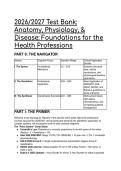
2026/2027 Test Bank:
Anatomy, Physiology, &
Disease: Foundations for the
Health Professions
PART 0: THE NAVIGATOR
Section Cognitive Focus Question Range Clinical Application
Domain
I. The Syntax Foundational Q1 – Q15 Systemic structural
Mechanics laws, cellular
mechanisms, and
physiological baseline
parameters.
II. The Simulation Professional Q16 – Q40 Direct application of
Application 2026/2027 AHA,
GOLD, KDIGO, and
Sepsis-3 guidelines to
acute scenarios.
III. The Synthesis Grandmaster Scenarios Q41 – Q55 Multi-system failure,
high-stakes
hemodynamics, and
competing guideline
management.
PART I: THE PRIMER
Welcome to the big leagues. Mastery of this specific niche yields high-level professional
success because the 2026/2027 clinical landscape demands the algorithmic application of
complex systems, not the passive recall of static textbook diagrams.
The "Panic Button" Cheat Sheet:
● Poiseuille’s Law: Resistance is inversely proportional to the 4th power of the radius
(Radius ÷ 2 = Resistance × 16).
● AHA 2026 PREVENT: Stage 1 HTN (130-139/80-89) + 10-year risk ≥ 7.5% = Immediate
pharmacotherapy.
● GOLD 2026 Group E: A single moderate/severe exacerbation triggers Group E
classification.
● KDIGO 2026 Anemia: Initiate proactive IV iron in HD unless Ferritin > 700 ng/mL or
TSAT ≥ 40%.
● Sepsis-3 (2025 Update): 1-Hour Bundle for shock; 3-Hour Bundle for stable suspected
, sepsis. Fluid bolus is 250mL incrementally.
PART II: THE ELITE TEST BANK
Q1: A patient in the intensive care unit presents with profound hypocalcemia. Based on
the sliding filament theory of the muscular system, what is the immediate biomechanical
consequence at the sarcomere level? A) The myosin heads permanently detach from the
actin filaments, causing flaccid paralysis. B) Tropomyosin remains in its blocking position over
the actin binding sites, preventing cross-bridge formation. C) The Z-lines rapidly contract
independent of ATP hydrolysis. D) The sarcoplasmic reticulum actively releases unchecked
sodium ions into the cytosol.
● The Answer: B (Tropomyosin remains in its blocking position over the actin binding sites,
preventing cross-bridge formation)
● Distractor Analysis: Option A describes ATP depletion (rigor mortis), not calcium
deficiency. Option C is a mechanical impossibility within muscular physics. Option D
conflates action potential propagation with the terminal mechanical trigger.
● The Mentor's Analysis: Calcium is the mechanical key to the muscular engine. Without
it, troponin cannot shift tropomyosin out of the way. If the actin binding sites are shielded,
the myosin heads have nothing to grab. Severe hypocalcemia paralyzes the diaphragm
not because the brain isn't sending the signal, but because the hardware is locked at the
cellular level.
Q2: During a routine assessment of the integumentary system in a severe burn victim,
the clinician notes massive systemic edema. Which foundational physiological principle
has failed? A) Loss of epidermal keratin has caused profound insensible water loss. B)
Sebaceous gland destruction has triggered unregulated renin release. C) Capillary permeability
has increased, causing intravascular proteins to leak into the interstitial space. D) The
dermal-epidermal junction has solidified, trapping extracellular fluid.
● The Answer: C (Capillary permeability has increased, causing intravascular proteins to
leak into the interstitial space)
● Distractor Analysis: Option A explains dehydration, not edema. Option B is a fabricated
physiological link. Option D is physically inaccurate and inverse to burn pathophysiology.
● The Mentor's Analysis: Edema in burn shock is a catastrophic failure of oncotic
pressure. When the inflammatory cytokine storm hits, endothelial gaps widen. Albumin,
the primary protein holding water in the vascular container, leaks out. Water follows the
albumin into the tissue. You are treating a profound loss of vascular integrity, not merely
an external skin wound.
Q3: A 70-year-old female presents with a distal radial fragility fracture. Her DEXA scan
T-score is -1.5 (Osteopenia). Why must the clinician classify this as severe osteoporotic
failure regardless of the scan? A) The T-score is inaccurate in the upper extremities. B)
Osteoarthritis fundamentally alters the mineralization of the radius. C) A fragility fracture proves
the biomechanical architecture has already failed under normal gravitational load. D) Synovial
fluid leakage disrupts the radiologic density calculation.
● The Answer: C (A fragility fracture proves the biomechanical architecture has already
failed under normal gravitational load)
● Distractor Analysis: Option A is a dangerous clinical myth. Option B confuses "wear and
tear" of joints (arthritis) with bone porosity. Option D is anatomical nonsense.
● The Mentor's Analysis: A T-score is a static, two-dimensional proxy for bone strength. If
, a bone shatters under the simple mechanical load of gravity, the architecture has failed.
The clinical event—the fragility fracture—permanently supersedes the diagnostic imaging,
elevating the diagnosis and mandating immediate pharmacological intervention.
Q4: In the context of the nervous system, a demyelinating disease fundamentally alters
the propagation of action potentials. What is the precise electrophysiological failure? A)
The absolute refractory period is permanently extended. B) Saltatory conduction fails, causing
the electrical signal to dissipate through the axonal membrane. C) Sodium-potassium pumps
reverse their concentration gradient. D) Neurotransmitters are enzymatically degraded before
crossing the synaptic cleft.
● The Answer: B (Saltatory conduction fails, causing the electrical signal to dissipate
through the axonal membrane)
● Distractor Analysis: Option A is false; demyelination does not alter the refractory period
itself. Option C violates the laws of thermodynamics. Option D describes a synaptic
failure, not an axonal transmission failure.
● The Mentor's Analysis: Myelin acts as biological electrical insulation. Without it, the
action potential cannot jump from node to node (saltatory conduction). The signal leaks
out like water through a perforated hose, resulting in delayed or absent downstream
muscular contraction. This is the physiological absolute governing multiple sclerosis.
Q5: A patient with chronic obstructive pulmonary disease (COPD) chronically retains
CO2. How does the renal system attempt to re-establish physiological homeostasis? A)
By increasing the glomerular filtration rate to excrete volatile acids. B) By retaining bicarbonate
(HCO3-) and excreting hydrogen ions (H+). C) By producing excess erythropoietin to bind free
hydrogen. D) By shifting potassium extracellularly to buffer the plasma.
● The Answer: B (By retaining bicarbonate (HCO3-) and excreting hydrogen ions (H+))
● Distractor Analysis: Option A is false; lungs excrete volatile acids (CO2), kidneys
excrete fixed acids. Option C is a response to hypoxia, not acidosis. Option D causes
hyperkalemia but is not the primary renal compensatory mechanism.
● The Mentor's Analysis: This is classic metabolic compensation for respiratory acidosis.
The lungs have failed their ventilation mechanics, so the kidneys must act as the chemical
buffer reserve, holding onto base (bicarbonate) to neutralize the acidic blood.
Understanding this interplay is essential for analyzing arterial blood gases.
Q6: According to the "Cell-Based Hemostasis" model of 2026, which physiological event
characterizes the "Propagation" phase? A) The initial binding of Factor VIIa to Tissue Factor.
B) The localized generation of a trace amount of thrombin. C) The massive "Thrombin Burst"
generated by the Prothrombinase complex on the activated platelet surface. D) The dissolution
of the fibrin mesh by plasminogen.
● The Answer: C (The massive "Thrombin Burst" generated by the Prothrombinase
complex on the activated platelet surface)
● Distractor Analysis: Option A and B describe the "Initiation" phase. Option D describes
fibrinolysis, which occurs after hemostasis.
● The Mentor's Analysis: The traditional coagulation cascade is obsolete. In cell-based
hemostasis, the actual explosion of clotting (the thrombin burst) happens directly on the
surface of the activated platelet. This is why platelet-inhibiting drugs are so lethal to clot
integrity; you are removing the physical stage upon which the coagulation factors perform.
Q7: Utilizing the Wiggers Diagram, what specific hemodynamic state defines
"Isovolumetric Contraction" of the left ventricle? A) The mitral valve is open, and aortic
pressure is peaking. B) Both the mitral and aortic valves are closed, and ventricular pressure is
rapidly spiking while volume remains static. C) The aortic valve opens, and ventricular volume
Anatomy, Physiology, &
Disease: Foundations for the
Health Professions
PART 0: THE NAVIGATOR
Section Cognitive Focus Question Range Clinical Application
Domain
I. The Syntax Foundational Q1 – Q15 Systemic structural
Mechanics laws, cellular
mechanisms, and
physiological baseline
parameters.
II. The Simulation Professional Q16 – Q40 Direct application of
Application 2026/2027 AHA,
GOLD, KDIGO, and
Sepsis-3 guidelines to
acute scenarios.
III. The Synthesis Grandmaster Scenarios Q41 – Q55 Multi-system failure,
high-stakes
hemodynamics, and
competing guideline
management.
PART I: THE PRIMER
Welcome to the big leagues. Mastery of this specific niche yields high-level professional
success because the 2026/2027 clinical landscape demands the algorithmic application of
complex systems, not the passive recall of static textbook diagrams.
The "Panic Button" Cheat Sheet:
● Poiseuille’s Law: Resistance is inversely proportional to the 4th power of the radius
(Radius ÷ 2 = Resistance × 16).
● AHA 2026 PREVENT: Stage 1 HTN (130-139/80-89) + 10-year risk ≥ 7.5% = Immediate
pharmacotherapy.
● GOLD 2026 Group E: A single moderate/severe exacerbation triggers Group E
classification.
● KDIGO 2026 Anemia: Initiate proactive IV iron in HD unless Ferritin > 700 ng/mL or
TSAT ≥ 40%.
● Sepsis-3 (2025 Update): 1-Hour Bundle for shock; 3-Hour Bundle for stable suspected
, sepsis. Fluid bolus is 250mL incrementally.
PART II: THE ELITE TEST BANK
Q1: A patient in the intensive care unit presents with profound hypocalcemia. Based on
the sliding filament theory of the muscular system, what is the immediate biomechanical
consequence at the sarcomere level? A) The myosin heads permanently detach from the
actin filaments, causing flaccid paralysis. B) Tropomyosin remains in its blocking position over
the actin binding sites, preventing cross-bridge formation. C) The Z-lines rapidly contract
independent of ATP hydrolysis. D) The sarcoplasmic reticulum actively releases unchecked
sodium ions into the cytosol.
● The Answer: B (Tropomyosin remains in its blocking position over the actin binding sites,
preventing cross-bridge formation)
● Distractor Analysis: Option A describes ATP depletion (rigor mortis), not calcium
deficiency. Option C is a mechanical impossibility within muscular physics. Option D
conflates action potential propagation with the terminal mechanical trigger.
● The Mentor's Analysis: Calcium is the mechanical key to the muscular engine. Without
it, troponin cannot shift tropomyosin out of the way. If the actin binding sites are shielded,
the myosin heads have nothing to grab. Severe hypocalcemia paralyzes the diaphragm
not because the brain isn't sending the signal, but because the hardware is locked at the
cellular level.
Q2: During a routine assessment of the integumentary system in a severe burn victim,
the clinician notes massive systemic edema. Which foundational physiological principle
has failed? A) Loss of epidermal keratin has caused profound insensible water loss. B)
Sebaceous gland destruction has triggered unregulated renin release. C) Capillary permeability
has increased, causing intravascular proteins to leak into the interstitial space. D) The
dermal-epidermal junction has solidified, trapping extracellular fluid.
● The Answer: C (Capillary permeability has increased, causing intravascular proteins to
leak into the interstitial space)
● Distractor Analysis: Option A explains dehydration, not edema. Option B is a fabricated
physiological link. Option D is physically inaccurate and inverse to burn pathophysiology.
● The Mentor's Analysis: Edema in burn shock is a catastrophic failure of oncotic
pressure. When the inflammatory cytokine storm hits, endothelial gaps widen. Albumin,
the primary protein holding water in the vascular container, leaks out. Water follows the
albumin into the tissue. You are treating a profound loss of vascular integrity, not merely
an external skin wound.
Q3: A 70-year-old female presents with a distal radial fragility fracture. Her DEXA scan
T-score is -1.5 (Osteopenia). Why must the clinician classify this as severe osteoporotic
failure regardless of the scan? A) The T-score is inaccurate in the upper extremities. B)
Osteoarthritis fundamentally alters the mineralization of the radius. C) A fragility fracture proves
the biomechanical architecture has already failed under normal gravitational load. D) Synovial
fluid leakage disrupts the radiologic density calculation.
● The Answer: C (A fragility fracture proves the biomechanical architecture has already
failed under normal gravitational load)
● Distractor Analysis: Option A is a dangerous clinical myth. Option B confuses "wear and
tear" of joints (arthritis) with bone porosity. Option D is anatomical nonsense.
● The Mentor's Analysis: A T-score is a static, two-dimensional proxy for bone strength. If
, a bone shatters under the simple mechanical load of gravity, the architecture has failed.
The clinical event—the fragility fracture—permanently supersedes the diagnostic imaging,
elevating the diagnosis and mandating immediate pharmacological intervention.
Q4: In the context of the nervous system, a demyelinating disease fundamentally alters
the propagation of action potentials. What is the precise electrophysiological failure? A)
The absolute refractory period is permanently extended. B) Saltatory conduction fails, causing
the electrical signal to dissipate through the axonal membrane. C) Sodium-potassium pumps
reverse their concentration gradient. D) Neurotransmitters are enzymatically degraded before
crossing the synaptic cleft.
● The Answer: B (Saltatory conduction fails, causing the electrical signal to dissipate
through the axonal membrane)
● Distractor Analysis: Option A is false; demyelination does not alter the refractory period
itself. Option C violates the laws of thermodynamics. Option D describes a synaptic
failure, not an axonal transmission failure.
● The Mentor's Analysis: Myelin acts as biological electrical insulation. Without it, the
action potential cannot jump from node to node (saltatory conduction). The signal leaks
out like water through a perforated hose, resulting in delayed or absent downstream
muscular contraction. This is the physiological absolute governing multiple sclerosis.
Q5: A patient with chronic obstructive pulmonary disease (COPD) chronically retains
CO2. How does the renal system attempt to re-establish physiological homeostasis? A)
By increasing the glomerular filtration rate to excrete volatile acids. B) By retaining bicarbonate
(HCO3-) and excreting hydrogen ions (H+). C) By producing excess erythropoietin to bind free
hydrogen. D) By shifting potassium extracellularly to buffer the plasma.
● The Answer: B (By retaining bicarbonate (HCO3-) and excreting hydrogen ions (H+))
● Distractor Analysis: Option A is false; lungs excrete volatile acids (CO2), kidneys
excrete fixed acids. Option C is a response to hypoxia, not acidosis. Option D causes
hyperkalemia but is not the primary renal compensatory mechanism.
● The Mentor's Analysis: This is classic metabolic compensation for respiratory acidosis.
The lungs have failed their ventilation mechanics, so the kidneys must act as the chemical
buffer reserve, holding onto base (bicarbonate) to neutralize the acidic blood.
Understanding this interplay is essential for analyzing arterial blood gases.
Q6: According to the "Cell-Based Hemostasis" model of 2026, which physiological event
characterizes the "Propagation" phase? A) The initial binding of Factor VIIa to Tissue Factor.
B) The localized generation of a trace amount of thrombin. C) The massive "Thrombin Burst"
generated by the Prothrombinase complex on the activated platelet surface. D) The dissolution
of the fibrin mesh by plasminogen.
● The Answer: C (The massive "Thrombin Burst" generated by the Prothrombinase
complex on the activated platelet surface)
● Distractor Analysis: Option A and B describe the "Initiation" phase. Option D describes
fibrinolysis, which occurs after hemostasis.
● The Mentor's Analysis: The traditional coagulation cascade is obsolete. In cell-based
hemostasis, the actual explosion of clotting (the thrombin burst) happens directly on the
surface of the activated platelet. This is why platelet-inhibiting drugs are so lethal to clot
integrity; you are removing the physical stage upon which the coagulation factors perform.
Q7: Utilizing the Wiggers Diagram, what specific hemodynamic state defines
"Isovolumetric Contraction" of the left ventricle? A) The mitral valve is open, and aortic
pressure is peaking. B) Both the mitral and aortic valves are closed, and ventricular pressure is
rapidly spiking while volume remains static. C) The aortic valve opens, and ventricular volume



