

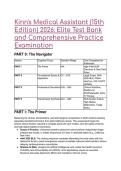
Kinn's Medical Assistant (15th
Edition) 2026: Elite Test Bank
and Comprehensive Practice
Examination
PART 0: The Navigator
Section Cognitive Focus Question Range Core Competencies
Addressed
PART I The Primer N/A High-Yield 2026
Directives & Hard Deck
Rules
PART II Foundational Syntax & Q1 – Q15 Legal Scope, AHA
Application 2026 BLS, OSHA
HazCom, ICD-10/CPT
Updates
PART II Professional Simulation Q16 – Q40 Clinical Workflow,
Shadow AI,
RTM/Telehealth, EKG,
IV Therapy
PART II Grandmaster Synthesis Q41 – Q55 Multi-System Failure,
High-Stakes
Malpractice, Triage
Ethics
PART I: The Primer
Mastering the clinical, administrative, and technological complexities of 2026 medical assisting
separates standard technicians from elite healthcare assets. This assessment forges the
precise clinical intuition required to navigate advanced care models, zero-fail safety protocols,
and high-stakes liability environments.
● Scope of Practice: Unlicensed assistive personnel cannot perform independent triage,
interpret test results, or initiate intravenous (IV) lines in restricted states (e.g., California,
New York).
● AHA 2026 BLS: The choking response mandates alternating five back blows with five
abdominal thrusts; opioid emergencies require immediate naloxone administration without
delaying cardiopulmonary resuscitation.
● Shadow AI Risk: Unapproved artificial intelligence tools violate the Health Insurance
Portability and Accountability Act (HIPAA); all AI applications require an executed
Business Associate Agreement (BAA) and mandatory clinician review.
, ● OSHA HazCom 2026: Full employer compliance with updated Globally Harmonized
System (GHS) Revision 7 labeling is mandated by November 20, 2026.
PART II: The Elite Test Bank
Q1: Under the 2026 American Heart Association (AHA) Basic Life Support (BLS)
guidelines, a medical assistant encounters a conscious adult male exhibiting severe
airway obstruction in the clinic waiting room. What is the mandated initial physical
intervention? A) Perform continuous abdominal thrusts until the object is dislodged. B)
Alternate five back blows with five abdominal thrusts. C) Administer five chest thrusts followed
by five back blows. D) Perform a blind finger sweep to locate the obstruction.
● The Answer: B (Alternate five back blows with five abdominal thrusts)
● Distractor Analysis: Option A represents the outdated pre-2025 standard which relied
solely on the Heimlich maneuver. Option C is the specific protocol reserved for infants, as
abdominal thrusts carry severe internal organ injury risks for patients under one year.
Option D is universally contraindicated across all demographics as it may lodge the object
deeper into the respiratory tract, converting a partial obstruction into a complete
occlusion.
● The Mentor's Analysis: The 2025/2026 AHA BLS update fundamentally shifted adult
and child choking protocols to mirror a hybrid biomechanical approach. The practitioner
must understand that alternating mechanics creates varying intrathoracic pressure
dynamics. Back blows create sharp, percussive spikes in pressure, while abdominal
thrusts create sustained upward diaphragmatic pressure, significantly increasing the
probability of expelling the foreign body before the patient succumbs to hypoxia and
becomes unresponsive.
Patient Demographic 2026 AHA Conscious Choking Protocol
Adults & Children Alternate 5 back blows with 5 abdominal
thrusts.
Infants (< 1 year) Alternate 5 back blows with 5 chest thrusts.
Pregnant/Obese Alternate 5 back blows with 5 chest thrusts.
Q2: A medical assistant discovers a patient unresponsive in the clinical restroom. The
patient displays pinpoint pupils, shallow agonal breathing, and cyanotic lips. According
to 2026 AHA guidelines, what is the immediate priority alongside initiating high-quality
CPR? A) Administering a synchronized electrical shock via an automated external defibrillator
(AED). B) Delaying chest compressions until rescue breaths are firmly established and
oxygenation is verified. C) Administering naloxone immediately without delaying the initiation of
chest compressions. D) Placing the patient in the recovery position to prevent aspiration of
emesis.
● The Answer: C (Administering naloxone immediately without delaying the initiation of
chest compressions)
● Distractor Analysis: Option A targets ventricular fibrillation or pulseless ventricular
tachycardia, not respiratory arrest secondary to an opioid overdose. Option B violates the
foundational C-A-B (Compressions-Airway-Breathing) sequence which prioritizes
systemic perfusion. Option D is inappropriate and lethal for an unresponsive patient
lacking adequate respirations, who requires immediate mechanical life support.
● The Mentor's Analysis: The integration of specific opioid overdose algorithms into the
2026 BLS framework reflects the escalating realities of the public health crisis. The clinical
, standard dictates that opioid antagonists (naloxone) must be administered rapidly to
reverse respiratory depression. However, the overarching professional intuition here is
that pharmacotherapy never supersedes mechanical circulation; naloxone administration
must occur concurrently with, or immediately alongside, continuous chest compressions
to ensure the brain remains oxygenated while the medication takes effect.
Q3: The Occupational Safety and Health Administration (OSHA) finalized its update to the
Hazard Communication Standard (HCS) aligning with GHS Revision 7. By what specific
date must healthcare employers update workplace secondary container labeling and
complete employee training for chemical substances? A) January 19, 2026 B) November
20, 2026 C) May 19, 2028 D) July 19, 2024
● The Answer: B (November 20, 2026)
● Distractor Analysis: Option A was the original deadline for chemical manufacturers
before OSHA issued a four-month extension. Option C is the extended deadline for
chemical mixtures, not primary single substances. Option D is the date the final rule
originally took effect, initiating the transition period, but it is not the enforcement deadline.
● The Mentor's Analysis: Regulatory compliance in clinical management requires precise
adherence to enforcement timelines. The extension granted by OSHA in early 2026
necessitates that clinical facilities update all internal secondary container labels (utilizing
the new GHS Revision 7 pictograms and hazard statements) and complete all staff
training by November 20, 2026. Failure to meet this deadline exposes the ambulatory
care facility to severe federal financial penalties and compromises occupational safety
during chemical spills.
Q4: A clinical provider, attempting to improve workflow efficiency, directs the medical
assistant to copy a complex patient’s progress note into an unauthorized, public
web-based Large Language Model (LLM) to generate a clinical summary. Why is this
specific action strictly prohibited under 2026 healthcare standards? A) The AI model may
require a commercial subscription fee, violating the clinic's operating budget. B) Using public
consumer AI platforms without an executed Business Associate Agreement (BAA) is a direct
HIPAA violation. C) The public LLM will automatically and permanently delete the patient data,
preventing record retention. D) The AI architecture will refuse to process the text due to complex
medical jargon.
● The Answer: B (Using public consumer AI platforms without an executed Business
Associate Agreement (BAA) is a direct HIPAA violation)
● Distractor Analysis: Option A is irrelevant to federal regulatory compliance and patient
safety. Option C is factually incorrect; public models frequently ingest and retain user
prompts to train future iterations of their algorithms. Option D is false, as modern
consumer LLMs easily process and synthesize complex medical terminology, making
them a tempting but dangerous tool.
● The Mentor's Analysis: "Shadow AI" represents a premier cybersecurity threat in
modern healthcare management. The professional must recognize that any transmission
of Protected Health Information (PHI) to a third-party server lacking an explicitly executed
BAA constitutes an illegal breach of the HIPAA Security Rule. Even if the assistant
attempts to "de-identify" the data, clinical narratives often contain enough nuanced detail
to remain identifiable, exposing the practice to catastrophic federal fines and civil liability.
Q5: A medical assistant residing in California successfully completes an advanced
7-hour Intravenous (IV) Therapy Certification course. A physician subsequently orders
the assistant to initiate a peripheral IV line for a severely dehydrated patient. What is the
legally mandated action for the medical assistant? A) Initiate the IV line, as the specialized
Edition) 2026: Elite Test Bank
and Comprehensive Practice
Examination
PART 0: The Navigator
Section Cognitive Focus Question Range Core Competencies
Addressed
PART I The Primer N/A High-Yield 2026
Directives & Hard Deck
Rules
PART II Foundational Syntax & Q1 – Q15 Legal Scope, AHA
Application 2026 BLS, OSHA
HazCom, ICD-10/CPT
Updates
PART II Professional Simulation Q16 – Q40 Clinical Workflow,
Shadow AI,
RTM/Telehealth, EKG,
IV Therapy
PART II Grandmaster Synthesis Q41 – Q55 Multi-System Failure,
High-Stakes
Malpractice, Triage
Ethics
PART I: The Primer
Mastering the clinical, administrative, and technological complexities of 2026 medical assisting
separates standard technicians from elite healthcare assets. This assessment forges the
precise clinical intuition required to navigate advanced care models, zero-fail safety protocols,
and high-stakes liability environments.
● Scope of Practice: Unlicensed assistive personnel cannot perform independent triage,
interpret test results, or initiate intravenous (IV) lines in restricted states (e.g., California,
New York).
● AHA 2026 BLS: The choking response mandates alternating five back blows with five
abdominal thrusts; opioid emergencies require immediate naloxone administration without
delaying cardiopulmonary resuscitation.
● Shadow AI Risk: Unapproved artificial intelligence tools violate the Health Insurance
Portability and Accountability Act (HIPAA); all AI applications require an executed
Business Associate Agreement (BAA) and mandatory clinician review.
, ● OSHA HazCom 2026: Full employer compliance with updated Globally Harmonized
System (GHS) Revision 7 labeling is mandated by November 20, 2026.
PART II: The Elite Test Bank
Q1: Under the 2026 American Heart Association (AHA) Basic Life Support (BLS)
guidelines, a medical assistant encounters a conscious adult male exhibiting severe
airway obstruction in the clinic waiting room. What is the mandated initial physical
intervention? A) Perform continuous abdominal thrusts until the object is dislodged. B)
Alternate five back blows with five abdominal thrusts. C) Administer five chest thrusts followed
by five back blows. D) Perform a blind finger sweep to locate the obstruction.
● The Answer: B (Alternate five back blows with five abdominal thrusts)
● Distractor Analysis: Option A represents the outdated pre-2025 standard which relied
solely on the Heimlich maneuver. Option C is the specific protocol reserved for infants, as
abdominal thrusts carry severe internal organ injury risks for patients under one year.
Option D is universally contraindicated across all demographics as it may lodge the object
deeper into the respiratory tract, converting a partial obstruction into a complete
occlusion.
● The Mentor's Analysis: The 2025/2026 AHA BLS update fundamentally shifted adult
and child choking protocols to mirror a hybrid biomechanical approach. The practitioner
must understand that alternating mechanics creates varying intrathoracic pressure
dynamics. Back blows create sharp, percussive spikes in pressure, while abdominal
thrusts create sustained upward diaphragmatic pressure, significantly increasing the
probability of expelling the foreign body before the patient succumbs to hypoxia and
becomes unresponsive.
Patient Demographic 2026 AHA Conscious Choking Protocol
Adults & Children Alternate 5 back blows with 5 abdominal
thrusts.
Infants (< 1 year) Alternate 5 back blows with 5 chest thrusts.
Pregnant/Obese Alternate 5 back blows with 5 chest thrusts.
Q2: A medical assistant discovers a patient unresponsive in the clinical restroom. The
patient displays pinpoint pupils, shallow agonal breathing, and cyanotic lips. According
to 2026 AHA guidelines, what is the immediate priority alongside initiating high-quality
CPR? A) Administering a synchronized electrical shock via an automated external defibrillator
(AED). B) Delaying chest compressions until rescue breaths are firmly established and
oxygenation is verified. C) Administering naloxone immediately without delaying the initiation of
chest compressions. D) Placing the patient in the recovery position to prevent aspiration of
emesis.
● The Answer: C (Administering naloxone immediately without delaying the initiation of
chest compressions)
● Distractor Analysis: Option A targets ventricular fibrillation or pulseless ventricular
tachycardia, not respiratory arrest secondary to an opioid overdose. Option B violates the
foundational C-A-B (Compressions-Airway-Breathing) sequence which prioritizes
systemic perfusion. Option D is inappropriate and lethal for an unresponsive patient
lacking adequate respirations, who requires immediate mechanical life support.
● The Mentor's Analysis: The integration of specific opioid overdose algorithms into the
2026 BLS framework reflects the escalating realities of the public health crisis. The clinical
, standard dictates that opioid antagonists (naloxone) must be administered rapidly to
reverse respiratory depression. However, the overarching professional intuition here is
that pharmacotherapy never supersedes mechanical circulation; naloxone administration
must occur concurrently with, or immediately alongside, continuous chest compressions
to ensure the brain remains oxygenated while the medication takes effect.
Q3: The Occupational Safety and Health Administration (OSHA) finalized its update to the
Hazard Communication Standard (HCS) aligning with GHS Revision 7. By what specific
date must healthcare employers update workplace secondary container labeling and
complete employee training for chemical substances? A) January 19, 2026 B) November
20, 2026 C) May 19, 2028 D) July 19, 2024
● The Answer: B (November 20, 2026)
● Distractor Analysis: Option A was the original deadline for chemical manufacturers
before OSHA issued a four-month extension. Option C is the extended deadline for
chemical mixtures, not primary single substances. Option D is the date the final rule
originally took effect, initiating the transition period, but it is not the enforcement deadline.
● The Mentor's Analysis: Regulatory compliance in clinical management requires precise
adherence to enforcement timelines. The extension granted by OSHA in early 2026
necessitates that clinical facilities update all internal secondary container labels (utilizing
the new GHS Revision 7 pictograms and hazard statements) and complete all staff
training by November 20, 2026. Failure to meet this deadline exposes the ambulatory
care facility to severe federal financial penalties and compromises occupational safety
during chemical spills.
Q4: A clinical provider, attempting to improve workflow efficiency, directs the medical
assistant to copy a complex patient’s progress note into an unauthorized, public
web-based Large Language Model (LLM) to generate a clinical summary. Why is this
specific action strictly prohibited under 2026 healthcare standards? A) The AI model may
require a commercial subscription fee, violating the clinic's operating budget. B) Using public
consumer AI platforms without an executed Business Associate Agreement (BAA) is a direct
HIPAA violation. C) The public LLM will automatically and permanently delete the patient data,
preventing record retention. D) The AI architecture will refuse to process the text due to complex
medical jargon.
● The Answer: B (Using public consumer AI platforms without an executed Business
Associate Agreement (BAA) is a direct HIPAA violation)
● Distractor Analysis: Option A is irrelevant to federal regulatory compliance and patient
safety. Option C is factually incorrect; public models frequently ingest and retain user
prompts to train future iterations of their algorithms. Option D is false, as modern
consumer LLMs easily process and synthesize complex medical terminology, making
them a tempting but dangerous tool.
● The Mentor's Analysis: "Shadow AI" represents a premier cybersecurity threat in
modern healthcare management. The professional must recognize that any transmission
of Protected Health Information (PHI) to a third-party server lacking an explicitly executed
BAA constitutes an illegal breach of the HIPAA Security Rule. Even if the assistant
attempts to "de-identify" the data, clinical narratives often contain enough nuanced detail
to remain identifiable, exposing the practice to catastrophic federal fines and civil liability.
Q5: A medical assistant residing in California successfully completes an advanced
7-hour Intravenous (IV) Therapy Certification course. A physician subsequently orders
the assistant to initiate a peripheral IV line for a severely dehydrated patient. What is the
legally mandated action for the medical assistant? A) Initiate the IV line, as the specialized


