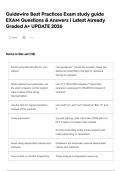
Guidewire Best Practices Exam study guide
EXAM Questions & Answers | Latest Already
Graded A+ UPDATE 2026
Save
Terms in this set (115)
Avoid using internal path for your com.guidewire.* should be avoided. These can
classes always be potentially changed or replaced
during an upgrade.
When referencing typecodes, use Use TC_TYPECODE instead of "typecode",
the static property on the typelist example: LossCause.TC_REAREND instead of
class instead of the string "rearend"
representation
Use the text for logical operators Use "and","or", and "not" instead of "&&", "||", and
instead of the symbols "!"
Code placement 1) Avoid placing code within the CODE tab of a
PCF. Create a UI helper class instead
2) Avoid extending entity enhancements with
code supporting UI operations
Avoid using deprecated classes and Guidewire will eventually remove deprecated
methods classes and methods.
Turn on and run Studio Inspections These analyze configuration resources
,Use whitespace effectively Add spaces around operators
Do not add spaces between parentheses and
operators
Indent logical blocks of code by two spaces only
Add a blank line after code blocks
Add two blank lines after methods, including the
last method in a class
Comments and Annotations Document new classes and functions with
Javadoc-style comments
Use single-line comments within functions and
methods when you need to clarify the intent of
the code
Use GoseDoc annotations which are included
when generating GosuDoc
"Upgrade-Safe" naming Columns added to existing entities
conventions: Add the suffix _Ext to Typecodes added to existing typelists
The name of custom entities
The name of custom typelists
New PCF files
Script parameters
Package naming conventions Use the format
customer.application.featurecategory.feature
Customer - company name abbreviation
Application- InsuranceSuite application code (pc,
bc, cc, suite)
Feature Category - major feature (delinquency,
configuration, integration)
Feature - feature (rating, catastrophe,
authentication)
Example: si.suite.integration.authentication
Class naming conventions Use UpperCamelCase
Do not add _Ext to classes within customer
package spaces
, Function naming conventions Use lowerCamelCase
Use a verb that describes that the function is
doing i.e. verifyAddress
Do not add _Ext suffix to private functions or
enhancements in customer package spaces
Variable naming conventions Member variable names use lowerCamelCase
with a leading underscore i.e.
_pluginCallbackHandler
Local variable names use lowerCamelCase short
names that describe the purpose i.e.
latestPolicyRevision
Display key naming conventions Add suffix _Ext too all new display keys
Do not modify automatically generated display
keys
Logging is The process of recording application actions and
state to a secondary interface
Logging is used for Application maintenance and troubleshooting
Creating statistics relating to application usage
Auditing by capturing significant events
Typical events to log are Success / Failure - a transaction or action has
succeeded or failed
Recovery - a system went down or connection
failed, retried, and recovered
Identification - any large functional areas such as
integration, rating, reinsurance, and rules
Logging components - Logger has a category and level, sends content to an
Appender
Logging components - Appender is an output destination (server console or rolling
file)
EXAM Questions & Answers | Latest Already
Graded A+ UPDATE 2026
Save
Terms in this set (115)
Avoid using internal path for your com.guidewire.* should be avoided. These can
classes always be potentially changed or replaced
during an upgrade.
When referencing typecodes, use Use TC_TYPECODE instead of "typecode",
the static property on the typelist example: LossCause.TC_REAREND instead of
class instead of the string "rearend"
representation
Use the text for logical operators Use "and","or", and "not" instead of "&&", "||", and
instead of the symbols "!"
Code placement 1) Avoid placing code within the CODE tab of a
PCF. Create a UI helper class instead
2) Avoid extending entity enhancements with
code supporting UI operations
Avoid using deprecated classes and Guidewire will eventually remove deprecated
methods classes and methods.
Turn on and run Studio Inspections These analyze configuration resources
,Use whitespace effectively Add spaces around operators
Do not add spaces between parentheses and
operators
Indent logical blocks of code by two spaces only
Add a blank line after code blocks
Add two blank lines after methods, including the
last method in a class
Comments and Annotations Document new classes and functions with
Javadoc-style comments
Use single-line comments within functions and
methods when you need to clarify the intent of
the code
Use GoseDoc annotations which are included
when generating GosuDoc
"Upgrade-Safe" naming Columns added to existing entities
conventions: Add the suffix _Ext to Typecodes added to existing typelists
The name of custom entities
The name of custom typelists
New PCF files
Script parameters
Package naming conventions Use the format
customer.application.featurecategory.feature
Customer - company name abbreviation
Application- InsuranceSuite application code (pc,
bc, cc, suite)
Feature Category - major feature (delinquency,
configuration, integration)
Feature - feature (rating, catastrophe,
authentication)
Example: si.suite.integration.authentication
Class naming conventions Use UpperCamelCase
Do not add _Ext to classes within customer
package spaces
, Function naming conventions Use lowerCamelCase
Use a verb that describes that the function is
doing i.e. verifyAddress
Do not add _Ext suffix to private functions or
enhancements in customer package spaces
Variable naming conventions Member variable names use lowerCamelCase
with a leading underscore i.e.
_pluginCallbackHandler
Local variable names use lowerCamelCase short
names that describe the purpose i.e.
latestPolicyRevision
Display key naming conventions Add suffix _Ext too all new display keys
Do not modify automatically generated display
keys
Logging is The process of recording application actions and
state to a secondary interface
Logging is used for Application maintenance and troubleshooting
Creating statistics relating to application usage
Auditing by capturing significant events
Typical events to log are Success / Failure - a transaction or action has
succeeded or failed
Recovery - a system went down or connection
failed, retried, and recovered
Identification - any large functional areas such as
integration, rating, reinsurance, and rules
Logging components - Logger has a category and level, sends content to an
Appender
Logging components - Appender is an output destination (server console or rolling
file)