

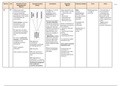
Theories Sub Dependent (Y) and Conceptual models Assumptions Hypothese Empirical examples Terms Critics
independent (X) (How?) (Why?)
(What?)
IOT TCT Why do orgs. exist? The higher F, U, and AS, Coase: because the use Main: Market governance - Too much focus on
To decrease transaction the higher the of the market is not free Vertical = change of cost minimization
costs and coordinate probability a more → transaction costs. (des)integration, ownership - Understates the
exchange and production of hierarchical form of Types: MD-form, IORs costs of organizing
goods (power of the market governance will be - Search costs (e.g. joint ventures (hierarchies cost!)
= full rationality and chosen - Contracting costs & strategic - Neglects importance
information). - Monitoring costs alliances) of intra-organizational
Behavioral assumptions: - Enforcement costs conflict
Unit of analysis: economic - Bounded rationality: Carsupplier and - Neglects social
transactions (= a cost We have the intention to Specific combinations of automaker relationships in
incurred in making an act in a rational way. But governance mechanisms relationship economic transactions
economic exchange) people don’t have the are combined:
capability to deal with all - Allocation of decision Membership of a
IV: Explanatory variables: the information that is making Trade Union
Frequency (F), Uncertainty offered to them, your - Input pricing / Output worker
(U), and Asset Specificity brains are incapable of pricing
(AS). processing. - Coordination
- Opportunism: Seeking monitoring and control
DV: choice of governance self-interest with guile.
structure = an institutional Given the opportunity, F, U and AS incur higher
arrangement that economic actors will transaction costs.
IV1: Behavioral
coordinates economic behave badly (commit
uncertainty (=
transactions fraud, mislead the other Actors want to minimize
predictability of behavior
actor). transaction costs.
of exchange partner)
Where: capitalistic
economies Efficient transacting as As long as they can
IV2: Frequency
source of competitive economize on
advantages transaction costs, they
When: Modern economies IV3: Asset specificity (=
possibility of alternative will select more
use) hierarchical governance
structures
DV: Organization of
transactions, i.e. choice of
governance structure (= an
institutional arrangement
that coordinates
economic transactions)
independent (X) (How?) (Why?)
(What?)
IOT TCT Why do orgs. exist? The higher F, U, and AS, Coase: because the use Main: Market governance - Too much focus on
To decrease transaction the higher the of the market is not free Vertical = change of cost minimization
costs and coordinate probability a more → transaction costs. (des)integration, ownership - Understates the
exchange and production of hierarchical form of Types: MD-form, IORs costs of organizing
goods (power of the market governance will be - Search costs (e.g. joint ventures (hierarchies cost!)
= full rationality and chosen - Contracting costs & strategic - Neglects importance
information). - Monitoring costs alliances) of intra-organizational
Behavioral assumptions: - Enforcement costs conflict
Unit of analysis: economic - Bounded rationality: Carsupplier and - Neglects social
transactions (= a cost We have the intention to Specific combinations of automaker relationships in
incurred in making an act in a rational way. But governance mechanisms relationship economic transactions
economic exchange) people don’t have the are combined:
capability to deal with all - Allocation of decision Membership of a
IV: Explanatory variables: the information that is making Trade Union
Frequency (F), Uncertainty offered to them, your - Input pricing / Output worker
(U), and Asset Specificity brains are incapable of pricing
(AS). processing. - Coordination
- Opportunism: Seeking monitoring and control
DV: choice of governance self-interest with guile.
structure = an institutional Given the opportunity, F, U and AS incur higher
arrangement that economic actors will transaction costs.
IV1: Behavioral
coordinates economic behave badly (commit
uncertainty (=
transactions fraud, mislead the other Actors want to minimize
predictability of behavior
actor). transaction costs.
of exchange partner)
Where: capitalistic
economies Efficient transacting as As long as they can
IV2: Frequency
source of competitive economize on
advantages transaction costs, they
When: Modern economies IV3: Asset specificity (=
possibility of alternative will select more
use) hierarchical governance
structures
DV: Organization of
transactions, i.e. choice of
governance structure (= an
institutional arrangement
that coordinates
economic transactions)


