

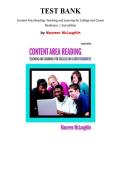
TEST BANK
Content Area Reading: Teaching and Learning for College and Career
Readiness, | 2nd edition
by Maureen McLaughlin
TU
TO
R
G
U
R
U
,Table of Content
1. Teaching in the 21st Century
2. Teaching and Learning in an Age of Multiple Literacies
3. The Common Core State Standards: Teaching and Learning in the Disciplines
4. Comprehending Content Area Text
5. Using Comprehension Strategies to Guide Thinking
TU
6. Using Comprehension Strategies to Extend Thinking
7. Teaching Vocabulary in the Content Areas
8. Organizing for Teaching and Learning
TO
9. Teaching Culturally and Linguistically Diverse Students
10. Writing in the Content Areas
11. Using Technology in the Content Areas
R
12. Inquiry: Key to Critical and Creative Thinking in the Content Areas
G
13. Poetry, Drama, Music, and Art: Alternative Representations of Thinking
14. Course-Based Assessment, Evaluation, and Reporting
U
15. Meeting Challenges and Continuing to Learn through Professional
development
R
U
,Test Bank: Chapter 1
Name: Section:
Chapter 1:
Teaching in the 21st Century
1.1 Multiple Choice Questions
1. Content area teachers make connections between best practices and national and state
A) standards.
TU
B) expectations.
C) textbooks.
D) research.
2. Influential teachers have knowledge of various aspects of learning.
A) in-depth
B) narrow
TO
C) shallow
D) perceived
3. Influential teachers have expectations for their students.
A) high
B) low
C) reasonable
R
D) unattainable
4. Twenty-first century students have been born into the age.
G
A) written
B) verbal
C) digital
D) reading
U
5. According to Howe and Strauss, Millennial students are the most generation in
history.
R
A) diverse
B) educated
C) neither A nor B
D) both A and B
U
6. One suggested strength of Millennial students is that they have a(n) learning style.
A) collaborative
B) unstructured
C) independent
D) biochronological
118
, Test Bank: Chapter 1
7. Offering multiple modes of response students.
A) confuses
B) overwhelms
C) constrains
D) motivates
8. According to the constructivist perspective, the more a student has about a topic, the
easier it is for the student to make connections to what they are learning.
A) writing experience
B) background knowledge
TU
C) instruction
D) teaching
9. Teaching activities should different points of view.
A) be mindful of
B) be devoid of
C) not take into account
TO
D) mandate
10. Motivation and are key factors in teaching and learning.
A) reading
B) engagement
C) complete understanding
R
D) excitement
1.2 Short Answer/Essay Questions
G
1. Describe the characteristics of Millennials.
2. Are you a visual, auditory, or tactile/kinesthetic learner? Describe your idea mode of
response after learning a chapter.
U
3. Defend the use of constructivism in the classroom. How do context, purpose, and social
interaction impact learning?
R
U
119
Content Area Reading: Teaching and Learning for College and Career
Readiness, | 2nd edition
by Maureen McLaughlin
TU
TO
R
G
U
R
U
,Table of Content
1. Teaching in the 21st Century
2. Teaching and Learning in an Age of Multiple Literacies
3. The Common Core State Standards: Teaching and Learning in the Disciplines
4. Comprehending Content Area Text
5. Using Comprehension Strategies to Guide Thinking
TU
6. Using Comprehension Strategies to Extend Thinking
7. Teaching Vocabulary in the Content Areas
8. Organizing for Teaching and Learning
TO
9. Teaching Culturally and Linguistically Diverse Students
10. Writing in the Content Areas
11. Using Technology in the Content Areas
R
12. Inquiry: Key to Critical and Creative Thinking in the Content Areas
G
13. Poetry, Drama, Music, and Art: Alternative Representations of Thinking
14. Course-Based Assessment, Evaluation, and Reporting
U
15. Meeting Challenges and Continuing to Learn through Professional
development
R
U
,Test Bank: Chapter 1
Name: Section:
Chapter 1:
Teaching in the 21st Century
1.1 Multiple Choice Questions
1. Content area teachers make connections between best practices and national and state
A) standards.
TU
B) expectations.
C) textbooks.
D) research.
2. Influential teachers have knowledge of various aspects of learning.
A) in-depth
B) narrow
TO
C) shallow
D) perceived
3. Influential teachers have expectations for their students.
A) high
B) low
C) reasonable
R
D) unattainable
4. Twenty-first century students have been born into the age.
G
A) written
B) verbal
C) digital
D) reading
U
5. According to Howe and Strauss, Millennial students are the most generation in
history.
R
A) diverse
B) educated
C) neither A nor B
D) both A and B
U
6. One suggested strength of Millennial students is that they have a(n) learning style.
A) collaborative
B) unstructured
C) independent
D) biochronological
118
, Test Bank: Chapter 1
7. Offering multiple modes of response students.
A) confuses
B) overwhelms
C) constrains
D) motivates
8. According to the constructivist perspective, the more a student has about a topic, the
easier it is for the student to make connections to what they are learning.
A) writing experience
B) background knowledge
TU
C) instruction
D) teaching
9. Teaching activities should different points of view.
A) be mindful of
B) be devoid of
C) not take into account
TO
D) mandate
10. Motivation and are key factors in teaching and learning.
A) reading
B) engagement
C) complete understanding
R
D) excitement
1.2 Short Answer/Essay Questions
G
1. Describe the characteristics of Millennials.
2. Are you a visual, auditory, or tactile/kinesthetic learner? Describe your idea mode of
response after learning a chapter.
U
3. Defend the use of constructivism in the classroom. How do context, purpose, and social
interaction impact learning?
R
U
119


