

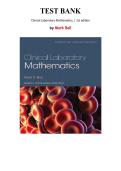
TEST BANK
Clinical Laboratory Mathematics, | 1st edition
by Mark Ball
TU
TO
R
G
U
R
U
,Table of Content
1. Arithmetic and Algebra
2. Exponential Notation and Logarithms
3. Rounding and the Significance of Figures
4. Systems of Measurement
5. Solutions and Concentrations
6. Dilutions
TU
7. Proportionality, Graphs, and Rates of Change
8. Statistics
TO
9. Chemistry
10. Hematology
11. Quality Control
R
12. Method Evaluation
G
U
R
U
, kjhgfds
All Chapters
TEST BANK FOR
Clinical Laboratory Mathematics (Ball) All Answers
Chapter 1 Arithmetic and Algebra
1) Which of the following best defines algebra?
A) The identification of the correlation between values using strategic and numerical
manipulation
B) The manipulation of scientific and laboratory measurements to best fit the expected outcome
C) The numerical manipulation of numbers through addition, subtraction, multiplication, and
division
TU
D) The strategic manipulation of relationships in order to find an unknown value
Answer: D
2) Which of the following best illustrates the commutative property of addition?
A) 5 + 3 + 2 = 10
B) 5 + (3 + 2) = (5 + 3) + 2
TO
C) 5 + 3 + 2 = 20 - 6 - 4
D) 5 + 3 + 2 = 2 + 3 + 5
Answer: D
3) Consider the following expression.
9 - (-3)
Which of the following expressions is another way of writing this?
R
A) 3 + 9
B) 3 - 9
C) 9 + 3
G
D) 9 - 3
Answer: C
4) Which of the following illustrates the commutative property of multiplication?
U
A) 1 × 2 × 3 = 6
B) 1 × 2 × 3 = 3 ÷ 2 ÷ 1
C) 1 × 2 × 3 = 3 × 1 × 2
R
D) (1 × 2) × 3 = 1 × (2 × 3)
Answer: C
U
5) Which of the following best illustrates the associative property of multiplication?
A) 1 × 2 × 3 = 6
B) 1 × 2 × 3 = 3 ÷ 2 ÷ 1
C) 1 × 2 × 3 = 3 × 1 × 2
D) (1 × 2) × 3 = 1 × (2 × 3)
Answer: D
hgfdshgfds
, kjhgfds
6) When a positive number is multiplied by a negative number, what sign will the value of the
product always have?
A) Negative
B) Positive
C) Neither of the above
D) The sign will vary.
Answer: A
7) What is the product of two reciprocals?
A) 0
B) 1
TU
C) 10
D) 100
Answer: B
8) What does the term "denominator" refer to?
A) The number by which a fraction is divided during reducing
TO
B) The number located on the top of a fraction
C) The number of equal parts into which something is divided
D) The number of parts of something that are being considered
Answer: C
9) Which of the following expressions demonstrates the correct procedure for multiplying a
R
fraction by a whole number?
2 10 2
A) 10 × 5 = 1 × 5
2 1 2
G
B) 10 × 5 = 10 × 5
2 1 4
C) 10 × 5 = 10 × 10
U
2
D) 10 × 5 = 10 × 5 × 2
Answer: A
R
10) What is the correct procedure for dividing fractions?
A) Add the numerators and add the denominators.
U
B) Multiply the numerators and multiply the denominators.
C) Multiply one fraction by the reciprocal of the other fraction.
D) Subtract the numerators and subtract the denominators.
Answer: C
hgfdshgfds
Clinical Laboratory Mathematics, | 1st edition
by Mark Ball
TU
TO
R
G
U
R
U
,Table of Content
1. Arithmetic and Algebra
2. Exponential Notation and Logarithms
3. Rounding and the Significance of Figures
4. Systems of Measurement
5. Solutions and Concentrations
6. Dilutions
TU
7. Proportionality, Graphs, and Rates of Change
8. Statistics
TO
9. Chemistry
10. Hematology
11. Quality Control
R
12. Method Evaluation
G
U
R
U
, kjhgfds
All Chapters
TEST BANK FOR
Clinical Laboratory Mathematics (Ball) All Answers
Chapter 1 Arithmetic and Algebra
1) Which of the following best defines algebra?
A) The identification of the correlation between values using strategic and numerical
manipulation
B) The manipulation of scientific and laboratory measurements to best fit the expected outcome
C) The numerical manipulation of numbers through addition, subtraction, multiplication, and
division
TU
D) The strategic manipulation of relationships in order to find an unknown value
Answer: D
2) Which of the following best illustrates the commutative property of addition?
A) 5 + 3 + 2 = 10
B) 5 + (3 + 2) = (5 + 3) + 2
TO
C) 5 + 3 + 2 = 20 - 6 - 4
D) 5 + 3 + 2 = 2 + 3 + 5
Answer: D
3) Consider the following expression.
9 - (-3)
Which of the following expressions is another way of writing this?
R
A) 3 + 9
B) 3 - 9
C) 9 + 3
G
D) 9 - 3
Answer: C
4) Which of the following illustrates the commutative property of multiplication?
U
A) 1 × 2 × 3 = 6
B) 1 × 2 × 3 = 3 ÷ 2 ÷ 1
C) 1 × 2 × 3 = 3 × 1 × 2
R
D) (1 × 2) × 3 = 1 × (2 × 3)
Answer: C
U
5) Which of the following best illustrates the associative property of multiplication?
A) 1 × 2 × 3 = 6
B) 1 × 2 × 3 = 3 ÷ 2 ÷ 1
C) 1 × 2 × 3 = 3 × 1 × 2
D) (1 × 2) × 3 = 1 × (2 × 3)
Answer: D
hgfdshgfds
, kjhgfds
6) When a positive number is multiplied by a negative number, what sign will the value of the
product always have?
A) Negative
B) Positive
C) Neither of the above
D) The sign will vary.
Answer: A
7) What is the product of two reciprocals?
A) 0
B) 1
TU
C) 10
D) 100
Answer: B
8) What does the term "denominator" refer to?
A) The number by which a fraction is divided during reducing
TO
B) The number located on the top of a fraction
C) The number of equal parts into which something is divided
D) The number of parts of something that are being considered
Answer: C
9) Which of the following expressions demonstrates the correct procedure for multiplying a
R
fraction by a whole number?
2 10 2
A) 10 × 5 = 1 × 5
2 1 2
G
B) 10 × 5 = 10 × 5
2 1 4
C) 10 × 5 = 10 × 10
U
2
D) 10 × 5 = 10 × 5 × 2
Answer: A
R
10) What is the correct procedure for dividing fractions?
A) Add the numerators and add the denominators.
U
B) Multiply the numerators and multiply the denominators.
C) Multiply one fraction by the reciprocal of the other fraction.
D) Subtract the numerators and subtract the denominators.
Answer: C
hgfdshgfds


