

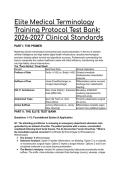
Elite Medical Terminology
Training Protocol Test Bank:
2026-2027 Clinical Standards
PART I: THE PRIMER
Mastering clinical nomenclature transcends basic board preparation; in the era of ambient
artificial intelligence and high-stakes digital health infrastructure, absolute terminological
precision dictates patient survival and algorithmic accuracy. Professionals commanding this
lexicon manipulate the modern healthcare matrix with lethal efficiency, transforming raw data
into high-fidelity clinical interventions.
The "Panic Button" Cheat Sheet:
Domain Hard Deck Rule Clinical Implication
Prefixes of Rate Tachy- (>100) vs. Brady- (<60) Dictates immediate
cardiovascular resuscitation
protocols.
Suffixes of Flow -rrhea (Flow/Discharge) vs. Differentiates routine mucosal
-rrhagia (Hemorrhage) discharge from catastrophic
bleeding.
ICD-11 Architecture Stem Code (DA63) + Extension Mandatory 2026/2027
Code (ME24.90) clustering requirement for
billing and acuity.
Anatomical Traps Ileum (GI Tract) vs. Ilium Prevents catastrophic surgical
(Pelvic Bone) site errors.
Action Suffixes -ectomy (Removal) vs. -stomy Differentiates complete organ
(New Opening) excision from palliative bypass.
PART II: THE ELITE TEST BANK
Questions 1–15: Foundational Syntax & Application
Q1: The attending practitioner is reviewing an emergency department admission note
generated by an ambient AI scribe. The patient presents with a severe, uncontrolled
nosebleed following blunt facial trauma. The AI documented "acute rhinorrhea." What is
the immediate required correction? A) Rhinitis B) Rhinorrhagia C) Rhinoplasty D)
Rhinomycosis
● The Answer: B (Rhinorrhagia)
● Distractor Analysis: Option A implies inflammation, not bleeding. Option C is a cosmetic
or reconstructive surgical repair. Option D implies a fungal infection. Options C and D are
completely irrelevant to an acute trauma presentation.
● The Mentor's Analysis: Ambient AI systems frequently hallucinate phonetically similar
suffixes. The suffix -rrhea indicates a standard fluid discharge (mucus), whereas -rrhagia
, means "bursting forth" or hemorrhage. Leaving "rhinorrhea" in the chart severely
down-codes the patient's acuity, potentially delaying necessary blood typing, transfusion
protocols, and surgical intervention.
Q2: A patient's continuous remote telemetry monitor triggers an automated alert for a
heart rate consistently dropping to 42 beats per minute. What is the correct terminology
for this condition? A) Tachycardia B) Cardiomegaly C) Bradycardia D) Cardiorrhexis
● The Answer: C (Bradycardia)
● Distractor Analysis: Option A (Tachycardia) is a fast heart rate (>100 bpm). Option B is
an enlarged heart. Option D is a physical rupture of the heart wall.
● The Mentor's Analysis: Brady- (slow) and Tachy- (fast) are the most fundamental
prefixes of rate. Under 2026 remote monitoring protocols, recognizing severe bradycardia
instantly triggers a clinical pathway for pacemaker evaluation or atropine administration.
Confusing these prefixes in an automated system leads to lethal pharmacological
interventions.
Q3: A surgical team plans to perform a procedure to view the interior of a patient's knee
joint to diagnose a torn meniscus. Which term accurately describes this specific
procedure? A) Arthrocentesis B) Arthroscopy C) Arthroplasty D) Arthrotomy
● The Answer: B (Arthroscopy)
● Distractor Analysis: Option A involves puncturing the joint with a needle to remove fluid.
Option C is the surgical repair or replacement of the joint. Option D is an open, invasive
incision directly into the joint space.
● The Mentor's Analysis: The suffix -scopy strictly denotes visual examination using an
illuminated instrument. In minimally invasive surgery, distinguishing between diagnostic
viewing (-scopy) and reconstructive repair (-plasty) is essential for accurate pre-operative
consent, billing, and specialized equipment sterilization requests.
Q4: A 65-year-old patient complains of severe, burning pain radiating down the back of
the leg. The neurologist suspects nerve root compression. What is the correct diagnostic
term for pain along the course of a nerve? A) Neuropathy B) Neurolysis C) Neuralgia D)
Neuroplasty
● The Answer: C (Neuralgia)
● Distractor Analysis: Option A refers broadly to any generalized disease of the nerves.
Option B is the destruction of nerve tissue. Option D is the surgical repair of a nerve.
● The Mentor's Analysis: The suffix -algia specifies acute pain, whereas -pathy indicates a
generalized disease process. Documenting "neuralgia" prompts targeted pain
management protocols (e.g., gabapentin), whereas "neuropathy" prompts broader,
systemic diagnostic workups (e.g., HbA1c testing for diabetes mellitus).
Q5: A patient with chronic liver failure presents to the outpatient clinic. The triage
practitioner notes a distinct yellow discoloration of the patient's skin and sclera. What is
the precise medical term for this clinical sign? A) Erythema B) Cyanosis C) Melanosis D)
Jaundice
● The Answer: D (Jaundice)
● Distractor Analysis: Option A is redness (usually inflammatory). Option B is a bluish tint
indicating severe tissue hypoxia. Option C is a dark brown/black pigmentation.
● The Mentor's Analysis: While icterus is an acceptable clinical synonym, jaundice is the
standard diagnostic indicator of hyperbilirubinemia. Identifying this specific integumentary
sign requires the immediate evaluation of hepatic function panels, biliary obstruction
parameters, and potential systemic toxicity.
Q6: The clinical documentation specialist is updating a patient's surgical history. The
, patient previously had their gallbladder surgically removed due to severe cholelithiasis.
Which term must be entered into the ICD-11 system? A) Cholecystotomy B)
Cholecystectomy C) Choledocholithotomy D) Cholecystostomy
● The Answer: B (Cholecystectomy)
● Distractor Analysis: Option A is merely an incision into the gallbladder. Option C is an
incision into the common bile duct to remove a stone. Option D is the creation of a new
opening in the gallbladder for drainage.
● The Mentor's Analysis: The suffix -ectomy mandates complete excision. Using -otomy
(incision) by mistake in the electronic health record (EHR) implies the organ is still
physically present within the patient, which will cause systemic contraindication alerts to
fail during future prescribing or diagnostic imaging.
Q7: A patient in the intensive care unit is producing less than 100 mL of urine per day
despite aggressive intravenous fluid resuscitation. Which precise term defines this
critical state? A) Polyuria B) Dysuria C) Oliguria D) Anuria
● The Answer: D (Anuria)
● Distractor Analysis: Option A is excessive urination. Option B is painful urination. Option
C is scant urination (typically defined as <500 mL/day), but <100 mL definitively crosses
the threshold into anuria.
● The Mentor's Analysis: The prefix an- (without) combined with -uria (urine) signals total
renal shutdown. Differentiating oliguria from anuria is not an academic exercise; it is the
physiological threshold that immediately activates hemodialysis protocols in a critical care
setting.
Q8: During a rapid trauma assessment, the physician notes a patient's bluish skin
discoloration and explicitly dictates that the patient is suffering from a complete lack of
oxygen to the tissues. Which term should the scribe record? A) Hypoxia B) Anoxia C)
Eupnea D) Tachypnea
● The Answer: B (Anoxia)
● Distractor Analysis: Option A indicates a deficiency of oxygen, not a complete lack.
Option C is normal, unlabored breathing. Option D is rapid breathing.
● The Mentor's Analysis: The distinction between hypo- (deficient) and an- (absence of)
dictates the aggressiveness of the airway intervention. Hypoxia may require supplemental
oxygen via a nasal cannula; anoxia requires immediate, definitive airway establishment
(endotracheal intubation) as cellular death is imminent.
Q9: A female patient is scheduled for the surgical removal of both her ovaries and
fallopian tubes. What is the comprehensive operative term? A) Bilateral
Salpingo-oophorectomy B) Bilateral Hysterectomy C) Colporrhaphy D) Oophoropexy
● The Answer: A (Bilateral Salpingo-oophorectomy)
● Distractor Analysis: Option B removes the uterus, not necessarily the tubes and ovaries.
Option C is the suturing of the vagina. Option D is the surgical fixation of a prolapsed
ovary.
● The Mentor's Analysis: Salping/o refers to the fallopian tubes, and oophor/o refers to the
ovaries. In 2026 oncology and preventative genetic pathways (e.g., BRCA1 mutations),
precise structural removal documentation is required. Removing the tubes is entirely
distinct from removing the uterus.
Q10: An oncology pathology report describes a highly malignant tumor originating from
connective, supportive tissue. Which suffix correctly classifies this specific malignancy?
A) -oma B) -carcinoma C) -sarcoma D) -plasia
● The Answer: C (-sarcoma)
Training Protocol Test Bank:
2026-2027 Clinical Standards
PART I: THE PRIMER
Mastering clinical nomenclature transcends basic board preparation; in the era of ambient
artificial intelligence and high-stakes digital health infrastructure, absolute terminological
precision dictates patient survival and algorithmic accuracy. Professionals commanding this
lexicon manipulate the modern healthcare matrix with lethal efficiency, transforming raw data
into high-fidelity clinical interventions.
The "Panic Button" Cheat Sheet:
Domain Hard Deck Rule Clinical Implication
Prefixes of Rate Tachy- (>100) vs. Brady- (<60) Dictates immediate
cardiovascular resuscitation
protocols.
Suffixes of Flow -rrhea (Flow/Discharge) vs. Differentiates routine mucosal
-rrhagia (Hemorrhage) discharge from catastrophic
bleeding.
ICD-11 Architecture Stem Code (DA63) + Extension Mandatory 2026/2027
Code (ME24.90) clustering requirement for
billing and acuity.
Anatomical Traps Ileum (GI Tract) vs. Ilium Prevents catastrophic surgical
(Pelvic Bone) site errors.
Action Suffixes -ectomy (Removal) vs. -stomy Differentiates complete organ
(New Opening) excision from palliative bypass.
PART II: THE ELITE TEST BANK
Questions 1–15: Foundational Syntax & Application
Q1: The attending practitioner is reviewing an emergency department admission note
generated by an ambient AI scribe. The patient presents with a severe, uncontrolled
nosebleed following blunt facial trauma. The AI documented "acute rhinorrhea." What is
the immediate required correction? A) Rhinitis B) Rhinorrhagia C) Rhinoplasty D)
Rhinomycosis
● The Answer: B (Rhinorrhagia)
● Distractor Analysis: Option A implies inflammation, not bleeding. Option C is a cosmetic
or reconstructive surgical repair. Option D implies a fungal infection. Options C and D are
completely irrelevant to an acute trauma presentation.
● The Mentor's Analysis: Ambient AI systems frequently hallucinate phonetically similar
suffixes. The suffix -rrhea indicates a standard fluid discharge (mucus), whereas -rrhagia
, means "bursting forth" or hemorrhage. Leaving "rhinorrhea" in the chart severely
down-codes the patient's acuity, potentially delaying necessary blood typing, transfusion
protocols, and surgical intervention.
Q2: A patient's continuous remote telemetry monitor triggers an automated alert for a
heart rate consistently dropping to 42 beats per minute. What is the correct terminology
for this condition? A) Tachycardia B) Cardiomegaly C) Bradycardia D) Cardiorrhexis
● The Answer: C (Bradycardia)
● Distractor Analysis: Option A (Tachycardia) is a fast heart rate (>100 bpm). Option B is
an enlarged heart. Option D is a physical rupture of the heart wall.
● The Mentor's Analysis: Brady- (slow) and Tachy- (fast) are the most fundamental
prefixes of rate. Under 2026 remote monitoring protocols, recognizing severe bradycardia
instantly triggers a clinical pathway for pacemaker evaluation or atropine administration.
Confusing these prefixes in an automated system leads to lethal pharmacological
interventions.
Q3: A surgical team plans to perform a procedure to view the interior of a patient's knee
joint to diagnose a torn meniscus. Which term accurately describes this specific
procedure? A) Arthrocentesis B) Arthroscopy C) Arthroplasty D) Arthrotomy
● The Answer: B (Arthroscopy)
● Distractor Analysis: Option A involves puncturing the joint with a needle to remove fluid.
Option C is the surgical repair or replacement of the joint. Option D is an open, invasive
incision directly into the joint space.
● The Mentor's Analysis: The suffix -scopy strictly denotes visual examination using an
illuminated instrument. In minimally invasive surgery, distinguishing between diagnostic
viewing (-scopy) and reconstructive repair (-plasty) is essential for accurate pre-operative
consent, billing, and specialized equipment sterilization requests.
Q4: A 65-year-old patient complains of severe, burning pain radiating down the back of
the leg. The neurologist suspects nerve root compression. What is the correct diagnostic
term for pain along the course of a nerve? A) Neuropathy B) Neurolysis C) Neuralgia D)
Neuroplasty
● The Answer: C (Neuralgia)
● Distractor Analysis: Option A refers broadly to any generalized disease of the nerves.
Option B is the destruction of nerve tissue. Option D is the surgical repair of a nerve.
● The Mentor's Analysis: The suffix -algia specifies acute pain, whereas -pathy indicates a
generalized disease process. Documenting "neuralgia" prompts targeted pain
management protocols (e.g., gabapentin), whereas "neuropathy" prompts broader,
systemic diagnostic workups (e.g., HbA1c testing for diabetes mellitus).
Q5: A patient with chronic liver failure presents to the outpatient clinic. The triage
practitioner notes a distinct yellow discoloration of the patient's skin and sclera. What is
the precise medical term for this clinical sign? A) Erythema B) Cyanosis C) Melanosis D)
Jaundice
● The Answer: D (Jaundice)
● Distractor Analysis: Option A is redness (usually inflammatory). Option B is a bluish tint
indicating severe tissue hypoxia. Option C is a dark brown/black pigmentation.
● The Mentor's Analysis: While icterus is an acceptable clinical synonym, jaundice is the
standard diagnostic indicator of hyperbilirubinemia. Identifying this specific integumentary
sign requires the immediate evaluation of hepatic function panels, biliary obstruction
parameters, and potential systemic toxicity.
Q6: The clinical documentation specialist is updating a patient's surgical history. The
, patient previously had their gallbladder surgically removed due to severe cholelithiasis.
Which term must be entered into the ICD-11 system? A) Cholecystotomy B)
Cholecystectomy C) Choledocholithotomy D) Cholecystostomy
● The Answer: B (Cholecystectomy)
● Distractor Analysis: Option A is merely an incision into the gallbladder. Option C is an
incision into the common bile duct to remove a stone. Option D is the creation of a new
opening in the gallbladder for drainage.
● The Mentor's Analysis: The suffix -ectomy mandates complete excision. Using -otomy
(incision) by mistake in the electronic health record (EHR) implies the organ is still
physically present within the patient, which will cause systemic contraindication alerts to
fail during future prescribing or diagnostic imaging.
Q7: A patient in the intensive care unit is producing less than 100 mL of urine per day
despite aggressive intravenous fluid resuscitation. Which precise term defines this
critical state? A) Polyuria B) Dysuria C) Oliguria D) Anuria
● The Answer: D (Anuria)
● Distractor Analysis: Option A is excessive urination. Option B is painful urination. Option
C is scant urination (typically defined as <500 mL/day), but <100 mL definitively crosses
the threshold into anuria.
● The Mentor's Analysis: The prefix an- (without) combined with -uria (urine) signals total
renal shutdown. Differentiating oliguria from anuria is not an academic exercise; it is the
physiological threshold that immediately activates hemodialysis protocols in a critical care
setting.
Q8: During a rapid trauma assessment, the physician notes a patient's bluish skin
discoloration and explicitly dictates that the patient is suffering from a complete lack of
oxygen to the tissues. Which term should the scribe record? A) Hypoxia B) Anoxia C)
Eupnea D) Tachypnea
● The Answer: B (Anoxia)
● Distractor Analysis: Option A indicates a deficiency of oxygen, not a complete lack.
Option C is normal, unlabored breathing. Option D is rapid breathing.
● The Mentor's Analysis: The distinction between hypo- (deficient) and an- (absence of)
dictates the aggressiveness of the airway intervention. Hypoxia may require supplemental
oxygen via a nasal cannula; anoxia requires immediate, definitive airway establishment
(endotracheal intubation) as cellular death is imminent.
Q9: A female patient is scheduled for the surgical removal of both her ovaries and
fallopian tubes. What is the comprehensive operative term? A) Bilateral
Salpingo-oophorectomy B) Bilateral Hysterectomy C) Colporrhaphy D) Oophoropexy
● The Answer: A (Bilateral Salpingo-oophorectomy)
● Distractor Analysis: Option B removes the uterus, not necessarily the tubes and ovaries.
Option C is the suturing of the vagina. Option D is the surgical fixation of a prolapsed
ovary.
● The Mentor's Analysis: Salping/o refers to the fallopian tubes, and oophor/o refers to the
ovaries. In 2026 oncology and preventative genetic pathways (e.g., BRCA1 mutations),
precise structural removal documentation is required. Removing the tubes is entirely
distinct from removing the uterus.
Q10: An oncology pathology report describes a highly malignant tumor originating from
connective, supportive tissue. Which suffix correctly classifies this specific malignancy?
A) -oma B) -carcinoma C) -sarcoma D) -plasia
● The Answer: C (-sarcoma)


