

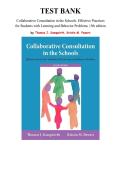
TEST BANK
Collaborative Consultation in the Schools: Effective Practices
for Students with Learning and Behavior Problems | 5th edition
by Thomas J. Kampwirth, Kristin M. Powers
TU
TO
R
G
U
R
U
,Table of Content
1. Overview of School-Based Consultation
2. Consultation Models and Professional Practices
3. Problem-Solving Consultation in a Multi-Tiered System of Support
4. Communication and Interpersonal Skills
TU
5. Legal and Ethical Issues in School Consultation
6. Consulting about Students with Social, Emotional, and/or Behavioral
TO
Problems
R
7. Consulting about Students with Academic Skill Problems
G
8. Transition Planning
U
9. Systems-Level Consultation: The Organization as the Target of Change
R
10. Case Studies in Collaborative Consultation
U
, kjhgfds
Chapter 1: Overview of School Based Consultation
Multiple Choice:
1. Which one of the following is NOT an expectation about the nature of collaborative
consultation:
a. The consultant is a trained professional.
b. Establishing a relationship based on mutual respect and trust is essential for
successful consultation.
c. The problem lies within the child.
d. The referral concern should direct the problem-solving process.
TU
2. MTSS stands for
a. Multiple Treatments Standards System
b. Math Tertiary System of Services
c. Multiplication, Times, Subtraction and Substitution
d. Multi-Tiered System of Services
TO
3. The law that protects the rights of students with disabilities to attend public school is
a. No Child Left Behind
b. Individuals with Disabilities Education Act
c. Common Core State Standards
d. Response to Intervention
R
4. Transition planning is
a. Preparing youth with disabilities for adult life
b. The right to participate in the least restrictive environment
G
c. Assessing whether an student’s disability caused him to break a school rule
d. Preparing a general education teacher to serve a student with disabilities in her
classroom.
U
5. NCLB
a. Requires teachers to have a master’s degree
R
b. Discourages consultation because of its expense
c. Is the reauthorization of the Elementary and Secondary Education Act.
d. Has been credited with closing the gap in achievement among all students.
U
True/False:
1. Districts prevail in most due process cases.
2. There is a preponderance of empirical support the effectiveness of school consultation.
3. In a collaborative model, the role of “expert” may shift from one participant to another.
4. Well-validated treatments will naturally be found acceptable to consultees.
5. The consultant must have the content expertise to be effective.
Essay:
1. Discuss how collaboration and consultation are alike and how they are different.
2
, kjhgfds
2. Draw and label the consultation triad.
3. Describe consultation at each tier of MTSS.
4. Discuss the concept of treatment fidelity in the consultation process.
Chapter 2: Consultation Models and Professional Practices
Multiple Choice:
1. What are the 4 stages in the behavioral consultation interview, in order?
a. Problem identification, problem analysis, plans implementation, plan evaluation.
TU
b. Plan evaluation, problem analysis, and plan implementation, problem identification.
c. Problem identification, FBA, problem solving, plan evaluation.
d. FBA, problem identification, plan evaluation, problem solving.
2. What are the four lacks that a consultee might have concerning their client?
a. Expertise, confidence, skill, objectivity.
TO
b. Classroom management, teacher relationships, confidence expertise.
c. Knowledge, skill, confidence, objectivity.
d. Knowledge, skill, teacher relationships, objectivity.
3. Poor classroom management skills, failure to engage students and are
the common reason for attrition with teachers.
R
a. Many students with learning disabilities in a classroom
b. Lack of support by the principal
c. A belief of fixed intelligence
G
d. Feeling of isolation
4. What is the purpose of an IEP team?
a. For all professionals to discuss a student’s weaknesses compared to his/her peers.
U
b. To discuss a child’s progress throughout the year/ reporting period, and determine next
goals and programs/ resources needed.
c. To conduct interviews for a FBA on the student’s behavior.
R
d. To determine how building funds should be allocated.
5. The main goal of mental health consultation is
a. Following the problem-solving process
U
b. Increasing the client’s capacities
c. Increasing the capacity of the consultee
d. Identifying evidence-based interventions.
True/False:
1. The current state of behaviorism only takes into consideration external and observable
reasons that are driving a person’s behavior.
3
Collaborative Consultation in the Schools: Effective Practices
for Students with Learning and Behavior Problems | 5th edition
by Thomas J. Kampwirth, Kristin M. Powers
TU
TO
R
G
U
R
U
,Table of Content
1. Overview of School-Based Consultation
2. Consultation Models and Professional Practices
3. Problem-Solving Consultation in a Multi-Tiered System of Support
4. Communication and Interpersonal Skills
TU
5. Legal and Ethical Issues in School Consultation
6. Consulting about Students with Social, Emotional, and/or Behavioral
TO
Problems
R
7. Consulting about Students with Academic Skill Problems
G
8. Transition Planning
U
9. Systems-Level Consultation: The Organization as the Target of Change
R
10. Case Studies in Collaborative Consultation
U
, kjhgfds
Chapter 1: Overview of School Based Consultation
Multiple Choice:
1. Which one of the following is NOT an expectation about the nature of collaborative
consultation:
a. The consultant is a trained professional.
b. Establishing a relationship based on mutual respect and trust is essential for
successful consultation.
c. The problem lies within the child.
d. The referral concern should direct the problem-solving process.
TU
2. MTSS stands for
a. Multiple Treatments Standards System
b. Math Tertiary System of Services
c. Multiplication, Times, Subtraction and Substitution
d. Multi-Tiered System of Services
TO
3. The law that protects the rights of students with disabilities to attend public school is
a. No Child Left Behind
b. Individuals with Disabilities Education Act
c. Common Core State Standards
d. Response to Intervention
R
4. Transition planning is
a. Preparing youth with disabilities for adult life
b. The right to participate in the least restrictive environment
G
c. Assessing whether an student’s disability caused him to break a school rule
d. Preparing a general education teacher to serve a student with disabilities in her
classroom.
U
5. NCLB
a. Requires teachers to have a master’s degree
R
b. Discourages consultation because of its expense
c. Is the reauthorization of the Elementary and Secondary Education Act.
d. Has been credited with closing the gap in achievement among all students.
U
True/False:
1. Districts prevail in most due process cases.
2. There is a preponderance of empirical support the effectiveness of school consultation.
3. In a collaborative model, the role of “expert” may shift from one participant to another.
4. Well-validated treatments will naturally be found acceptable to consultees.
5. The consultant must have the content expertise to be effective.
Essay:
1. Discuss how collaboration and consultation are alike and how they are different.
2
, kjhgfds
2. Draw and label the consultation triad.
3. Describe consultation at each tier of MTSS.
4. Discuss the concept of treatment fidelity in the consultation process.
Chapter 2: Consultation Models and Professional Practices
Multiple Choice:
1. What are the 4 stages in the behavioral consultation interview, in order?
a. Problem identification, problem analysis, plans implementation, plan evaluation.
TU
b. Plan evaluation, problem analysis, and plan implementation, problem identification.
c. Problem identification, FBA, problem solving, plan evaluation.
d. FBA, problem identification, plan evaluation, problem solving.
2. What are the four lacks that a consultee might have concerning their client?
a. Expertise, confidence, skill, objectivity.
TO
b. Classroom management, teacher relationships, confidence expertise.
c. Knowledge, skill, confidence, objectivity.
d. Knowledge, skill, teacher relationships, objectivity.
3. Poor classroom management skills, failure to engage students and are
the common reason for attrition with teachers.
R
a. Many students with learning disabilities in a classroom
b. Lack of support by the principal
c. A belief of fixed intelligence
G
d. Feeling of isolation
4. What is the purpose of an IEP team?
a. For all professionals to discuss a student’s weaknesses compared to his/her peers.
U
b. To discuss a child’s progress throughout the year/ reporting period, and determine next
goals and programs/ resources needed.
c. To conduct interviews for a FBA on the student’s behavior.
R
d. To determine how building funds should be allocated.
5. The main goal of mental health consultation is
a. Following the problem-solving process
U
b. Increasing the client’s capacities
c. Increasing the capacity of the consultee
d. Identifying evidence-based interventions.
True/False:
1. The current state of behaviorism only takes into consideration external and observable
reasons that are driving a person’s behavior.
3


