

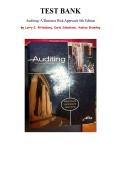
TEST BANK
Auditing: A Business Risk Approach 8th Edition
by Larry E. Rittenberg, Karla Johnstone, Audrey Gramling
SC
O
R
EG
U
ID
ES
,Chapter 1: Auditing: Integral to the Economy
TRUE/FALSE
1. The need for assurance services arises because the interests of the users of information may be
different from that of the interests of those responsible for providing information.
ANS: T PTS: 1 OBJ: Auditing Defined
NAT: AACSB-Analytical skills | AICPA BB-Critical thinking
2. An audit of financial statements is a form of attestation service.
SC
ANS: T PTS: 1 OBJ: Auditing Defined
NAT: AACSB-Analytical skills | AICPA BB-Critical thinking
3. Independence is an attribute necessary to perform assurance services.
ANS: T PTS: 1 OBJ: Scope of Services
NAT: AACSB-Analytical skills | AICPA BB-Critical thinking
4. A bank using Milton Company's financial statements to determine the creditworthiness of a
O
potential loan to Milton is a good example of the need for unbiased reporting.
ANS: T PTS: 1 OBJ: Auditing Defined
NAT: AACSB-Analytical skills | AICPA BB-Critical thinking
R
5. Independence is only required for assurance service providers.
ANS: T PTS: 1 OBJ: Scope of Services
NAT: AACSB-Analytical skills | AICPA BB-Critical thinking
EG
6. A CPA automatically qualifies as an assurance provider in all areas of business.
ANS: F PTS: 1 OBJ: Scope of Services
NAT: AACSB-Analytical skills | AICPA BB-Critical thinking
7. Attestation services are a subset of assurance services and always involve a report that goes to a
third party.
ANS: T PTS: 1 OBJ: Scope of Services
U
NAT: AACSB-Analytical skills | AICPA BB-Critical thinking
ID
ES
1-1
© 2012 Cengage Learning. All Rights Reserved. This edition is intended for use outside of the U.S. only, with content that may be different from
the U.S. Edition. May not be scanned, copied, duplicated, or posted to a publicly accessible website, in whole or in part.
, 1-2 Chapter 1: Auditing: Integral to the Economy
8. The American Institute of Certified Public Accountants has the primary authority to set auditing
standards for public companies.
ANS: F PTS: 1 OBJ: Public Company Auditing Standards
NAT: AACSB-Analytical skills | AICPA BB-Critical thinking
9. The audit function is unique because it exists to perform services on a "client" on behalf of
shareholders, directors and other parties.
ANS: T PTS: 1 OBJ: Auditing Defined
NAT: AACSB-Analytical skills | AICPA BB-Critical thinking
SC
10. Auditing is the process of attesting to assertions about economic actions and events.
ANS: T PTS: 1 OBJ: Auditing Defined
NAT: AACSB-Analytical skills | AICPA BB-Critical thinking
11. Auditing is the process of verifying the accuracy of the financial statements.
ANS: F PTS: 1 OBJ: Auditing Defined
NAT: AACSB-Analytical skills | AICPA BB-Critical thinking
O
12. Internal auditing only provides assurance services to clients.
ANS: F PTS: 1 OBJ: Internal and Governmental Auditors
NAT: AACSB-Analytical skills | AICPA BB-Critical thinking
R
13. Auditing primarily exists because users need unbiased information on which to assess
management performance and make economic decisions.
ANS: T PTS: 1 OBJ: Auditing Defined
NAT: AACSB-Analytical skills | AICPA BB-Critical thinking
EG
14. The degree of confidence that users place on management's financial statements is higher than
that placed on audited financial statements because few users have direct knowledge of the
company's operations and management is the most knowledgeable about operations.
ANS: F PTS: 1 OBJ: Public Company Auditing Standards
NAT: AACSB-Analytical skills | AICPA BB-Critical thinking
15. U.S. nonpublic companies will have an audit performed in accordance with generally accepted
U
auditing standards that have been promulgated by the PCAOB.
ANS: F PTS: 1 OBJ: Public Company Auditing Standards
NAT: AACSB-Analytical skills | AICPA BB-Critical thinking
ID
16. An assertion is a statement about an action, event, condition, or performance over a specified
time period.
ANS: T PTS: 1 OBJ: Opinion Formation Process
NAT: AACSB-Analytical skills | AICPA BB-Critical thinking
ES
17. Management is required to comment on the fairness of the company's financial presentation.
This reduces the auditor's legal responsibility for the opinion rendered on the financial
statements.
ANS: F PTS: 1 OBJ: Auditing Defined
NAT: AACSB-Analytical skills | AICPA BB-Critical thinking
18. Audited financial statements should be free from all errors and fraud.
ANS: F PTS: 1 OBJ: Public Company Auditing Standards
NAT: AACSB-Analytical skills | AICPA BB-Critical thinking
19. Audited financial statements should be presented fairly according to the substance of GAAP.
ANS: T PTS: 1 OBJ: Professional and Regulatory Organizations
© 2012 Cengage Learning. All Rights Reserved. This edition is intended for use outside of the U.S. only, with content that may be different from
the U.S. Edition. May not be scanned, copied, duplicated, or posted to a publicly accessible website, in whole or in part.
, Auditing, 8e 1-3
NAT: AACSB-Analytical skills | AICPA BB-Critical thinking
20. Audited financial statements should be presented fairly according to the substance of GAAS.
ANS: F PTS: 1 OBJ: Professional and Regulatory Organizations
NAT: AACSB-Analytical skills | AICPA BB-Critical thinking
21. A plan to converge the U.S. generally accepted auditing standards (GAAS) with the International
Standards on Auditing (ISAs) was developed by the .AICPA’s Auditing Standards Board (ASB).
ANS: T PTS: 1 OBJ: Public Company Auditing Standards
NAT: AACSB-Analytical skills | AICPA BB-Critical thinking
SC
22. Attestation is confined to an audit of client financial statements.
ANS: F PTS: 1 OBJ: Scope of Services
NAT: AACSB-Analytical skills | AICPA BB-Critical thinking
23. An auditor must have a good understanding of the risks associated with a client's industry in
order to ensure that the financial statements reflect the underlying substance of accounting
transactions and the economic effects of such transactions.
O
ANS: T PTS: 1 OBJ: Types of Service Providers
NAT: AACSB-Analytical skills | AICPA BB-Critical thinking
24. Public Company Accounting Oversight Board provides the criteria against which the auditor
R
measures the fairness of financial statement presentation for public companies.
ANS: F PTS: 1 OBJ: Professional and Regulatory Organizations
NAT: AACSB-Analytical skills | AICPA BB-Critical thinking
EG
25. Generally accepted accounting principles provide the criteria against which the auditor measures
the fairness of financial statement presentation.
ANS: T PTS: 1 OBJ: Professional and Regulatory Organizations
NAT: AACSB-Analytical skills | AICPA BB-Critical thinking
26. Businesses that use independent auditors do not need the use of internal auditors.
ANS: F PTS: 1 OBJ: Internal and Governmental Auditors
NAT: AACSB-Analytical skills | AICPA BB-Critical thinking
U
27. CPA certificates for auditors are issued by state boards of accountancy.
ANS: T PTS: 1 OBJ: Professional and Regulatory Organizations
NAT: AACSB-Analytical skills | AICPA BB-Critical thinking
ID
28. Internal auditing is an objective evaluation function established within an organization.
ANS: T PTS: 1 OBJ: Internal and Governmental Auditors
NAT: AACSB-Analytical skills | AICPA BB-Critical thinking
29. Operational audits are designed to determine if the company’s financial statements are prepared
ES
in compliance with GAAP.
ANS: F PTS: 1 OBJ: Internal and Governmental Auditors
NAT: AACSB-Analytical skills | AICPA BB-Critical thinking
30. Governmental auditors perform operational and financial statement audits.
ANS: T PTS: 1 OBJ: Internal and Governmental Auditors
NAT: AACSB-Analytical skills | AICPA BB-Critical thinking
31. The internal audit profession adheres exclusively to standards set by the Public Company
Accounting Oversight Board.
ANS: F PTS: 1 OBJ: Internal and Governmental Auditors
NAT: AACSB-Analytical skills | AICPA BB-Critical thinking
© 2012 Cengage Learning. All Rights Reserved. This edition is intended for use outside of the U.S. only, with content that may be different from
the U.S. Edition. May not be scanned, copied, duplicated, or posted to a publicly accessible website, in whole or in part.
Auditing: A Business Risk Approach 8th Edition
by Larry E. Rittenberg, Karla Johnstone, Audrey Gramling
SC
O
R
EG
U
ID
ES
,Chapter 1: Auditing: Integral to the Economy
TRUE/FALSE
1. The need for assurance services arises because the interests of the users of information may be
different from that of the interests of those responsible for providing information.
ANS: T PTS: 1 OBJ: Auditing Defined
NAT: AACSB-Analytical skills | AICPA BB-Critical thinking
2. An audit of financial statements is a form of attestation service.
SC
ANS: T PTS: 1 OBJ: Auditing Defined
NAT: AACSB-Analytical skills | AICPA BB-Critical thinking
3. Independence is an attribute necessary to perform assurance services.
ANS: T PTS: 1 OBJ: Scope of Services
NAT: AACSB-Analytical skills | AICPA BB-Critical thinking
4. A bank using Milton Company's financial statements to determine the creditworthiness of a
O
potential loan to Milton is a good example of the need for unbiased reporting.
ANS: T PTS: 1 OBJ: Auditing Defined
NAT: AACSB-Analytical skills | AICPA BB-Critical thinking
R
5. Independence is only required for assurance service providers.
ANS: T PTS: 1 OBJ: Scope of Services
NAT: AACSB-Analytical skills | AICPA BB-Critical thinking
EG
6. A CPA automatically qualifies as an assurance provider in all areas of business.
ANS: F PTS: 1 OBJ: Scope of Services
NAT: AACSB-Analytical skills | AICPA BB-Critical thinking
7. Attestation services are a subset of assurance services and always involve a report that goes to a
third party.
ANS: T PTS: 1 OBJ: Scope of Services
U
NAT: AACSB-Analytical skills | AICPA BB-Critical thinking
ID
ES
1-1
© 2012 Cengage Learning. All Rights Reserved. This edition is intended for use outside of the U.S. only, with content that may be different from
the U.S. Edition. May not be scanned, copied, duplicated, or posted to a publicly accessible website, in whole or in part.
, 1-2 Chapter 1: Auditing: Integral to the Economy
8. The American Institute of Certified Public Accountants has the primary authority to set auditing
standards for public companies.
ANS: F PTS: 1 OBJ: Public Company Auditing Standards
NAT: AACSB-Analytical skills | AICPA BB-Critical thinking
9. The audit function is unique because it exists to perform services on a "client" on behalf of
shareholders, directors and other parties.
ANS: T PTS: 1 OBJ: Auditing Defined
NAT: AACSB-Analytical skills | AICPA BB-Critical thinking
SC
10. Auditing is the process of attesting to assertions about economic actions and events.
ANS: T PTS: 1 OBJ: Auditing Defined
NAT: AACSB-Analytical skills | AICPA BB-Critical thinking
11. Auditing is the process of verifying the accuracy of the financial statements.
ANS: F PTS: 1 OBJ: Auditing Defined
NAT: AACSB-Analytical skills | AICPA BB-Critical thinking
O
12. Internal auditing only provides assurance services to clients.
ANS: F PTS: 1 OBJ: Internal and Governmental Auditors
NAT: AACSB-Analytical skills | AICPA BB-Critical thinking
R
13. Auditing primarily exists because users need unbiased information on which to assess
management performance and make economic decisions.
ANS: T PTS: 1 OBJ: Auditing Defined
NAT: AACSB-Analytical skills | AICPA BB-Critical thinking
EG
14. The degree of confidence that users place on management's financial statements is higher than
that placed on audited financial statements because few users have direct knowledge of the
company's operations and management is the most knowledgeable about operations.
ANS: F PTS: 1 OBJ: Public Company Auditing Standards
NAT: AACSB-Analytical skills | AICPA BB-Critical thinking
15. U.S. nonpublic companies will have an audit performed in accordance with generally accepted
U
auditing standards that have been promulgated by the PCAOB.
ANS: F PTS: 1 OBJ: Public Company Auditing Standards
NAT: AACSB-Analytical skills | AICPA BB-Critical thinking
ID
16. An assertion is a statement about an action, event, condition, or performance over a specified
time period.
ANS: T PTS: 1 OBJ: Opinion Formation Process
NAT: AACSB-Analytical skills | AICPA BB-Critical thinking
ES
17. Management is required to comment on the fairness of the company's financial presentation.
This reduces the auditor's legal responsibility for the opinion rendered on the financial
statements.
ANS: F PTS: 1 OBJ: Auditing Defined
NAT: AACSB-Analytical skills | AICPA BB-Critical thinking
18. Audited financial statements should be free from all errors and fraud.
ANS: F PTS: 1 OBJ: Public Company Auditing Standards
NAT: AACSB-Analytical skills | AICPA BB-Critical thinking
19. Audited financial statements should be presented fairly according to the substance of GAAP.
ANS: T PTS: 1 OBJ: Professional and Regulatory Organizations
© 2012 Cengage Learning. All Rights Reserved. This edition is intended for use outside of the U.S. only, with content that may be different from
the U.S. Edition. May not be scanned, copied, duplicated, or posted to a publicly accessible website, in whole or in part.
, Auditing, 8e 1-3
NAT: AACSB-Analytical skills | AICPA BB-Critical thinking
20. Audited financial statements should be presented fairly according to the substance of GAAS.
ANS: F PTS: 1 OBJ: Professional and Regulatory Organizations
NAT: AACSB-Analytical skills | AICPA BB-Critical thinking
21. A plan to converge the U.S. generally accepted auditing standards (GAAS) with the International
Standards on Auditing (ISAs) was developed by the .AICPA’s Auditing Standards Board (ASB).
ANS: T PTS: 1 OBJ: Public Company Auditing Standards
NAT: AACSB-Analytical skills | AICPA BB-Critical thinking
SC
22. Attestation is confined to an audit of client financial statements.
ANS: F PTS: 1 OBJ: Scope of Services
NAT: AACSB-Analytical skills | AICPA BB-Critical thinking
23. An auditor must have a good understanding of the risks associated with a client's industry in
order to ensure that the financial statements reflect the underlying substance of accounting
transactions and the economic effects of such transactions.
O
ANS: T PTS: 1 OBJ: Types of Service Providers
NAT: AACSB-Analytical skills | AICPA BB-Critical thinking
24. Public Company Accounting Oversight Board provides the criteria against which the auditor
R
measures the fairness of financial statement presentation for public companies.
ANS: F PTS: 1 OBJ: Professional and Regulatory Organizations
NAT: AACSB-Analytical skills | AICPA BB-Critical thinking
EG
25. Generally accepted accounting principles provide the criteria against which the auditor measures
the fairness of financial statement presentation.
ANS: T PTS: 1 OBJ: Professional and Regulatory Organizations
NAT: AACSB-Analytical skills | AICPA BB-Critical thinking
26. Businesses that use independent auditors do not need the use of internal auditors.
ANS: F PTS: 1 OBJ: Internal and Governmental Auditors
NAT: AACSB-Analytical skills | AICPA BB-Critical thinking
U
27. CPA certificates for auditors are issued by state boards of accountancy.
ANS: T PTS: 1 OBJ: Professional and Regulatory Organizations
NAT: AACSB-Analytical skills | AICPA BB-Critical thinking
ID
28. Internal auditing is an objective evaluation function established within an organization.
ANS: T PTS: 1 OBJ: Internal and Governmental Auditors
NAT: AACSB-Analytical skills | AICPA BB-Critical thinking
29. Operational audits are designed to determine if the company’s financial statements are prepared
ES
in compliance with GAAP.
ANS: F PTS: 1 OBJ: Internal and Governmental Auditors
NAT: AACSB-Analytical skills | AICPA BB-Critical thinking
30. Governmental auditors perform operational and financial statement audits.
ANS: T PTS: 1 OBJ: Internal and Governmental Auditors
NAT: AACSB-Analytical skills | AICPA BB-Critical thinking
31. The internal audit profession adheres exclusively to standards set by the Public Company
Accounting Oversight Board.
ANS: F PTS: 1 OBJ: Internal and Governmental Auditors
NAT: AACSB-Analytical skills | AICPA BB-Critical thinking
© 2012 Cengage Learning. All Rights Reserved. This edition is intended for use outside of the U.S. only, with content that may be different from
the U.S. Edition. May not be scanned, copied, duplicated, or posted to a publicly accessible website, in whole or in part.


