

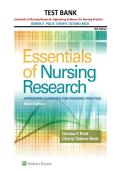
TEST BANK
Essentials of Nursing Research: Appraising Evidence for Nursing Practice
DENISE F. POLIT, CHERYL TATANO BECK
9th Edition
,Test Bank For Essentials of Nursing Research: Appraising Evidence for
Nursing Practice 9th Edition by Polit, Beck
Table of Contents:
Chapter 1 Introducing Nursing Research for Evidence-Based Practice
Chapter 2 Understanding Key Concepts and Steps in Quantitative and Qualitative
Research
Chapter 3 Reading and Critically Appraising Research Articles
Chapter 4 Attending to Ethics in Research
Chapter 5 Identifying Research Problems, Research Questions, and Hypotheses
Chapter 6 Finding and Reviewing Research Evidence in the Literature
Chapter 7 Understanding Theoretical and Conceptual Frameworks
Chapter 8 Appraising Quantitative Research Design
Chapter 9 Appraising Sampling and Data Collection in Quantitative Studies
Chapter 10 Appraising Qualitative Designs and Approaches
Chapter 11 Appraising Sampling and Data Collection in Qualitative Studies
Chapter 12 Understanding Mixed Methods Research, Quality Improvement, and Other
Special Types of Research
Chapter 13 Understanding Statistical Analysis of Quantitative Data
Chapter 14 Interpreting Quantitative Findings and Evaluating Clinical Significance
Chapter 15 Understanding the Analysis of Qualitative Data
Chapter 16 Appraising Trustworthiness and Integrity in Qualitative Research
Chapter 17 Learning From Systematic Reviews
Chapter 18 Putting Research Evidence Into Practice: Evidence-Based Practice and
Practice-Based Evidence
,CHAPTER 1: Introducing Nursing Research For Evidence-Based Practice
Essentials of Nursing Research: Appraising Evidence for Nursing Practice 9th Edition by Polit, Beck
1. Which of the following groups would be best served by the development of a scientific base for
nursing practice?
A) Nursing administrators
B) Practicing nurses
C) Nurses' clients
D) Health care policymakers
Ans: C Fe
edback:
Nursing research is systematic inquiry designed to develop trustworthy evidence about is sues of
y
importance to nurses and their clients. Nurse leaders recognize the need to base sp ecific nursing
decisions on evidence indicating that the decisions are clinically appropriat e, cost-
effective, and result in positive client outcomes. Although all of the people listed would b
y
enefit from the development of a scientific base for nursing practice, ultimately it is the cl ients
y
themselves who would most benefit, as they would then receive the most appropriat e and most
effective care.
2. An especially important goal for the nursing profession is to do which of the following?
A) Conduct research to better understand the context of nursing practice
B) Establish a solid base of evidence for practice through disciplined research
C) Document the role nursing serves in society
y
D) Establish research priorities
Ans: B Fe
edback:
Nurses are increasingly expected to understand and undertake research and to base their p ractice
y
on evidence from research. Evidence-
based practice is the use of the best evidence in making patient care decisions and typicall y comes
y
from research conducted by nurses and other health-
care professionals. All of the other answers are possible goals for the nursing profession, but none
y
is as important as establishing evidence for practice.
y
3. Which of the following is a fundamental belief of those who hold to the constructivist
paradigm?
A) A fixed reality exists in nature for humans to understand
B) The nature of reality has changed over time
C) Reality is multiply constructed and multiply interpreted by humans
D) Reality cannot be studied empirically
Ans: C Fe
edback:
In the constructivist paradigm, it is assumed that reality is not a fixed entity but is rather a
y
construction of human minds, and thus “truth” is a composite of multiple constructions of
Page 1
, reality. However, constructivists do believe that reality can be studied empirically.
Belief in a fixed reality that exists in nature for humans to understand would be anexample of a positivist belief,
not a constructivist one. The constructivist belief does not hold so much that the nature of reality h as changed over
y y
time as that it has always been constructed by human minds.
4. Which of the following is a fundamental belief of those who hold to the positivist
paradigm?
A) The researcher is objective and independent of those being studied
B) The researcher cannot interact with those being studied
y y y
C) The researcher instructs those being studied to be objective in providing
information
D) The distance between the researcher and those being researched is minimized to
enhance the interactive process
Ans: A Fe
edback:
In the positivist paradigm, it is assumed that there is an objective reality and that natural p
henomena are regular and orderly. In the constructivist paradigm, it is assumed that realit y is
y
not a fixed entity but is rather a construction of human minds, and thus “truth” is a co mposite of
y
multiple constructions of reality.
5. Which of the following attributes is least characteristic of the traditional scientific method?
A) Control over external factors
B) Systematic measurement and observation of natural phenomena
y
C) Testing of hunches deduced from theory or prior research
D) Emphasis on a holistic view of a phenomenon, studied in a rich context
Ans: D F
eedback:
Quantitative research (associated with positivism) involves the collection and analysis o f
numeric information. Quantitative research is typically conducted within the traditiona l scientific
method, which is systematic and controlled. Quantitative researchers base the ir findings on
empirical evidence (evidence collected by way of the human senses) and s trive for
generalizability beyond a single setting or situation.
Constructivist researchers emphasize understanding human experience as it is lived through the
y y
collection and analysis of subjective, narrative materials using flexible procedures; this paradigm
is associated with qualitative research.
6. Empiricism refers to which of the following?
A) Making generalizations from specific observations
B) Articulating a study purpose in terms of an appropriate classification system
C) Gathering evidence about real-world phenomena through the senses
D) Verifying the assumptions on which the study was based
y
Ans: CFeedback:
Empiricism is gathering and analyzing evidence through their senses. Quantitative resear ch
involves the collection and analysis of numeric information. Quantitative research is ty
Page 2
Essentials of Nursing Research: Appraising Evidence for Nursing Practice
DENISE F. POLIT, CHERYL TATANO BECK
9th Edition
,Test Bank For Essentials of Nursing Research: Appraising Evidence for
Nursing Practice 9th Edition by Polit, Beck
Table of Contents:
Chapter 1 Introducing Nursing Research for Evidence-Based Practice
Chapter 2 Understanding Key Concepts and Steps in Quantitative and Qualitative
Research
Chapter 3 Reading and Critically Appraising Research Articles
Chapter 4 Attending to Ethics in Research
Chapter 5 Identifying Research Problems, Research Questions, and Hypotheses
Chapter 6 Finding and Reviewing Research Evidence in the Literature
Chapter 7 Understanding Theoretical and Conceptual Frameworks
Chapter 8 Appraising Quantitative Research Design
Chapter 9 Appraising Sampling and Data Collection in Quantitative Studies
Chapter 10 Appraising Qualitative Designs and Approaches
Chapter 11 Appraising Sampling and Data Collection in Qualitative Studies
Chapter 12 Understanding Mixed Methods Research, Quality Improvement, and Other
Special Types of Research
Chapter 13 Understanding Statistical Analysis of Quantitative Data
Chapter 14 Interpreting Quantitative Findings and Evaluating Clinical Significance
Chapter 15 Understanding the Analysis of Qualitative Data
Chapter 16 Appraising Trustworthiness and Integrity in Qualitative Research
Chapter 17 Learning From Systematic Reviews
Chapter 18 Putting Research Evidence Into Practice: Evidence-Based Practice and
Practice-Based Evidence
,CHAPTER 1: Introducing Nursing Research For Evidence-Based Practice
Essentials of Nursing Research: Appraising Evidence for Nursing Practice 9th Edition by Polit, Beck
1. Which of the following groups would be best served by the development of a scientific base for
nursing practice?
A) Nursing administrators
B) Practicing nurses
C) Nurses' clients
D) Health care policymakers
Ans: C Fe
edback:
Nursing research is systematic inquiry designed to develop trustworthy evidence about is sues of
y
importance to nurses and their clients. Nurse leaders recognize the need to base sp ecific nursing
decisions on evidence indicating that the decisions are clinically appropriat e, cost-
effective, and result in positive client outcomes. Although all of the people listed would b
y
enefit from the development of a scientific base for nursing practice, ultimately it is the cl ients
y
themselves who would most benefit, as they would then receive the most appropriat e and most
effective care.
2. An especially important goal for the nursing profession is to do which of the following?
A) Conduct research to better understand the context of nursing practice
B) Establish a solid base of evidence for practice through disciplined research
C) Document the role nursing serves in society
y
D) Establish research priorities
Ans: B Fe
edback:
Nurses are increasingly expected to understand and undertake research and to base their p ractice
y
on evidence from research. Evidence-
based practice is the use of the best evidence in making patient care decisions and typicall y comes
y
from research conducted by nurses and other health-
care professionals. All of the other answers are possible goals for the nursing profession, but none
y
is as important as establishing evidence for practice.
y
3. Which of the following is a fundamental belief of those who hold to the constructivist
paradigm?
A) A fixed reality exists in nature for humans to understand
B) The nature of reality has changed over time
C) Reality is multiply constructed and multiply interpreted by humans
D) Reality cannot be studied empirically
Ans: C Fe
edback:
In the constructivist paradigm, it is assumed that reality is not a fixed entity but is rather a
y
construction of human minds, and thus “truth” is a composite of multiple constructions of
Page 1
, reality. However, constructivists do believe that reality can be studied empirically.
Belief in a fixed reality that exists in nature for humans to understand would be anexample of a positivist belief,
not a constructivist one. The constructivist belief does not hold so much that the nature of reality h as changed over
y y
time as that it has always been constructed by human minds.
4. Which of the following is a fundamental belief of those who hold to the positivist
paradigm?
A) The researcher is objective and independent of those being studied
B) The researcher cannot interact with those being studied
y y y
C) The researcher instructs those being studied to be objective in providing
information
D) The distance between the researcher and those being researched is minimized to
enhance the interactive process
Ans: A Fe
edback:
In the positivist paradigm, it is assumed that there is an objective reality and that natural p
henomena are regular and orderly. In the constructivist paradigm, it is assumed that realit y is
y
not a fixed entity but is rather a construction of human minds, and thus “truth” is a co mposite of
y
multiple constructions of reality.
5. Which of the following attributes is least characteristic of the traditional scientific method?
A) Control over external factors
B) Systematic measurement and observation of natural phenomena
y
C) Testing of hunches deduced from theory or prior research
D) Emphasis on a holistic view of a phenomenon, studied in a rich context
Ans: D F
eedback:
Quantitative research (associated with positivism) involves the collection and analysis o f
numeric information. Quantitative research is typically conducted within the traditiona l scientific
method, which is systematic and controlled. Quantitative researchers base the ir findings on
empirical evidence (evidence collected by way of the human senses) and s trive for
generalizability beyond a single setting or situation.
Constructivist researchers emphasize understanding human experience as it is lived through the
y y
collection and analysis of subjective, narrative materials using flexible procedures; this paradigm
is associated with qualitative research.
6. Empiricism refers to which of the following?
A) Making generalizations from specific observations
B) Articulating a study purpose in terms of an appropriate classification system
C) Gathering evidence about real-world phenomena through the senses
D) Verifying the assumptions on which the study was based
y
Ans: CFeedback:
Empiricism is gathering and analyzing evidence through their senses. Quantitative resear ch
involves the collection and analysis of numeric information. Quantitative research is ty
Page 2


