I:*:
. Thermodynamics:
Zainab Modan
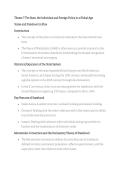
,Zainab Modan Thermodynamics is the study of energy and its transformation.
THERMODYNAMICS
v v
0
heat " "
o
Not static from
☐
temperature ' '
Greek word →
power
energy
a
1. FIRST LAW OF THERMODYNAMICS
• energy cannot be created nor destroyed.
• Therefore, the total energy of the universe is a constant.
• Energy can, however, be converted from one form to another or transferred from a system to the surroundings or vice versa
Two ways for energy to be transferred
Heat gained by the system Heat lost by the system
work done on
system work done
by system
OE
qtw
=
-
-
↳ path -2
functions
SPONTANEOUS PROCESSES
• Spontaneous processes are those that can proceed
without any outside intervention, i.e. without ongoing
input of energy from outside the system.
• The gas in vessel B will spontaneously effuse into
vessel A, but once the gas is in both vessels, it will
not spontaneously return to vessel B.
• Processes that are spontaneous in one direction are nonspontaneous in the reverse direction.
• Spontaneity does not predict the rate (speed) of the reaction
*SPONTANEOUS DOESN’T MEAN FAST *
• Rusting of an iron nail is spontaneous and slow.
• Processes that are spontaneous at one temperature may be nonspontaneous at other temperatures.
– Above 0 oC, it is spontaneous for ice to melt. ( s ) → (e) : spontaneous
– Below 0 oC, the reverse process is spontaneous (e) → (s ) : not span .
, REVERSIBLE PROCESSES IRREVERSIBLE PROCESSES
-In a reversible process the system changes in • Irreversible processes cannot be undone by exactly
such a way that the system and surroundings can be reversing the change to the system.
put back in their original states by exactly • Spontaneous processes are irreversible.
reversing the process.
-The direction of heat flow can be changed by an
Infinitesimal change in T or another property.
• In an spontaneous process, the path
between reactants and products is
irreversible.
• The system cannot return to its original
state without there being a permanent
• Chemical systems in equilibrium are reversible. change in the surroundings.
• Both the system and its surroundings can be
restored to their original state
Thermodynamics gives us the direction of a process. It cannot predict the speed at which the process will occur.
Direction of a process can be exothermic or endothermic.
ENTROPY
Entropy – measure of the disorder/randomness of a system.
• Entropy (S) is a term coined by Rudolph Clausius in the 19th century.
• Clausius was convinced of the significance of the ratio of heat (q) delivered and the temperature (T) at which it is delivered
→ heat
9 delivered
S
✓ g-
=
Entropy ,
↳ Temperature
• Entropy – measure of the disorder/randomness of a system.
• It is related to the various modes of motion in molecules. Entropy increases with the
• Like internal energy, E, and enthalpy, H, entropy (S) is a state freedom of motion of molecules.
function. 05 =
Therefore,
5final S initial
S(g) > S(l) > S(s)
-
• For a process occurring at constant temperature (an isothermal process), the change in entropy is
equal to the heat that would be transferred if the process were reversible divided by the temperature:
Heat transferred under
Eren →
reversible conditions
OS =
I The units of entropy are J K-1
Temp at which process takes place
Zainab Modan
. Thermodynamics:
Zainab Modan
,Zainab Modan Thermodynamics is the study of energy and its transformation.
THERMODYNAMICS
v v
0
heat " "
o
Not static from
☐
temperature ' '
Greek word →
power
energy
a
1. FIRST LAW OF THERMODYNAMICS
• energy cannot be created nor destroyed.
• Therefore, the total energy of the universe is a constant.
• Energy can, however, be converted from one form to another or transferred from a system to the surroundings or vice versa
Two ways for energy to be transferred
Heat gained by the system Heat lost by the system
work done on
system work done
by system
OE
qtw
=
-
-
↳ path -2
functions
SPONTANEOUS PROCESSES
• Spontaneous processes are those that can proceed
without any outside intervention, i.e. without ongoing
input of energy from outside the system.
• The gas in vessel B will spontaneously effuse into
vessel A, but once the gas is in both vessels, it will
not spontaneously return to vessel B.
• Processes that are spontaneous in one direction are nonspontaneous in the reverse direction.
• Spontaneity does not predict the rate (speed) of the reaction
*SPONTANEOUS DOESN’T MEAN FAST *
• Rusting of an iron nail is spontaneous and slow.
• Processes that are spontaneous at one temperature may be nonspontaneous at other temperatures.
– Above 0 oC, it is spontaneous for ice to melt. ( s ) → (e) : spontaneous
– Below 0 oC, the reverse process is spontaneous (e) → (s ) : not span .
, REVERSIBLE PROCESSES IRREVERSIBLE PROCESSES
-In a reversible process the system changes in • Irreversible processes cannot be undone by exactly
such a way that the system and surroundings can be reversing the change to the system.
put back in their original states by exactly • Spontaneous processes are irreversible.
reversing the process.
-The direction of heat flow can be changed by an
Infinitesimal change in T or another property.
• In an spontaneous process, the path
between reactants and products is
irreversible.
• The system cannot return to its original
state without there being a permanent
• Chemical systems in equilibrium are reversible. change in the surroundings.
• Both the system and its surroundings can be
restored to their original state
Thermodynamics gives us the direction of a process. It cannot predict the speed at which the process will occur.
Direction of a process can be exothermic or endothermic.
ENTROPY
Entropy – measure of the disorder/randomness of a system.
• Entropy (S) is a term coined by Rudolph Clausius in the 19th century.
• Clausius was convinced of the significance of the ratio of heat (q) delivered and the temperature (T) at which it is delivered
→ heat
9 delivered
S
✓ g-
=
Entropy ,
↳ Temperature
• Entropy – measure of the disorder/randomness of a system.
• It is related to the various modes of motion in molecules. Entropy increases with the
• Like internal energy, E, and enthalpy, H, entropy (S) is a state freedom of motion of molecules.
function. 05 =
Therefore,
5final S initial
S(g) > S(l) > S(s)
-
• For a process occurring at constant temperature (an isothermal process), the change in entropy is
equal to the heat that would be transferred if the process were reversible divided by the temperature:
Heat transferred under
Eren →
reversible conditions
OS =
I The units of entropy are J K-1
Temp at which process takes place
Zainab Modan