

1
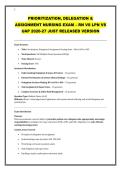
PRIORITIZATION, DELEGATION &
ASSIGNMENT NURSING EXAM – RN VS LPN VS
UAP 2026-27 JUST RELEASED VERSION
Exam Structure
• Title: Prioritization, Delegation & Assignment Nursing Exam – RN vs LPN vs UAP
• Total Questions: 100 Multiple Choice Questions (MCQs)
• Time Allowed: 2 hours
• Passing Score: 75%
Sections & Distribution:
1. Understanding Delegation & Scope of Practice – 15 questions
2. Patient Prioritization in Various Clinical Settings – 25 questions
3. Delegation Decision-Making: RN vs LPN vs UAP – 35 questions
4. Task Assignment & Supervision – 15 questions
5. Complex Scenarios & Safety-Risk Management – 10 questions
Question Type: Multiple Choice (A–D)
Difficulty: Mixed – knowledge-based, application, and scenario-based reflecting real-world delegation and
prioritization.
Exam Introduction
Purpose:
This exam evaluates a nurse’s ability to prioritize patient care, delegate tasks appropriately, and assign
responsibilities according to the scope of practice of RNs, LPNs, and UAPs. Emphasis is on safe, efficient,
and legal nursing practice.
Content Areas Covered:
• Principles of delegation and assignment
• Understanding scope of practice: RN, LPN, UAP
• Prioritizing care based on patient acuity
• Task delegation and supervision
• Handling complex, multi-patient situations safely
,2
Instructions:
1. Read each question carefully and choose the best answer (A, B, C, or D).
2. Each question carries 1 point; total 100 points.
3. Complete the exam within 2 hours.
4. Answers and rationales are provided for self-assessment and learning reinforcement.
Learning Outcome:
Demonstrates proficiency in safe delegation, prioritization, and assignment in accordance with nursing
scope of practice and patient safety standards.
Section 1: Understanding Delegation & Scope of Practice
(Questions 1–15)
Q1. Which statement best describes delegation in
nursing?
A. Transferring responsibility while retaining accountability
B. Transferring both responsibility and accountability
C. Allowing another nurse to make all decisions
independently
D. Assigning tasks to anyone without supervision
Answer: A
Rationale:
Delegation involves transferring the responsibility for
performing a task to another team member while the RN
retains accountability for the outcome.
,3
Q2. Which tasks can a UAP safely perform?
A. Administer IV medications
B. Measure vital signs and assist with hygiene
C. Assess new patient symptoms
D. Evaluate effectiveness of prescribed medications
Answer: B
Rationale:
UAPs are limited to routine, non-invasive tasks such as
vital signs, hygiene, and ambulation.
Q3. Which action is within an LPN’s scope of practice?
A. Perform initial patient assessment
B. Administer oral medications and provide wound care
C. Prescribe medications
D. Develop the nursing care plan independently
Answer: B
Rationale:
LPNs can perform medication administration (excluding
IV in some states), wound care, and basic nursing
interventions, but cannot perform initial comprehensive
assessments or develop care plans independently.
Q4. An RN delegates a task to a UAP. Which is the RN’s
responsibility?
, 4
A. Ensuring the task is completed safely and verifying
outcomes
B. Ignoring task completion
C. Allowing UAP to decide how to perform the task
D. Delegating accountability as well
Answer: A
Rationale:
The RN remains accountable for patient safety and must
ensure the task is performed correctly.
Q5. Which factor is most important when deciding
whether to delegate a task?
A. Task complexity and patient condition
B. RN’s personal preference
C. How busy the RN is
D. UAP availability only
Answer: A
Rationale:
Patient safety and the complexity of the task determine
delegation appropriateness. Delegation should match
patient needs with staff competency.
Q6. Which task can be safely delegated to an LPN?
A. Administering IV push medications to a new unstable
PRIORITIZATION, DELEGATION &
ASSIGNMENT NURSING EXAM – RN VS LPN VS
UAP 2026-27 JUST RELEASED VERSION
Exam Structure
• Title: Prioritization, Delegation & Assignment Nursing Exam – RN vs LPN vs UAP
• Total Questions: 100 Multiple Choice Questions (MCQs)
• Time Allowed: 2 hours
• Passing Score: 75%
Sections & Distribution:
1. Understanding Delegation & Scope of Practice – 15 questions
2. Patient Prioritization in Various Clinical Settings – 25 questions
3. Delegation Decision-Making: RN vs LPN vs UAP – 35 questions
4. Task Assignment & Supervision – 15 questions
5. Complex Scenarios & Safety-Risk Management – 10 questions
Question Type: Multiple Choice (A–D)
Difficulty: Mixed – knowledge-based, application, and scenario-based reflecting real-world delegation and
prioritization.
Exam Introduction
Purpose:
This exam evaluates a nurse’s ability to prioritize patient care, delegate tasks appropriately, and assign
responsibilities according to the scope of practice of RNs, LPNs, and UAPs. Emphasis is on safe, efficient,
and legal nursing practice.
Content Areas Covered:
• Principles of delegation and assignment
• Understanding scope of practice: RN, LPN, UAP
• Prioritizing care based on patient acuity
• Task delegation and supervision
• Handling complex, multi-patient situations safely
,2
Instructions:
1. Read each question carefully and choose the best answer (A, B, C, or D).
2. Each question carries 1 point; total 100 points.
3. Complete the exam within 2 hours.
4. Answers and rationales are provided for self-assessment and learning reinforcement.
Learning Outcome:
Demonstrates proficiency in safe delegation, prioritization, and assignment in accordance with nursing
scope of practice and patient safety standards.
Section 1: Understanding Delegation & Scope of Practice
(Questions 1–15)
Q1. Which statement best describes delegation in
nursing?
A. Transferring responsibility while retaining accountability
B. Transferring both responsibility and accountability
C. Allowing another nurse to make all decisions
independently
D. Assigning tasks to anyone without supervision
Answer: A
Rationale:
Delegation involves transferring the responsibility for
performing a task to another team member while the RN
retains accountability for the outcome.
,3
Q2. Which tasks can a UAP safely perform?
A. Administer IV medications
B. Measure vital signs and assist with hygiene
C. Assess new patient symptoms
D. Evaluate effectiveness of prescribed medications
Answer: B
Rationale:
UAPs are limited to routine, non-invasive tasks such as
vital signs, hygiene, and ambulation.
Q3. Which action is within an LPN’s scope of practice?
A. Perform initial patient assessment
B. Administer oral medications and provide wound care
C. Prescribe medications
D. Develop the nursing care plan independently
Answer: B
Rationale:
LPNs can perform medication administration (excluding
IV in some states), wound care, and basic nursing
interventions, but cannot perform initial comprehensive
assessments or develop care plans independently.
Q4. An RN delegates a task to a UAP. Which is the RN’s
responsibility?
, 4
A. Ensuring the task is completed safely and verifying
outcomes
B. Ignoring task completion
C. Allowing UAP to decide how to perform the task
D. Delegating accountability as well
Answer: A
Rationale:
The RN remains accountable for patient safety and must
ensure the task is performed correctly.
Q5. Which factor is most important when deciding
whether to delegate a task?
A. Task complexity and patient condition
B. RN’s personal preference
C. How busy the RN is
D. UAP availability only
Answer: A
Rationale:
Patient safety and the complexity of the task determine
delegation appropriateness. Delegation should match
patient needs with staff competency.
Q6. Which task can be safely delegated to an LPN?
A. Administering IV push medications to a new unstable


