NSG 6420 - WEEK 9 QUIZ. Questions & Answers 2021. LATEST
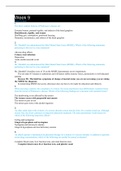
Week 9 Return to deck 1. The three cardinal features of Parkinson’s disease are: Essential tremor, postural rigidity, and infarcts of the basal ganglion Bradykinesia, rigidity, and tremor Shuffling gait, constipation, positional freezing. Dementia, incontinence, and infarcts of the basal ganglion 2. Mr. Marshall was administered the Mini-Mental State Exam (MMSE). Which of the following statements pertaining to this tool is a true statement? Adverse drug effects Urinary tract infection Depression Acute cerebrovascular event 3. Mr. Marshall was administered the Mini-Mental State Exam (MMSE). Which of the following statements pertaining to this tool is a true statement? Mr. Marshall’s baseline score of 18 on the MMSE demonstrates severe impairment. The test takes 45 minutes to administer and will detect subtle memory losses, particularly in well-educated patients Because Mr. Marshall has symptoms of change of mental status you are not screening; you are doing the MMSE for diagnosis. In interpreting MMSE test scores, allowance does not have to be made for education and ethnicity 4. When assessing a patient who complains of a tremor, the nurse practitioner must differentiate essential tremor from the tremor of Parkinson’s disease. Which of the following findings are consistent with essential tremor? The handwriting is not affected by the tremor The tremor occurs with purposeful movements The tremor occurs at rest The tremor gets worse with alcohol ingestion 5. An older adult client with a history of a seizure disorder comes into the clinic for a routine check-up. Although seizure free, the client continues on long-term phenytoin treatment. The nurse practitioner would assess for which of the following long-term effects? Lid lag and nystagmus Gingival hyperplasia and nystagmus Nystagmus and microcytic anemia Gingival hyperplasia and iron deficiency anemia 6. An elderly patient is maintained on phenytoin therapy for a history of a seizure disorder. In addition to periodic serum drug concentrations, which of the following are needed for annual evaluation? Complete blood count, liver function tests, and renal function tests Complete blood count, liver function tests, and platelet count Because of megaloblastic anemia? Renal function and calculated creatinine clearance Serum albumin, liver function tests, and renal function tests 7. An elderly patient has had a CVA in the anterior cerebral circulatory system (frontal lobe). What symptoms are most likely expressed? Neglect of body and difficulty organizing space Wernicke’s aphasia (difficulty understanding speech) Disorders of behavior and cognition Bilateral motor and sensory problem 8. The most common neurological cause of seizures in an older adult is Alzheimer’s disease Multiple sclerosis Stroke Peripheral neuropathy 9. Mr. Andrews experienced a brief onset of right-sided weakness, slurred speech, and confusion yesterday. The symptoms have resolved. What should the nurse practitioner do? Assure the patient that he will not experience the symptoms again Identify modifiable cardiovascular risk factors Do a thorough medication review and a CT scan Order a stat EEG and administer O2 by mask
Written for
- Institution
-
South University
- Course
-
Nsg 6420
Document information
- Uploaded on
- April 10, 2021
- Number of pages
- 4
- Written in
- 2020/2021
- Type
- Exam (elaborations)
- Contains
- Questions & answers
Subjects
- nsg 6420
- week 9 nsg 6420
- nsg 6420 week 9 quiz
- nsg 6420 week 9 2021
-
nsg 6420 week 9 quiz nsg6420 week 9 quiz
-
nsg 6420 week 9 quiz nsg6420 week 9 quiz

Also available in package deal