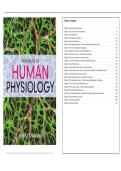
Table of Contents
Chapter 1 Introduction to Physiology 2
TEST BANK Chapter 2 The Cell - Structure and Function
Chapter 3 Cell Metabolism
34
93
Principles of Human Physiology Chapter 4 Cell Membrane Transport 150
Chapter 5 Chemical Messengers 196
Chapter 6 The Endocrine System - Endocrine Glands and Hormone Actions 236
Chapter 7 Nerve Cells and Electrical Signaling 262
Cindy Stanfield Chapter 8 Synaptic Transmission and Neural Integration 303
Chapter 9 The Nervous System - Central Nervous System 349
6th Edition Chapter 10 The Nervous System - Sensory Systems 402
Mbuthia
Mbuthia
Chapter 11 The Nervous System - Autonomic and Motor Systems 475
Chapter 12 Muscle Physiology 500
Chapter 13 The Cardiovascular System - Cardiac Function 557
Chapter 14 The Cardiovascular System - Blood Vessels, Blood Flow, and Blood Pressure 603
Chapter 15 The Cardiovascular System - Blood 662
Chapter 16 The Respiratory System - Pulmonary Ventilation 693
Chapter 17 The Respiratory System - Gas Exchange and Regulation of Breathing 737
Chapter 18 The Urinary System - Renal Function 785
Chapter 19 The Urinary System - Fluid and Electrolyte Balance 840
Chapter 20 The Gastrointestinal System 889
Chapter 21 The Endocrine System - Regulation of Energy Metabolism and Growth 959
Chapter 22 The Reproductive System 1008
Chapter 23 The Immune System 1066
Chapter 24 Diabetes Mellitus 1113
WWW.TBSM.WS
,______________________________________________________________________________________________
Test Bank - Principles of Human Physiology, 6e (Stanfield, 2016) ______________________________________________________________________________________________
Test Bank - Principles of Human Physiology, 6e (Stanfield, 2016)
Principles of Human Physiology, 6e (Stanfield) 4) ________ are found in the linings of hollow organs where they separate fluids in the interior
Chapter 1 Introduction to Physiology cavity from the surrounding body fluids. The interior cavity of a hollow organ or vessel is known
as a ________.
1.1 Multiple Choice Questions A) Endocrine cells : lumen
B) Smooth muscle cells : cavity
1) The smallest living units capable of carrying out their own basic life functions are called C) Epithelial : lumen
A) organs. D) Connective tissues : basement membran
B) organ systems. E) Elastin cells : cavity
C) tissues. Answer: C
D) cells. Learning Outcome: 1.1
E) organelles. HAPS LO: HAPS-1
Answer: D Bloom's Taxonomy: Knowledge
Mbuthia
Mbuthia
HAPS LO: HAPS-1 Chapter Section: 1.1
Bloom's Taxonomy: Knowledge
Chapter Section: 1.1 5) The tissue type that generates mechanical force and movement, and whose activity is
controlled both on a voluntary and involuntary level, is ________ tissue.
2) Cells are classified into which of the following four broad categories? A) muscle
A) squamous, cubodial, columnar, and basement membranes B) epithelial
B) skeletal, cardiac, endocrine, and nervous C) connective
C) neurons, muscle, epithelial, and connective tissue D) nervous
D) atoms, tissues, organs, and organ systems E) skeletal
E) endocrine, nervous, integumentary, and reproductive Answer: A
Answer: C Learning Outcome: 1.1
Learning Outcome: 1.1 HAPS LO: HAPS-1|2
HAPS LO: HAPS-1 Bloom's Taxonomy: Knowledge
Bloom's Taxonomy: Knowledge Chapter Section: 1.1
Chapter Section: 1.1
6) Glands are derived from what type of tissue?
3) Epithelial cells are associated with a noncellular material called a(n) A) muscle
A) fibroblast. B) connective
B) connective tissue. C) epithelial
C) endocrine gland. D) nerve
D) basement membrane. E) reticular
E) muscle fiber. Answer: C
Answer: D Learning Outcome: 1.1
Learning Outcome: 1.1 HAPS LO: HAPS-1
HAPS LO: HAPS-1 Bloom's Taxonomy: Knowledge
Bloom's Taxonomy: Knowledge Chapter Section: 1.1
Chapter Section: 1.1
______________________________________________________________________________________________ ______________________________________________________________________________________________
WWW.TBSM.WS 1|Page WWW.TBSM.WS 2|Page
,______________________________________________________________________________________________
Test Bank - Principles of Human Physiology, 6e (Stanfield, 2016) ______________________________________________________________________________________________
Test Bank - Principles of Human Physiology, 6e (Stanfield, 2016)
7) The cell types blood, bone, fat, and lymph would be categorized into which of the following 10) Which of the following is a protein found in connective tissue that provides the tensile
major cell classes? strength to resist stretching?
A) neurons A) collagen
B) muscle cells B) elastin
C) epithelial cells C) erythropoietin
D) connective tissue cells D) basement membrane
E) endocrine cells E) vimentin
Answer: D Answer: A
Learning Outcome: 1.1 Learning Outcome: 1.1
HAPS LO: HAPS-1 HAPS LO: HAPS-2
Bloom's Taxonomy: Knowledge Bloom's Taxonomy: Knowledge
Chapter Section: 1.1 Chapter Section: 1.1
Mbuthia
Mbuthia
8) Which tissue type includes cells contained in an extracellular matrix composed of collagen 11) What are the structures that attach bone to muscle?
and elastin? A) ligaments
A) muscle tissue B) aponeuroses
B) epithelial tissue C) extracellular matrix proteins
C) connective tissue D) tendons
D) nervous tissue E) intracellular matrix proteins
E) endocrine tissue Answer: D
Answer: C Learning Outcome: 1.1
Learning Outcome: 1.1 HAPS LO: HAPS-2
HAPS LO: HAPS-1|2 Bloom's Taxonomy: Knowledge
Bloom's Taxonomy: Knowledge Chapter Section: 1.1
Chapter Section: 1.1
12) Organs of the body are defined as
9) What is a general name for the noncellular material that holds the widely scattered cells of A) a collection of cells that perform similar functions.
connective tissue together? B) two or more tissues combined to form a structure that allows each tissue to function
A) basement membrane independently.
B) collagen C) a collection of cells that function independently of one another.
C) intracellular matrix D) a combination of two or more tissues that make up a structure which performs a specific
D) extracellular matrix function.
E) elastin E) a collection of tissues that function independently of one another.
Answer: D Answer: D
HAPS LO: HAPS-1 HAPS LO: HAPS-1
Bloom's Taxonomy: Knowledge Bloom's Taxonomy: Knowledge
Chapter Section: 1.1 Chapter Section: 1.1
______________________________________________________________________________________________ ______________________________________________________________________________________________
WWW.TBSM.WS 3|Page WWW.TBSM.WS 4|Page
, ______________________________________________________________________________________________
Test Bank - Principles of Human Physiology, 6e (Stanfield, 2016) ______________________________________________________________________________________________
Test Bank - Principles of Human Physiology, 6e (Stanfield, 2016)
13) Which of the following accurately represents the order of complexity for the components of 17) The process whereby fluid from the bloodstream enters the tubules of the kidneys is called
the body, from least to most complex? A) filtration.
A) organ systems, cells, tissues, organs B) excretion.
B) tissues, cells, organs, organ systems C) secretion.
C) cells, tissues, organs, organ systems D) absorption.
D) cells, tissues, organ systems, organs E) reabsorption.
E) organ systems, organs, tissues, cells Answer: A
Answer: C HAPS LO: HAPS-1
HAPS LO: HAPS-1 Bloom's Taxonomy: Comprehension
Bloom's Taxonomy: Knowledge Chapter Section: 1.1
Chapter Section: 1.1
18) The process whereby fluid in the kidneys is transported from the tubules back into the
Mbuthia
Mbuthia
14) The uptake of nutrients across the epithelial cells of the gastrointestinal tract and into the bloodstream is called
bloodstream is called A) filtration.
A) filtration. B) excretion.
B) excretion. C) secretion.
C) secretion. D) absorption.
D) absorption. E) reabsorption.
E) reabsorption. Answer: E
Answer: D HAPS LO: HAPS-1
Learning Outcome: 1.2 Bloom's Taxonomy: Comprehension
HAPS LO: HAPS-1 Chapter Section: 1.1
Bloom's Taxonomy: Knowledge
Chapter Section: 1.1 19) Referring to a membrane as "selectively permeable" describes its ability to
A) allow the movement of particular molecules across a membrane.
15) What organ system includes the pituitary gland, adrenal gland, and thyroid gland? B) restrict only the movement of sodium across a membrane.
A) nervous C) provide a barrier that restricts the movement of all molecules across a membrane.
B) endocrine D) provide a minimal barrier that allows almost any molecule to move across a membrane.
C) cardiovascular E) restrict only the movement of potassium across the membrane.
D) integumentary Answer: A
E) immune HAPS LO: HAPS-2
Answer: B Bloom's Taxonomy: Comprehension
HAPS LO: HAPS-1 Chapter Section: 1.1
Bloom's Taxonomy: Knowledge
Chapter Section: 1.1 20) Extracellular fluid is composed of
A) interstitial fluid and plasma.
16) The lumen of which of the following systems is part of the internal environment? B) plasma and intracellular fluid.
A) gastrointestinal system C) interstitial fluid only.
B) respiratory system D) plasma only.
C) cardiovascular system E) intracellular fluid only.
D) urinary system Answer: A
E) gastrointestinal and urinary systems Learning Outcome: 1.2
Answer: C HAPS LO: HAPS-1
Learning Outcome: 1.2 Bloom's Taxonomy: Knowledge
HAPS LO: HAPS-2 Chapter Section: 1.1
Bloom's Taxonomy: Comprehension
Chapter Section: 1.1
______________________________________________________________________________________________ ______________________________________________________________________________________________
WWW.TBSM.WS 5|Page WWW.TBSM.WS 6|Page
Chapter 1 Introduction to Physiology 2
TEST BANK Chapter 2 The Cell - Structure and Function
Chapter 3 Cell Metabolism
34
93
Principles of Human Physiology Chapter 4 Cell Membrane Transport 150
Chapter 5 Chemical Messengers 196
Chapter 6 The Endocrine System - Endocrine Glands and Hormone Actions 236
Chapter 7 Nerve Cells and Electrical Signaling 262
Cindy Stanfield Chapter 8 Synaptic Transmission and Neural Integration 303
Chapter 9 The Nervous System - Central Nervous System 349
6th Edition Chapter 10 The Nervous System - Sensory Systems 402
Mbuthia
Mbuthia
Chapter 11 The Nervous System - Autonomic and Motor Systems 475
Chapter 12 Muscle Physiology 500
Chapter 13 The Cardiovascular System - Cardiac Function 557
Chapter 14 The Cardiovascular System - Blood Vessels, Blood Flow, and Blood Pressure 603
Chapter 15 The Cardiovascular System - Blood 662
Chapter 16 The Respiratory System - Pulmonary Ventilation 693
Chapter 17 The Respiratory System - Gas Exchange and Regulation of Breathing 737
Chapter 18 The Urinary System - Renal Function 785
Chapter 19 The Urinary System - Fluid and Electrolyte Balance 840
Chapter 20 The Gastrointestinal System 889
Chapter 21 The Endocrine System - Regulation of Energy Metabolism and Growth 959
Chapter 22 The Reproductive System 1008
Chapter 23 The Immune System 1066
Chapter 24 Diabetes Mellitus 1113
WWW.TBSM.WS
,______________________________________________________________________________________________
Test Bank - Principles of Human Physiology, 6e (Stanfield, 2016) ______________________________________________________________________________________________
Test Bank - Principles of Human Physiology, 6e (Stanfield, 2016)
Principles of Human Physiology, 6e (Stanfield) 4) ________ are found in the linings of hollow organs where they separate fluids in the interior
Chapter 1 Introduction to Physiology cavity from the surrounding body fluids. The interior cavity of a hollow organ or vessel is known
as a ________.
1.1 Multiple Choice Questions A) Endocrine cells : lumen
B) Smooth muscle cells : cavity
1) The smallest living units capable of carrying out their own basic life functions are called C) Epithelial : lumen
A) organs. D) Connective tissues : basement membran
B) organ systems. E) Elastin cells : cavity
C) tissues. Answer: C
D) cells. Learning Outcome: 1.1
E) organelles. HAPS LO: HAPS-1
Answer: D Bloom's Taxonomy: Knowledge
Mbuthia
Mbuthia
HAPS LO: HAPS-1 Chapter Section: 1.1
Bloom's Taxonomy: Knowledge
Chapter Section: 1.1 5) The tissue type that generates mechanical force and movement, and whose activity is
controlled both on a voluntary and involuntary level, is ________ tissue.
2) Cells are classified into which of the following four broad categories? A) muscle
A) squamous, cubodial, columnar, and basement membranes B) epithelial
B) skeletal, cardiac, endocrine, and nervous C) connective
C) neurons, muscle, epithelial, and connective tissue D) nervous
D) atoms, tissues, organs, and organ systems E) skeletal
E) endocrine, nervous, integumentary, and reproductive Answer: A
Answer: C Learning Outcome: 1.1
Learning Outcome: 1.1 HAPS LO: HAPS-1|2
HAPS LO: HAPS-1 Bloom's Taxonomy: Knowledge
Bloom's Taxonomy: Knowledge Chapter Section: 1.1
Chapter Section: 1.1
6) Glands are derived from what type of tissue?
3) Epithelial cells are associated with a noncellular material called a(n) A) muscle
A) fibroblast. B) connective
B) connective tissue. C) epithelial
C) endocrine gland. D) nerve
D) basement membrane. E) reticular
E) muscle fiber. Answer: C
Answer: D Learning Outcome: 1.1
Learning Outcome: 1.1 HAPS LO: HAPS-1
HAPS LO: HAPS-1 Bloom's Taxonomy: Knowledge
Bloom's Taxonomy: Knowledge Chapter Section: 1.1
Chapter Section: 1.1
______________________________________________________________________________________________ ______________________________________________________________________________________________
WWW.TBSM.WS 1|Page WWW.TBSM.WS 2|Page
,______________________________________________________________________________________________
Test Bank - Principles of Human Physiology, 6e (Stanfield, 2016) ______________________________________________________________________________________________
Test Bank - Principles of Human Physiology, 6e (Stanfield, 2016)
7) The cell types blood, bone, fat, and lymph would be categorized into which of the following 10) Which of the following is a protein found in connective tissue that provides the tensile
major cell classes? strength to resist stretching?
A) neurons A) collagen
B) muscle cells B) elastin
C) epithelial cells C) erythropoietin
D) connective tissue cells D) basement membrane
E) endocrine cells E) vimentin
Answer: D Answer: A
Learning Outcome: 1.1 Learning Outcome: 1.1
HAPS LO: HAPS-1 HAPS LO: HAPS-2
Bloom's Taxonomy: Knowledge Bloom's Taxonomy: Knowledge
Chapter Section: 1.1 Chapter Section: 1.1
Mbuthia
Mbuthia
8) Which tissue type includes cells contained in an extracellular matrix composed of collagen 11) What are the structures that attach bone to muscle?
and elastin? A) ligaments
A) muscle tissue B) aponeuroses
B) epithelial tissue C) extracellular matrix proteins
C) connective tissue D) tendons
D) nervous tissue E) intracellular matrix proteins
E) endocrine tissue Answer: D
Answer: C Learning Outcome: 1.1
Learning Outcome: 1.1 HAPS LO: HAPS-2
HAPS LO: HAPS-1|2 Bloom's Taxonomy: Knowledge
Bloom's Taxonomy: Knowledge Chapter Section: 1.1
Chapter Section: 1.1
12) Organs of the body are defined as
9) What is a general name for the noncellular material that holds the widely scattered cells of A) a collection of cells that perform similar functions.
connective tissue together? B) two or more tissues combined to form a structure that allows each tissue to function
A) basement membrane independently.
B) collagen C) a collection of cells that function independently of one another.
C) intracellular matrix D) a combination of two or more tissues that make up a structure which performs a specific
D) extracellular matrix function.
E) elastin E) a collection of tissues that function independently of one another.
Answer: D Answer: D
HAPS LO: HAPS-1 HAPS LO: HAPS-1
Bloom's Taxonomy: Knowledge Bloom's Taxonomy: Knowledge
Chapter Section: 1.1 Chapter Section: 1.1
______________________________________________________________________________________________ ______________________________________________________________________________________________
WWW.TBSM.WS 3|Page WWW.TBSM.WS 4|Page
, ______________________________________________________________________________________________
Test Bank - Principles of Human Physiology, 6e (Stanfield, 2016) ______________________________________________________________________________________________
Test Bank - Principles of Human Physiology, 6e (Stanfield, 2016)
13) Which of the following accurately represents the order of complexity for the components of 17) The process whereby fluid from the bloodstream enters the tubules of the kidneys is called
the body, from least to most complex? A) filtration.
A) organ systems, cells, tissues, organs B) excretion.
B) tissues, cells, organs, organ systems C) secretion.
C) cells, tissues, organs, organ systems D) absorption.
D) cells, tissues, organ systems, organs E) reabsorption.
E) organ systems, organs, tissues, cells Answer: A
Answer: C HAPS LO: HAPS-1
HAPS LO: HAPS-1 Bloom's Taxonomy: Comprehension
Bloom's Taxonomy: Knowledge Chapter Section: 1.1
Chapter Section: 1.1
18) The process whereby fluid in the kidneys is transported from the tubules back into the
Mbuthia
Mbuthia
14) The uptake of nutrients across the epithelial cells of the gastrointestinal tract and into the bloodstream is called
bloodstream is called A) filtration.
A) filtration. B) excretion.
B) excretion. C) secretion.
C) secretion. D) absorption.
D) absorption. E) reabsorption.
E) reabsorption. Answer: E
Answer: D HAPS LO: HAPS-1
Learning Outcome: 1.2 Bloom's Taxonomy: Comprehension
HAPS LO: HAPS-1 Chapter Section: 1.1
Bloom's Taxonomy: Knowledge
Chapter Section: 1.1 19) Referring to a membrane as "selectively permeable" describes its ability to
A) allow the movement of particular molecules across a membrane.
15) What organ system includes the pituitary gland, adrenal gland, and thyroid gland? B) restrict only the movement of sodium across a membrane.
A) nervous C) provide a barrier that restricts the movement of all molecules across a membrane.
B) endocrine D) provide a minimal barrier that allows almost any molecule to move across a membrane.
C) cardiovascular E) restrict only the movement of potassium across the membrane.
D) integumentary Answer: A
E) immune HAPS LO: HAPS-2
Answer: B Bloom's Taxonomy: Comprehension
HAPS LO: HAPS-1 Chapter Section: 1.1
Bloom's Taxonomy: Knowledge
Chapter Section: 1.1 20) Extracellular fluid is composed of
A) interstitial fluid and plasma.
16) The lumen of which of the following systems is part of the internal environment? B) plasma and intracellular fluid.
A) gastrointestinal system C) interstitial fluid only.
B) respiratory system D) plasma only.
C) cardiovascular system E) intracellular fluid only.
D) urinary system Answer: A
E) gastrointestinal and urinary systems Learning Outcome: 1.2
Answer: C HAPS LO: HAPS-1
Learning Outcome: 1.2 Bloom's Taxonomy: Knowledge
HAPS LO: HAPS-2 Chapter Section: 1.1
Bloom's Taxonomy: Comprehension
Chapter Section: 1.1
______________________________________________________________________________________________ ______________________________________________________________________________________________
WWW.TBSM.WS 5|Page WWW.TBSM.WS 6|Page