

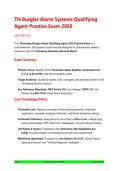
TN Burglar Alarm Systems Qualifying
Agent Practice Exam 2026
DESCRIPTION
This Tennessee Burglar Alarm Qualifying Agent (QA) Practice Exam is a
comprehensive, 250-question study resource designed for professionals seeking
licensure under the Tennessee Detection Services Board.
Exam Summary
Primary Focus: Mastery of the Tennessee Alarm Systems Contractors Act
(T.C.A. § 62-32-301) and technical safety codes.
Target Audience: Qualifying Agents (QA), managers, and business owners in the
Tennessee security industry.
Key Reference Standards: NEC Article 725 (Low Voltage), NFPA 101 (Life
Safety), and SIA CP-01 (False Alarm Reduction).
Core Knowledge Pillars
Tennessee Law: Rigorous coverage of licensing requirements, employee
registration, mandatory background checks, and Board disciplinary actions.
Technical Proficiency: Deep dive into circuit theory (Ohm’s Law, voltage drop),
sensor technologies (PIR, Dual-Tech, Glassbreak), and grounding protocols.
Life Safety & Egress: Compliance with Americans with Disabilities Act
(ADA) mounting heights and emergency fail-safe lock requirements.
Monitoring Operations: Protocols for Line Seizure (RJ-31X), Central Station
signal prioritization, and "Verified Response" strategies.
2026 Question And ANSWER Latest Update
,This set features Multiple-Choice Questions with detailed rationales in italics,
providing the legal and technical "why" behind every answer to ensure success on
the Tennessee QA state exam.
Tennessee Burglar Alarm Qualifying Agent (QA) Practice Exam
Batch 1: Licensing, Law, and Board Rules)
1. According to T.C.A. § 62-32-303, which body is responsible for the
administration and enforcement of the Alarm Systems Contractors Act?
A) The Tennessee Bureau of Investigation (TBI)
B) The Tennessee Detection Services Board
C) The State Fire Marshal’s Office
D) The Department of Safety and Homeland Security
Answer: B
Rationale: The Tennessee Detection Services Board, under the Department of
Commerce and Insurance, oversees the licensing and regulation of alarm contractors,
qualifying agents, and employees.
2. What is the minimum age required to be licensed as a Qualifying Agent (QA) in
Tennessee?
A) 18 years
B) 19 years
C) 21 years
D) 25 years
Answer: C
Rationale: T.C.A. § 62-32-312 requires QAs to be at least 21 years old. Note that
general registered employees only need to be 18.
3. A Tennessee alarm company must notify the Board of a change in its primary
business address within how many days?
A) 10 days
B) 15 days
C) 30 days
D) 45 days
Answer: C
2026 Question And ANSWER Latest Update
,Rationale: Board Rule 1175-01-.06 mandates that the Board be notified in writing of any
change in business location within 30 days to ensure regulatory oversight.
4. If a Qualifying Agent (QA) ceases to be affiliated with a licensed alarm
company, the company must notify the Board within how many days?
A) 5 business days
B) 10 business days
C) 15 business days
D) 30 business days
Answer: B
Rationale: The company must notify the Board within 10 business days of the QA’s
departure. The company then typically has 30 days to designate a new QA.
5. Which of the following is a mandatory requirement for an individual applying
for an alarm employee registration card?
A) A Bachelor's degree
B) A $50,000 personal bond
C) Submission of fingerprints for a criminal background check
D) 5 years of Tennessee residency
Answer: C
Rationale: T.C.A. § 62-32-312 requires all applicants to be fingerprinted for a TBI and
FBI criminal history check to ensure they do not have disqualifying convictions.
6. A Qualifying Agent must complete how many hours of Board-approved
continuing education (CE) every two years?
A) 8 hours
/B) 12 hours
C) 16 hours
D) 24 hours
Answer: C
Rationale: Rule 1175-04-.01 requires QAs to complete 16 hours of CE during each two-
year renewal cycle to stay current on laws and technology.
7. In Tennessee, an alarm system contractor’s license is generally valid for a
period of:
A) 1 year
B) 2 years
C) 3 years
D) 5 years
Answer: B
2026 Question And ANSWER Latest Update
, Rationale: All licenses and registrations issued by the Detection Services Board expire
every two years and must be renewed with the appropriate fee and CE documentation.
8. Which of the following is considered a "Class B" violation by the Tennessee
Detection Services Board?
A) Failure to display a registration card
B) Operating with an expired license
C) Failure to notify the Board of an address change
D) All of the above
Answer: D
Rationale: Administrative failures, such as expired licenses or missing notifications, are
classified as violations that can result in civil penalties of up to $1,000 per occurrence.
9. What is the maximum civil penalty the Board can impose for a single violation
of the Alarm Systems Contractors Act?
A) $500
B) $1,000
C) $2,500
D) $5,000
Answer: B
Rationale: T.C.A. § 62-32-320 authorizes the Board to assess a civil penalty not to
exceed $1,000 for each violation.
10. A "Qualifying Agent" is legally defined as:
A) The person who owns at least 51% of the company
B) An individual who has passed the required exam and is responsible for the daily
operations and technical supervision of the company
C) Any employee who installs a wire
D) The company's legal attorney
Answer: B
Rationale: The QA is the technical lead of the company. A company cannot perform
alarm contracting without an active QA.
11. When an alarm system is installed in a residential property, the contractor
must provide the customer with:
A) A copy of the QA's driver's license
B) A written contract and a "Notice of Cancellation" (3-day right to rescind)
C) The personal cell phone number of the installer
D) A free 5-year warranty
Answer: B
2026 Question And ANSWER Latest Update
Agent Practice Exam 2026
DESCRIPTION
This Tennessee Burglar Alarm Qualifying Agent (QA) Practice Exam is a
comprehensive, 250-question study resource designed for professionals seeking
licensure under the Tennessee Detection Services Board.
Exam Summary
Primary Focus: Mastery of the Tennessee Alarm Systems Contractors Act
(T.C.A. § 62-32-301) and technical safety codes.
Target Audience: Qualifying Agents (QA), managers, and business owners in the
Tennessee security industry.
Key Reference Standards: NEC Article 725 (Low Voltage), NFPA 101 (Life
Safety), and SIA CP-01 (False Alarm Reduction).
Core Knowledge Pillars
Tennessee Law: Rigorous coverage of licensing requirements, employee
registration, mandatory background checks, and Board disciplinary actions.
Technical Proficiency: Deep dive into circuit theory (Ohm’s Law, voltage drop),
sensor technologies (PIR, Dual-Tech, Glassbreak), and grounding protocols.
Life Safety & Egress: Compliance with Americans with Disabilities Act
(ADA) mounting heights and emergency fail-safe lock requirements.
Monitoring Operations: Protocols for Line Seizure (RJ-31X), Central Station
signal prioritization, and "Verified Response" strategies.
2026 Question And ANSWER Latest Update
,This set features Multiple-Choice Questions with detailed rationales in italics,
providing the legal and technical "why" behind every answer to ensure success on
the Tennessee QA state exam.
Tennessee Burglar Alarm Qualifying Agent (QA) Practice Exam
Batch 1: Licensing, Law, and Board Rules)
1. According to T.C.A. § 62-32-303, which body is responsible for the
administration and enforcement of the Alarm Systems Contractors Act?
A) The Tennessee Bureau of Investigation (TBI)
B) The Tennessee Detection Services Board
C) The State Fire Marshal’s Office
D) The Department of Safety and Homeland Security
Answer: B
Rationale: The Tennessee Detection Services Board, under the Department of
Commerce and Insurance, oversees the licensing and regulation of alarm contractors,
qualifying agents, and employees.
2. What is the minimum age required to be licensed as a Qualifying Agent (QA) in
Tennessee?
A) 18 years
B) 19 years
C) 21 years
D) 25 years
Answer: C
Rationale: T.C.A. § 62-32-312 requires QAs to be at least 21 years old. Note that
general registered employees only need to be 18.
3. A Tennessee alarm company must notify the Board of a change in its primary
business address within how many days?
A) 10 days
B) 15 days
C) 30 days
D) 45 days
Answer: C
2026 Question And ANSWER Latest Update
,Rationale: Board Rule 1175-01-.06 mandates that the Board be notified in writing of any
change in business location within 30 days to ensure regulatory oversight.
4. If a Qualifying Agent (QA) ceases to be affiliated with a licensed alarm
company, the company must notify the Board within how many days?
A) 5 business days
B) 10 business days
C) 15 business days
D) 30 business days
Answer: B
Rationale: The company must notify the Board within 10 business days of the QA’s
departure. The company then typically has 30 days to designate a new QA.
5. Which of the following is a mandatory requirement for an individual applying
for an alarm employee registration card?
A) A Bachelor's degree
B) A $50,000 personal bond
C) Submission of fingerprints for a criminal background check
D) 5 years of Tennessee residency
Answer: C
Rationale: T.C.A. § 62-32-312 requires all applicants to be fingerprinted for a TBI and
FBI criminal history check to ensure they do not have disqualifying convictions.
6. A Qualifying Agent must complete how many hours of Board-approved
continuing education (CE) every two years?
A) 8 hours
/B) 12 hours
C) 16 hours
D) 24 hours
Answer: C
Rationale: Rule 1175-04-.01 requires QAs to complete 16 hours of CE during each two-
year renewal cycle to stay current on laws and technology.
7. In Tennessee, an alarm system contractor’s license is generally valid for a
period of:
A) 1 year
B) 2 years
C) 3 years
D) 5 years
Answer: B
2026 Question And ANSWER Latest Update
, Rationale: All licenses and registrations issued by the Detection Services Board expire
every two years and must be renewed with the appropriate fee and CE documentation.
8. Which of the following is considered a "Class B" violation by the Tennessee
Detection Services Board?
A) Failure to display a registration card
B) Operating with an expired license
C) Failure to notify the Board of an address change
D) All of the above
Answer: D
Rationale: Administrative failures, such as expired licenses or missing notifications, are
classified as violations that can result in civil penalties of up to $1,000 per occurrence.
9. What is the maximum civil penalty the Board can impose for a single violation
of the Alarm Systems Contractors Act?
A) $500
B) $1,000
C) $2,500
D) $5,000
Answer: B
Rationale: T.C.A. § 62-32-320 authorizes the Board to assess a civil penalty not to
exceed $1,000 for each violation.
10. A "Qualifying Agent" is legally defined as:
A) The person who owns at least 51% of the company
B) An individual who has passed the required exam and is responsible for the daily
operations and technical supervision of the company
C) Any employee who installs a wire
D) The company's legal attorney
Answer: B
Rationale: The QA is the technical lead of the company. A company cannot perform
alarm contracting without an active QA.
11. When an alarm system is installed in a residential property, the contractor
must provide the customer with:
A) A copy of the QA's driver's license
B) A written contract and a "Notice of Cancellation" (3-day right to rescind)
C) The personal cell phone number of the installer
D) A free 5-year warranty
Answer: B
2026 Question And ANSWER Latest Update


