

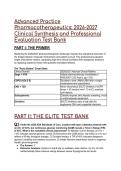
Advanced Practice
Pharmacotherapeutics: 2026-2027
Clinical Synthesis and Professional
Evaluation Test Bank
PART I: THE PRIMER
Mastering the 2026/2027 pharmacotherapeutic landscape requires the operational execution of
the bridge between molecular mechanisms and patient survival. This professional evaluation
forges prescriptive intuition, separating high-level clinical architects from dangerous amateurs
by replacing academic theory with guideline-mandated reflexes.
The "Panic Button" Cheat Sheet
Clinical Domain 2026/2027 Absolute Clinical Redline
Stage 1 HTN Initiate pharmacotherapy immediately if
PREVENT CVD Risk is \ge 7.5\%.
COPD (GOLD E) Escalate to dual LAMA/LABA after a single
moderate/severe exacerbation.
CKD + T2D Never discontinue SGLT2 inhibitors if eGFR
drops < 20 \text{mL/min/1.73 m}^2; maintain
until dialysis.
Schizophrenia Cobenfy requires strict hepatic screening; avoid
in mild/moderate impairment.
Geriatrics SGLT2 inhibitors carry a high alert for
euglycemic DKA and urogenital infections.
PART II: THE ELITE TEST BANK
Q1: Under the 2026 ADA Standards of Care, a patient with type 2 diabetes presents with
an A1c of 6.8%, but continuous glucose monitoring (CGM) reveals a Time in Range (TIR)
of 45%. What is the mandated clinical assessment? A) Maintain current therapy; an A1c <
7.0% indicates optimal glycemic control. B) Discontinue the CGM device; rely solely on A1c as it
reflects a 90-day biological average. C) Escalate therapy; a TIR of 45% indicates dangerous
glycemic variability and masked excursions. D) Initiate intensive basal-bolus insulin to suppress
hepatic gluconeogenesis.
● The Answer: C
● Distractor Analysis: Options A and B rely on outdated, static metrics. An A1c of 6.8%
mathematically hides massive swings between severe hypoglycemia and acute
, hyperglycemia. Option D is a reactionary over-correction without assessing specific
time-based excursion patterns.
● The Mentor's Analysis: The 2026 paradigm replaces A1c with Time in Range (TIR) as
the primary indicator of efficacy. A TIR of 45% falls far below the >70% target (70-180
mg/dL), proving the A1c is artificially lowered by hypoglycemic events. Advanced
practitioners manage the dynamic physiological waveform.
Q2: A 58-year-old male with type 2 diabetes, a BMI of 34, and symptomatic heart failure
with preserved ejection fraction (HFpEF) requires glycemic escalation. Based on the ADA
2026 guidelines, which pharmacotherapeutic agent is explicitly mandated? A) A
sulfonylurea to rapidly force pancreatic insulin secretion. B) A dual GIP/GLP-1 receptor agonist
or a GLP-1 RA with proven HF benefits. C) A DPP-4 inhibitor to stabilize incretin levels safely.
D) A thiazolidinedione to increase peripheral insulin sensitivity.
● The Answer: B
● Distractor Analysis: Option A increases cardiovascular mortality and hypoglycemia risks
in HF patients. Option C has neutral or negative HF outcomes. Option D causes fluid
retention, an absolute contraindication in symptomatic HFpEF.
● The Mentor's Analysis: The 2026 ADA Standards specifically recommend dual
GIP/GLP-1 RAs for patients with T2D, obesity, and symptomatic HFpEF. Managing
diabetes requires rewiring the metabolic thermostat to reduce adipose tissue and offload
cardiac strain.
Q3: A clinician is evaluating a 45-year-old female with an average office blood pressure
of 134/84 mmHg. She has no history of cardiovascular disease. The AHA 2023 PREVENT
equations yield a 10-year CVD risk score of 8.2%. According to the 2025/2026 AHA/ACC
Hypertension Guidelines, what is the required intervention? A) Recommend a 6-month trial
of the DASH diet and weight loss before considering medication. B) Initiate a single-pill
combination (SPC) of two first-line antihypertensive agents. C) Initiate monotherapy with a
first-line antihypertensive agent alongside lifestyle modifications. D) Classify her as "Elevated
BP" and schedule a follow-up in one year.
● The Answer: C
● Distractor Analysis: Option A ignores the high-risk PREVENT threshold. Option B is
aggressive and reserved for Stage 2 HTN. Option D is a misclassification; 134/84 is Stage
1 HTN.
● The Mentor's Analysis: The 2025 AHA/ACC guidelines shifted the Stage 1 HTN
treatment threshold. If a patient is Stage 1 (130-139/80-89) and their PREVENT score is
\ge 7.5\%, the clinical redline is crossed, and pharmacological initiation is mandated to
prevent target organ damage.
Q4: A 62-year-old male with Stage 2 Hypertension (146/92 mmHg) requires immediate
pharmacotherapy. Following the 2025 AHA/ACC guidelines, what is the optimal
prescribing strategy? A) Start lisinopril 10 mg daily, titrate to 40 mg before adding a second
agent. B) Initiate a single-pill combination (SPC) containing two first-line agents from different
classes. C) Prescribe a beta-blocker as first-line monotherapy. D) Combine an ACE inhibitor
with an ARB to maximize RAAS blockade.
● The Answer: B
, ● Distractor Analysis: Option A relies on archaic, slow-step titration that leaves the patient
exposed to sheer hemodynamic stress. Option C is incorrect; beta-blockers are not
first-line for uncomplicated HTN. Option D is a fatal prescribing cascade causing acute
kidney injury.
● The Mentor's Analysis: Time to BP control is a critical survival metric. The 2025
guidelines mandate Single Pill Combinations (SPCs) as initial therapy for Stage 2 HTN
because combining mechanisms (e.g., CCB + ACEi) neutralizes counter-regulatory
pathways and significantly improves adherence.
Q5: A patient with Chronic Obstructive Pulmonary Disease (COPD) suffered a single
moderate exacerbation requiring oral corticosteroids three months ago. According to the
2026 GOLD Report, what is their classification and baseline pharmacotherapy? A) GOLD
Group A; prescribe a short-acting bronchodilator (SABA) PRN. B) GOLD Group B; prescribe a
long-acting muscarinic antagonist (LAMA) monotherapy. C) GOLD Group E; prescribe dual
LAMA + LABA therapy. D) GOLD Group E; prescribe triple therapy (LAMA + LABA + ICS)
regardless of eosinophil count.
● The Answer: C
● Distractor Analysis: Options A and B ignore the exacerbation history. Option D is
dangerous; ICS is only added if blood eosinophils are \ge 300 cells/µL.
● The Mentor's Analysis: The 2026 GOLD Report lowered the threshold for the high-risk
"Group E" classification to just one moderate or severe exacerbation. A single
exacerbation sends a massive cardiovascular shockwave through the system. Dual
bronchodilation is the required structural scaffolding to maintain airway patency.
Q6: A prescriber is managing a 68-year-old with Type 2 Diabetes and CKD. His eGFR is
35 \text{mL/min/1.73 m}^2, and his urine albumin-to-creatinine ratio (UACR) is 300 mg/g
despite maximum tolerated ACE inhibitor therapy. His serum potassium is 4.5 mEq/L.
Which agent should be initiated based on KDIGO 2025 guidelines? A) Spironolactone. B)
Finerenone. C) A second RAAS inhibitor (ARB). D) Discontinue the ACE inhibitor due to the low
eGFR.
● The Answer: B
● Distractor Analysis: Option A carries a significantly higher risk of hyperkalemia and
lacks specific CKD outcome data. Option C is strictly contraindicated. Option D removes
vital nephroprotection.
● The Mentor's Analysis: Finerenone is a novel non-steroidal mineralocorticoid receptor
antagonist (nsMRA). Because it distributes evenly between the heart and kidneys, it
reduces albuminuria and cardiovascular events with a much lower hyperkalemia risk than
classic steroidal MRAs. Initiation requires K+ < 4.8 mEq/L.
Q7: A 24-year-old male with schizophrenia has experienced severe metabolic syndrome
on second-generation dopamine antagonists. The prescriber elects to initiate the newly
FDA-approved agent Cobenfy (xanomeline and trospium). Which of the following is a
critical monitoring requirement? A) Weekly absolute neutrophil counts (ANC). B) Assessment
of liver enzymes/bilirubin and monitoring for urinary retention. C) Daily fasting lipid panels and
HbA1c. D) Continuous ECG monitoring for QTc prolongation.
● The Answer: B
● Distractor Analysis: Option A applies to clozapine. Options C and D are primary
Pharmacotherapeutics: 2026-2027
Clinical Synthesis and Professional
Evaluation Test Bank
PART I: THE PRIMER
Mastering the 2026/2027 pharmacotherapeutic landscape requires the operational execution of
the bridge between molecular mechanisms and patient survival. This professional evaluation
forges prescriptive intuition, separating high-level clinical architects from dangerous amateurs
by replacing academic theory with guideline-mandated reflexes.
The "Panic Button" Cheat Sheet
Clinical Domain 2026/2027 Absolute Clinical Redline
Stage 1 HTN Initiate pharmacotherapy immediately if
PREVENT CVD Risk is \ge 7.5\%.
COPD (GOLD E) Escalate to dual LAMA/LABA after a single
moderate/severe exacerbation.
CKD + T2D Never discontinue SGLT2 inhibitors if eGFR
drops < 20 \text{mL/min/1.73 m}^2; maintain
until dialysis.
Schizophrenia Cobenfy requires strict hepatic screening; avoid
in mild/moderate impairment.
Geriatrics SGLT2 inhibitors carry a high alert for
euglycemic DKA and urogenital infections.
PART II: THE ELITE TEST BANK
Q1: Under the 2026 ADA Standards of Care, a patient with type 2 diabetes presents with
an A1c of 6.8%, but continuous glucose monitoring (CGM) reveals a Time in Range (TIR)
of 45%. What is the mandated clinical assessment? A) Maintain current therapy; an A1c <
7.0% indicates optimal glycemic control. B) Discontinue the CGM device; rely solely on A1c as it
reflects a 90-day biological average. C) Escalate therapy; a TIR of 45% indicates dangerous
glycemic variability and masked excursions. D) Initiate intensive basal-bolus insulin to suppress
hepatic gluconeogenesis.
● The Answer: C
● Distractor Analysis: Options A and B rely on outdated, static metrics. An A1c of 6.8%
mathematically hides massive swings between severe hypoglycemia and acute
, hyperglycemia. Option D is a reactionary over-correction without assessing specific
time-based excursion patterns.
● The Mentor's Analysis: The 2026 paradigm replaces A1c with Time in Range (TIR) as
the primary indicator of efficacy. A TIR of 45% falls far below the >70% target (70-180
mg/dL), proving the A1c is artificially lowered by hypoglycemic events. Advanced
practitioners manage the dynamic physiological waveform.
Q2: A 58-year-old male with type 2 diabetes, a BMI of 34, and symptomatic heart failure
with preserved ejection fraction (HFpEF) requires glycemic escalation. Based on the ADA
2026 guidelines, which pharmacotherapeutic agent is explicitly mandated? A) A
sulfonylurea to rapidly force pancreatic insulin secretion. B) A dual GIP/GLP-1 receptor agonist
or a GLP-1 RA with proven HF benefits. C) A DPP-4 inhibitor to stabilize incretin levels safely.
D) A thiazolidinedione to increase peripheral insulin sensitivity.
● The Answer: B
● Distractor Analysis: Option A increases cardiovascular mortality and hypoglycemia risks
in HF patients. Option C has neutral or negative HF outcomes. Option D causes fluid
retention, an absolute contraindication in symptomatic HFpEF.
● The Mentor's Analysis: The 2026 ADA Standards specifically recommend dual
GIP/GLP-1 RAs for patients with T2D, obesity, and symptomatic HFpEF. Managing
diabetes requires rewiring the metabolic thermostat to reduce adipose tissue and offload
cardiac strain.
Q3: A clinician is evaluating a 45-year-old female with an average office blood pressure
of 134/84 mmHg. She has no history of cardiovascular disease. The AHA 2023 PREVENT
equations yield a 10-year CVD risk score of 8.2%. According to the 2025/2026 AHA/ACC
Hypertension Guidelines, what is the required intervention? A) Recommend a 6-month trial
of the DASH diet and weight loss before considering medication. B) Initiate a single-pill
combination (SPC) of two first-line antihypertensive agents. C) Initiate monotherapy with a
first-line antihypertensive agent alongside lifestyle modifications. D) Classify her as "Elevated
BP" and schedule a follow-up in one year.
● The Answer: C
● Distractor Analysis: Option A ignores the high-risk PREVENT threshold. Option B is
aggressive and reserved for Stage 2 HTN. Option D is a misclassification; 134/84 is Stage
1 HTN.
● The Mentor's Analysis: The 2025 AHA/ACC guidelines shifted the Stage 1 HTN
treatment threshold. If a patient is Stage 1 (130-139/80-89) and their PREVENT score is
\ge 7.5\%, the clinical redline is crossed, and pharmacological initiation is mandated to
prevent target organ damage.
Q4: A 62-year-old male with Stage 2 Hypertension (146/92 mmHg) requires immediate
pharmacotherapy. Following the 2025 AHA/ACC guidelines, what is the optimal
prescribing strategy? A) Start lisinopril 10 mg daily, titrate to 40 mg before adding a second
agent. B) Initiate a single-pill combination (SPC) containing two first-line agents from different
classes. C) Prescribe a beta-blocker as first-line monotherapy. D) Combine an ACE inhibitor
with an ARB to maximize RAAS blockade.
● The Answer: B
, ● Distractor Analysis: Option A relies on archaic, slow-step titration that leaves the patient
exposed to sheer hemodynamic stress. Option C is incorrect; beta-blockers are not
first-line for uncomplicated HTN. Option D is a fatal prescribing cascade causing acute
kidney injury.
● The Mentor's Analysis: Time to BP control is a critical survival metric. The 2025
guidelines mandate Single Pill Combinations (SPCs) as initial therapy for Stage 2 HTN
because combining mechanisms (e.g., CCB + ACEi) neutralizes counter-regulatory
pathways and significantly improves adherence.
Q5: A patient with Chronic Obstructive Pulmonary Disease (COPD) suffered a single
moderate exacerbation requiring oral corticosteroids three months ago. According to the
2026 GOLD Report, what is their classification and baseline pharmacotherapy? A) GOLD
Group A; prescribe a short-acting bronchodilator (SABA) PRN. B) GOLD Group B; prescribe a
long-acting muscarinic antagonist (LAMA) monotherapy. C) GOLD Group E; prescribe dual
LAMA + LABA therapy. D) GOLD Group E; prescribe triple therapy (LAMA + LABA + ICS)
regardless of eosinophil count.
● The Answer: C
● Distractor Analysis: Options A and B ignore the exacerbation history. Option D is
dangerous; ICS is only added if blood eosinophils are \ge 300 cells/µL.
● The Mentor's Analysis: The 2026 GOLD Report lowered the threshold for the high-risk
"Group E" classification to just one moderate or severe exacerbation. A single
exacerbation sends a massive cardiovascular shockwave through the system. Dual
bronchodilation is the required structural scaffolding to maintain airway patency.
Q6: A prescriber is managing a 68-year-old with Type 2 Diabetes and CKD. His eGFR is
35 \text{mL/min/1.73 m}^2, and his urine albumin-to-creatinine ratio (UACR) is 300 mg/g
despite maximum tolerated ACE inhibitor therapy. His serum potassium is 4.5 mEq/L.
Which agent should be initiated based on KDIGO 2025 guidelines? A) Spironolactone. B)
Finerenone. C) A second RAAS inhibitor (ARB). D) Discontinue the ACE inhibitor due to the low
eGFR.
● The Answer: B
● Distractor Analysis: Option A carries a significantly higher risk of hyperkalemia and
lacks specific CKD outcome data. Option C is strictly contraindicated. Option D removes
vital nephroprotection.
● The Mentor's Analysis: Finerenone is a novel non-steroidal mineralocorticoid receptor
antagonist (nsMRA). Because it distributes evenly between the heart and kidneys, it
reduces albuminuria and cardiovascular events with a much lower hyperkalemia risk than
classic steroidal MRAs. Initiation requires K+ < 4.8 mEq/L.
Q7: A 24-year-old male with schizophrenia has experienced severe metabolic syndrome
on second-generation dopamine antagonists. The prescriber elects to initiate the newly
FDA-approved agent Cobenfy (xanomeline and trospium). Which of the following is a
critical monitoring requirement? A) Weekly absolute neutrophil counts (ANC). B) Assessment
of liver enzymes/bilirubin and monitoring for urinary retention. C) Daily fasting lipid panels and
HbA1c. D) Continuous ECG monitoring for QTc prolongation.
● The Answer: B
● Distractor Analysis: Option A applies to clozapine. Options C and D are primary


