

lOMoARcPSD|51648332
lOMoARcPSD|51648332
Blood is a type of connective tissue that circulates throughout the body, transporting necessary nutrients and
waste products to and from the body tissues. It is composed of a liquid component called plasma which holds
the formed elements of erythrocytes (red blood cells), leukocytes (white blood cells), and thrombocytes
(platelets). Total blood volume in the average adult is 5 to 6 liters. Figure 4.1 depicts the breakdown of blood
components in an anticoagulated and centrifuged (separated out) blood sample.
As stated earlier, plasma is the liquid component of blood; it contains mostly water (approximately 90% of its
total composition), a small amount of proteins (approximately 6-8% including albumin, fibrinogen, and
globulins), and other small molecular substances (approximately 2%.). Plasma functions in many capacities
primarily in the transport of nutrients, waste products, and even hormones throughout the body. It also plays
a vital role in heat distribution, fluid regulation and acid-base balance.
Blood cells are synthesized in the bone marrow and not all are considered true cells (due to the fact that
some lack a nuclei and organelles). Erythrocytes, or red blood cells (RBCs), carry oxygen to the body tissues
by way of a protein called hemoglobin, and carbon dioxide away from the tissues to be expelled from the
body. RBCs live approximately 120 days. Leukocytes, or white blood cells (WBCs), function in immunity and
the inflammatory response (see Module 3). Platelets assist in blood clotting mechanisms, releasing chemical
messengers and adhesion proteins associated with coagulation while associating at the site of injury to form a
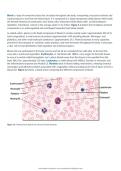
blood clot. Figure 4.2 shows a blood smear containing the different components of blood.
Figure 4.2 A blood smear depicts the various formed elements
Downloaded by Benjamin Luca ()
, lOMoARcPSD|51648332
leukocyte
Hemostasis is defined as the stoppage of blood flow and is divided into three stages:
o Vascular constriction
o Formation of the platelet plug
o Blood coagulation
When an injury occurs within a blood vessel, chemical signals are released from the damaged cells. In the
first step of hemostasis, the damaged cells will constrict which leads to a decrease in blood flow. In the
second step, platelets arrive at the vessel wall
Downloaded by Benjamin Luca ()
, lOMoARcPSD|51648332
where they are activated by cytokines and by contact with collagen. They become sticky, attracting more
platelets which come together to form a plug. Platelet adhesion requires a protein molecule called von
Willebrand factor, which serves to carry coagulation factor
VIII. People who are deficient in platelets or von Willebrand factor cannot, upon injury, effectively form a
platelet plug which leads to excessive bleeding. Figure 4.3 depicts the stages of hemostasis.
Figure 4.3 The 3 stages of hemostasis
Medications including aspirin and clopidogrel (Plavix) are considered platelet aggregation inhibitors. They are
used to prevent clot formation in people at risk for peripheral artery disease, myocardial infarction, and/or
stroke.
The third step of hemostasis (blood coagulation), is the process in which fibrinogen is converted to fibrin.
The fibrin strands form a clot by adhering platelets and other blood components together. The body
contains pro-coagulation factors that promote clotting as well as anti-coagulation factors which inhibit
clotting; therefore, regulating this process. There are intrinsic and extrinsic coagulation pathways containing
multiple steps, each perpetuating the next. Thus, an abnormality in any one of these steps can lead to
problems. Figure 4.4 depicts details of these coagulation pathways.
Downloaded by Benjamin Luca ()
, lOMoARcPSD|51648332
Figure 4.4 The intrinsic and extrinsic coagulation pathways. The product of both pathways is the same. Calcium, factors X and V,
and platelet phospholipids combine to form prothrombin activator, which then converts prothrombin to thrombin. This
interaction converts fibrinogen to fibrin strands that ultimately form a blood clot.
Most of these protein coagulation factors are formed in the liver. Vitamin K is needed to synthesize factors II,
VII, IX, and X, prothrombin, and protein C. A deficiency of vitamin K or liver failure will result in abnormal
bleeding as prothrombin will not be made. Calcium is also needed to carry out most of these conversions as
shown in Figure 4.4.
The intrinsic and extrinsic pathways both form prothrombin activator. The intrinsic pathway begins with
factor XII and is the slower of the two pathways, taking 1-6 minutes to form a clot. The extrinsic pathway
beings with thromboplastin which is released from the subendothelial cells. It is the quicker of the two
pathways, forming a clot in approximately 15 seconds. Both pathways converge to activate factor X which
converts prothrombin to thrombin. Thrombin then converts fibrinogen to fibrin, the material needed to
stabilize a clot. Both pathways are necessary for hemostasis to occur.
To maintain balance within the body, there are also several naturally occurring anticoagulants found within
the body including antithrombin III, protein C, and protein S. A deficiency of these substances increases a
person’s risk for clotting. There are several
Downloaded by Benjamin Luca ()
lOMoARcPSD|51648332
Blood is a type of connective tissue that circulates throughout the body, transporting necessary nutrients and
waste products to and from the body tissues. It is composed of a liquid component called plasma which holds
the formed elements of erythrocytes (red blood cells), leukocytes (white blood cells), and thrombocytes
(platelets). Total blood volume in the average adult is 5 to 6 liters. Figure 4.1 depicts the breakdown of blood
components in an anticoagulated and centrifuged (separated out) blood sample.
As stated earlier, plasma is the liquid component of blood; it contains mostly water (approximately 90% of its
total composition), a small amount of proteins (approximately 6-8% including albumin, fibrinogen, and
globulins), and other small molecular substances (approximately 2%.). Plasma functions in many capacities
primarily in the transport of nutrients, waste products, and even hormones throughout the body. It also plays
a vital role in heat distribution, fluid regulation and acid-base balance.
Blood cells are synthesized in the bone marrow and not all are considered true cells (due to the fact that
some lack a nuclei and organelles). Erythrocytes, or red blood cells (RBCs), carry oxygen to the body tissues
by way of a protein called hemoglobin, and carbon dioxide away from the tissues to be expelled from the
body. RBCs live approximately 120 days. Leukocytes, or white blood cells (WBCs), function in immunity and
the inflammatory response (see Module 3). Platelets assist in blood clotting mechanisms, releasing chemical
messengers and adhesion proteins associated with coagulation while associating at the site of injury to form a
blood clot. Figure 4.2 shows a blood smear containing the different components of blood.
Figure 4.2 A blood smear depicts the various formed elements
Downloaded by Benjamin Luca ()
, lOMoARcPSD|51648332
leukocyte
Hemostasis is defined as the stoppage of blood flow and is divided into three stages:
o Vascular constriction
o Formation of the platelet plug
o Blood coagulation
When an injury occurs within a blood vessel, chemical signals are released from the damaged cells. In the
first step of hemostasis, the damaged cells will constrict which leads to a decrease in blood flow. In the
second step, platelets arrive at the vessel wall
Downloaded by Benjamin Luca ()
, lOMoARcPSD|51648332
where they are activated by cytokines and by contact with collagen. They become sticky, attracting more
platelets which come together to form a plug. Platelet adhesion requires a protein molecule called von
Willebrand factor, which serves to carry coagulation factor
VIII. People who are deficient in platelets or von Willebrand factor cannot, upon injury, effectively form a
platelet plug which leads to excessive bleeding. Figure 4.3 depicts the stages of hemostasis.
Figure 4.3 The 3 stages of hemostasis
Medications including aspirin and clopidogrel (Plavix) are considered platelet aggregation inhibitors. They are
used to prevent clot formation in people at risk for peripheral artery disease, myocardial infarction, and/or
stroke.
The third step of hemostasis (blood coagulation), is the process in which fibrinogen is converted to fibrin.
The fibrin strands form a clot by adhering platelets and other blood components together. The body
contains pro-coagulation factors that promote clotting as well as anti-coagulation factors which inhibit
clotting; therefore, regulating this process. There are intrinsic and extrinsic coagulation pathways containing
multiple steps, each perpetuating the next. Thus, an abnormality in any one of these steps can lead to
problems. Figure 4.4 depicts details of these coagulation pathways.
Downloaded by Benjamin Luca ()
, lOMoARcPSD|51648332
Figure 4.4 The intrinsic and extrinsic coagulation pathways. The product of both pathways is the same. Calcium, factors X and V,
and platelet phospholipids combine to form prothrombin activator, which then converts prothrombin to thrombin. This
interaction converts fibrinogen to fibrin strands that ultimately form a blood clot.
Most of these protein coagulation factors are formed in the liver. Vitamin K is needed to synthesize factors II,
VII, IX, and X, prothrombin, and protein C. A deficiency of vitamin K or liver failure will result in abnormal
bleeding as prothrombin will not be made. Calcium is also needed to carry out most of these conversions as
shown in Figure 4.4.
The intrinsic and extrinsic pathways both form prothrombin activator. The intrinsic pathway begins with
factor XII and is the slower of the two pathways, taking 1-6 minutes to form a clot. The extrinsic pathway
beings with thromboplastin which is released from the subendothelial cells. It is the quicker of the two
pathways, forming a clot in approximately 15 seconds. Both pathways converge to activate factor X which
converts prothrombin to thrombin. Thrombin then converts fibrinogen to fibrin, the material needed to
stabilize a clot. Both pathways are necessary for hemostasis to occur.
To maintain balance within the body, there are also several naturally occurring anticoagulants found within
the body including antithrombin III, protein C, and protein S. A deficiency of these substances increases a
person’s risk for clotting. There are several
Downloaded by Benjamin Luca ()


