

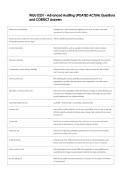
WGU D251 - Advanced Auditing UPDATED ACTUAL Questions
and CORRECT Answers
Performance Materiality Tolerable error; used to determine significant accounts, locations, and audit
procedures for those accounts and locations
What should an auditor do if they discover performance Perform additional substantive procedures
materiality has been set too high?
Overall materiality Planning materiality; used as a guide and decision aid to assist in making
consistent judgments; determining whether financial statements over all are
materially correct.
Posting materiality Misstatements identified throughout the audit to be considered at the end of the
audit to determine if the financial statements are overall materially correct
Considerations when setting materiality statement items users will focus on; nature of client and industry; size of client;
client financing; benchmark volatility
Client business risks Risks affecting the business operations and potential outcomes of an
organization's activities; likely pervasive across organization; can affect risk of
material misstatement
Examples of client business risks lacks personnel or expertise to deal with industry changes; uncertain likelihood of
success of new offerings; incompatible information technology across systems;
poorly implemented new business strategy
Audit Risk Model Formula Audit Risk = Inherent Risk x Control Risk x Detection Risk
Inherent risks Normal risks of doing business, not always controllable. Such as cash is high risk
of theft, subjective valuation for book value of assets, high volume of non-routine
transactions
Control risk The risk that a material misstatement that could occur in an account will not be
prevented or detected on a timely basis by internal controls
Detection risk The risk of not detecting material misstatements; the only part of the audit risk
formula an auditor can control
Audit sampling looking at less than 100% of the transactions that occurred during the audit
period; used to test operations of controls and accuracy of account balances
Data analytics tools Software programs that can test 100% of the population to use qualitative and
quantitative techniques and processes to identify risk areas and patterns
Nonsampling risk Risk that the auditor reaches an erroneous conclusion for any reason not related
to sampling risk
and CORRECT Answers
Performance Materiality Tolerable error; used to determine significant accounts, locations, and audit
procedures for those accounts and locations
What should an auditor do if they discover performance Perform additional substantive procedures
materiality has been set too high?
Overall materiality Planning materiality; used as a guide and decision aid to assist in making
consistent judgments; determining whether financial statements over all are
materially correct.
Posting materiality Misstatements identified throughout the audit to be considered at the end of the
audit to determine if the financial statements are overall materially correct
Considerations when setting materiality statement items users will focus on; nature of client and industry; size of client;
client financing; benchmark volatility
Client business risks Risks affecting the business operations and potential outcomes of an
organization's activities; likely pervasive across organization; can affect risk of
material misstatement
Examples of client business risks lacks personnel or expertise to deal with industry changes; uncertain likelihood of
success of new offerings; incompatible information technology across systems;
poorly implemented new business strategy
Audit Risk Model Formula Audit Risk = Inherent Risk x Control Risk x Detection Risk
Inherent risks Normal risks of doing business, not always controllable. Such as cash is high risk
of theft, subjective valuation for book value of assets, high volume of non-routine
transactions
Control risk The risk that a material misstatement that could occur in an account will not be
prevented or detected on a timely basis by internal controls
Detection risk The risk of not detecting material misstatements; the only part of the audit risk
formula an auditor can control
Audit sampling looking at less than 100% of the transactions that occurred during the audit
period; used to test operations of controls and accuracy of account balances
Data analytics tools Software programs that can test 100% of the population to use qualitative and
quantitative techniques and processes to identify risk areas and patterns
Nonsampling risk Risk that the auditor reaches an erroneous conclusion for any reason not related
to sampling risk


