

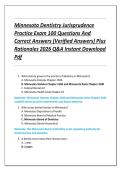
Minnesota Dentistry Jurisprudence
Practice Exam 100 Questions And
Correct Answers (Verified Answers) Plus
Rationales 2026 Q&A Instant Download
Pdf
1. What statute governs the practice of dentistry in Minnesota?
A. Minnesota Statutes Chapter 150A
B. Minnesota Statutes Chapter 150A and Minnesota Rules Chapter 3100
C. Federal Dental Act
D. Minnesota Health Code Chapter 62
Rationale: Minnesota Statutes Chapter 150A and Minnesota Rules Chapter 3100
establish dental practice requirements and board authority.
2. Who issues dental licenses in Minnesota?
A. Minnesota Department of Health
B. Minnesota Board of Medical Practice
C. Minnesota Board of Dentistry
D. Minnesota Dental Association
Rationale: The Minnesota Board of Dentistry is the regulatory authority for
dental licenses and discipline.
3. A dentist must renew their license every:
A. 1 year
B. 2 years
, C. 3 years
D. 5 years
Rationale: Minnesota dentistry licenses renew biennially unless changed by rule.
4. How many hours of continuing education (CE) are required per renewal
cycle?
A. 10
B. 20
C. 30
D. 40
Rationale: Minnesota requires 30 CE hours for dentists per biennium, including
specific topic requirements.
5. Which CE topic is mandatory?
A. Cosmetic dentistry
B. Practice management
C. Infection control and risk management
D. Marketing
Rationale: Minnesota rules require CE on infection control and risk management
every renewal cycle.
6. Before administering anesthesia, a dentist must:
A. Read online resources only
B. Complete no special training
C. Complete Board-approved training and maintain competency
D. Submit a letter of intent
Rationale: Anesthesia requires specific education, training, and documented
competency.
7. Which of the following is required in a patient record?
A. Billing codes only
B. Next appointment date only
C. Diagnosis, treatment plan, and progress notes
D. Insurance coverage summary
, Rationale: Minnesota rules require comprehensive documentation, including
diagnosis and treatment.
8. In Minnesota, dental assistants can perform coronal polishing:
A. Never
B. With direct supervision after training
C. With indirect supervision only
D. Independently
Rationale: Coronal polishing may be delegated with appropriate training and
direct supervision.
9. Which supervision level allows a dentist to delegate procedures when the
dentist is not on-site?
A. Direct
B. General
C. Indirect
D. Remote
Rationale: Indirect supervision allows delegation when the dentist is available
by communication but not physically present.
10.Delegation of tasks must be:
A. Verbal only
B. In accordance with Board rules and training of the assistant
C. Documented in state registry
D. Optional and informal
Rationale: Delegation must comply with rules and training requirements.
11.Minnesota infection control rules are modeled after:
A. OSHA only
B. CDC and OSHA
C. EPA only
D. ADA guidelines only
Rationale: Minnesota adopts CDC infection control with OSHA standards for
workplace safety.
Practice Exam 100 Questions And
Correct Answers (Verified Answers) Plus
Rationales 2026 Q&A Instant Download
1. What statute governs the practice of dentistry in Minnesota?
A. Minnesota Statutes Chapter 150A
B. Minnesota Statutes Chapter 150A and Minnesota Rules Chapter 3100
C. Federal Dental Act
D. Minnesota Health Code Chapter 62
Rationale: Minnesota Statutes Chapter 150A and Minnesota Rules Chapter 3100
establish dental practice requirements and board authority.
2. Who issues dental licenses in Minnesota?
A. Minnesota Department of Health
B. Minnesota Board of Medical Practice
C. Minnesota Board of Dentistry
D. Minnesota Dental Association
Rationale: The Minnesota Board of Dentistry is the regulatory authority for
dental licenses and discipline.
3. A dentist must renew their license every:
A. 1 year
B. 2 years
, C. 3 years
D. 5 years
Rationale: Minnesota dentistry licenses renew biennially unless changed by rule.
4. How many hours of continuing education (CE) are required per renewal
cycle?
A. 10
B. 20
C. 30
D. 40
Rationale: Minnesota requires 30 CE hours for dentists per biennium, including
specific topic requirements.
5. Which CE topic is mandatory?
A. Cosmetic dentistry
B. Practice management
C. Infection control and risk management
D. Marketing
Rationale: Minnesota rules require CE on infection control and risk management
every renewal cycle.
6. Before administering anesthesia, a dentist must:
A. Read online resources only
B. Complete no special training
C. Complete Board-approved training and maintain competency
D. Submit a letter of intent
Rationale: Anesthesia requires specific education, training, and documented
competency.
7. Which of the following is required in a patient record?
A. Billing codes only
B. Next appointment date only
C. Diagnosis, treatment plan, and progress notes
D. Insurance coverage summary
, Rationale: Minnesota rules require comprehensive documentation, including
diagnosis and treatment.
8. In Minnesota, dental assistants can perform coronal polishing:
A. Never
B. With direct supervision after training
C. With indirect supervision only
D. Independently
Rationale: Coronal polishing may be delegated with appropriate training and
direct supervision.
9. Which supervision level allows a dentist to delegate procedures when the
dentist is not on-site?
A. Direct
B. General
C. Indirect
D. Remote
Rationale: Indirect supervision allows delegation when the dentist is available
by communication but not physically present.
10.Delegation of tasks must be:
A. Verbal only
B. In accordance with Board rules and training of the assistant
C. Documented in state registry
D. Optional and informal
Rationale: Delegation must comply with rules and training requirements.
11.Minnesota infection control rules are modeled after:
A. OSHA only
B. CDC and OSHA
C. EPA only
D. ADA guidelines only
Rationale: Minnesota adopts CDC infection control with OSHA standards for
workplace safety.


