

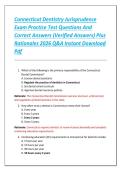
Connecticut Dentistry Jurisprudence
Exam Practice Test Questions And
Correct Answers (Verified Answers) Plus
Rationales 2026 Q&A Instant Download
Pdf
1. Which of the following is the primary responsibility of the Connecticut
Dental Commission?
A. License dental assistants
B. Regulate the practice of dentistry in Connecticut
C. Set dental school curricula
D. Approve dental insurance policies
Rationale: The Connecticut Dental Commission oversees licensure, enforcement,
and regulation of dental practice in the state.
2. How often must a dentist in Connecticut renew their license?
A. Every year
B. Every 3 years
C. Every 2 years
D. Every 5 years
Rationale: Connecticut requires dentists to renew licenses biennially and complete
continuing education requirements.
3. Continuing education (CE) requirements in Connecticut for dentists include:
A. 5 hours per year
B. 15 hours per year
C. 30 hours per year
D. 50 hours every 2 years
,Rationale: Dentists must complete 50 CE hours every two years to maintain
licensure.
4. A dentist practicing outside the scope of their training may be subject to:
A. Peer review only
B. Disciplinary action by the Dental Commission
C. Civil lawsuit but not commission action
D. None of the above
Rationale: The Dental Commission has authority to discipline dentists for
practicing beyond their scope of training.
5. A dentist must maintain patient records for a minimum of:
A. 1 year
B. 3 years
C. 5 years
D. 7 years
Rationale: Connecticut law requires dental records to be retained for at least
seven years from the date of last treatment.
6. Who is responsible for obtaining informed consent in dentistry?
A. Dental assistant
B. Office manager
C. The treating dentist
D. Hygienist
Rationale: Only the licensed dentist performing the procedure can obtain legally
valid informed consent.
7. Which of the following must be included in informed consent?
A. Procedure description
B. Risks and benefits
C. Alternatives
D. All of the above
Rationale: Informed consent requires explaining the procedure, alternatives, risks,
and benefits.
, 8. In Connecticut, a dentist may prescribe controlled substances:
A. For any reason
B. Only after consultation with a pharmacist
C. For legitimate dental purposes
D. Only in hospital settings
Rationale: Controlled substances may only be prescribed when medically or
dentally necessary and appropriate.
9. How should a dentist respond to a patient requesting records?
A. Refuse unless paid upfront
B. Provide copies within a reasonable time
C. Only provide a summary
D. Only release to insurance companies
Rationale: Patients have the right to access their records; dentists must provide
copies promptly under Connecticut law.
10.The confidentiality of patient information is protected under:
A. OSHA
B. DEA regulations
C. HIPAA
D. FDA guidelines
Rationale: HIPAA establishes standards for protecting patient health information.
11.What is the minimum age for a dental license applicant in Connecticut?
A. 18 years
B. 20 years
C. 21 years
D. 25 years
Rationale: Connecticut requires dental license applicants to be at least 21 years
old.
12.Dental malpractice in Connecticut is governed primarily by:
A. Criminal law
B. Civil law
Exam Practice Test Questions And
Correct Answers (Verified Answers) Plus
Rationales 2026 Q&A Instant Download
1. Which of the following is the primary responsibility of the Connecticut
Dental Commission?
A. License dental assistants
B. Regulate the practice of dentistry in Connecticut
C. Set dental school curricula
D. Approve dental insurance policies
Rationale: The Connecticut Dental Commission oversees licensure, enforcement,
and regulation of dental practice in the state.
2. How often must a dentist in Connecticut renew their license?
A. Every year
B. Every 3 years
C. Every 2 years
D. Every 5 years
Rationale: Connecticut requires dentists to renew licenses biennially and complete
continuing education requirements.
3. Continuing education (CE) requirements in Connecticut for dentists include:
A. 5 hours per year
B. 15 hours per year
C. 30 hours per year
D. 50 hours every 2 years
,Rationale: Dentists must complete 50 CE hours every two years to maintain
licensure.
4. A dentist practicing outside the scope of their training may be subject to:
A. Peer review only
B. Disciplinary action by the Dental Commission
C. Civil lawsuit but not commission action
D. None of the above
Rationale: The Dental Commission has authority to discipline dentists for
practicing beyond their scope of training.
5. A dentist must maintain patient records for a minimum of:
A. 1 year
B. 3 years
C. 5 years
D. 7 years
Rationale: Connecticut law requires dental records to be retained for at least
seven years from the date of last treatment.
6. Who is responsible for obtaining informed consent in dentistry?
A. Dental assistant
B. Office manager
C. The treating dentist
D. Hygienist
Rationale: Only the licensed dentist performing the procedure can obtain legally
valid informed consent.
7. Which of the following must be included in informed consent?
A. Procedure description
B. Risks and benefits
C. Alternatives
D. All of the above
Rationale: Informed consent requires explaining the procedure, alternatives, risks,
and benefits.
, 8. In Connecticut, a dentist may prescribe controlled substances:
A. For any reason
B. Only after consultation with a pharmacist
C. For legitimate dental purposes
D. Only in hospital settings
Rationale: Controlled substances may only be prescribed when medically or
dentally necessary and appropriate.
9. How should a dentist respond to a patient requesting records?
A. Refuse unless paid upfront
B. Provide copies within a reasonable time
C. Only provide a summary
D. Only release to insurance companies
Rationale: Patients have the right to access their records; dentists must provide
copies promptly under Connecticut law.
10.The confidentiality of patient information is protected under:
A. OSHA
B. DEA regulations
C. HIPAA
D. FDA guidelines
Rationale: HIPAA establishes standards for protecting patient health information.
11.What is the minimum age for a dental license applicant in Connecticut?
A. 18 years
B. 20 years
C. 21 years
D. 25 years
Rationale: Connecticut requires dental license applicants to be at least 21 years
old.
12.Dental malpractice in Connecticut is governed primarily by:
A. Criminal law
B. Civil law


