

Lecture 1:
Information Systems (IS):
• Combinations of hardware, software and telecommunications networks that people build
and use to collect, create, and distribute useful data in organizational settings
• Primary function: to convert data into information
Lecture 2:
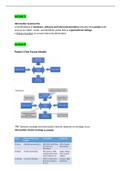
Porter’s Five Forces Model:
‘’Fit’’ between strategy and Information Systems depends on strategic focus
Information System strategy is needed
,IS strategy is:
“A portfolio of IS to be implemented, which is both highly aligned with business
strategy and may have the ability to create an advantage over competitors.” (Based
on Ward and Peppard, 2002, p. 118)
“The organizational perspective on the investment in, deployment, use and
management of information systems” (Chen et al., 2010, p. 237)
IS Strategy Process:
“The process of identifying a portfolio of computer-based applications that will support an
organization’s business plans, thus enabling the organization to align its IS with its business
needs and achieve its business goals (Reich & Benbasat, 2000).”
Five phases of IS Strategy Process (Mentzas, 1997):
1. Strategic awareness (planning the IS planning process): Determining key planning issues,
Identifying business strategic objectives, Identifying IS strategic objectives, Aligning business
and IS strategies, Organizing the planning process
2. Situation analysis (analyzing the current environment): SWOT analysis, Analyzing current
internal and external business environment, Analyzing current internal and external
information systems environment
3. Strategy conception (conceiving strategy alternatives): Identifying opportunities for
improvement, Evaluating opportunities for improvement, Identifying role of IS in realizing
opportunities, Identifying high level IS strategies
4. Strategy formulation (selecting strategy): Formulating IS strategy goals, Formulating new
business architecture /organization, Formulating new IT architecture / portfolio
5. Strategy implementation: Defining change management approach, Identifying specific
new projects, Defining action plan, Evaluating action plan, Defining follow‐up and control
procedure
,Strategic Awareness: Alignment
Alignment: the degree of fit and integration among business strategy, IT strategy,
business infrastructure, and IT infrastructure (Henderson & Venkatraman, 1993)
Positively influences IS contribution to competitive advantage (Kearns & Lederer,
2000).
Persistent issue for IT managers in practice
Henderson & Venkatraman (1993) on Strategic Alignment:
External and internal domain
Business and IT domain
Four approaches to alignment
\
1. Technology Potential:
Business strategy is the driver:
Determines IT strategy
How can IS support Business strategy? (What portfolio of IS strategies are needed for
our goal)
Not constrained by current organization
Example: Vrije Universiteit (strategy: operational excellence, choice of IS: SAP)
, 2. Competitive Potential:
IT strategy is the driver
Determines Business Strategy
What are emerging IT capabilities we can exploit in shaping our Business strategy?
Adapt organization to IT possibilities
IT-driven innovation
Example: Netflix (strategy: digitization of content, Internet, DVD, streaming choice of BS:
from DVD rental to content)
3. Strategy Execution
Business strategy is driver
Determines organizational structure and processes
How can IS optimally support the current organization?
4. Service Level Alignment
IT strategy is driver
Determines IT infrastructure and processes
Organization adapts to new technology (technology push)
How can we build an optimal IS organization?
Information Systems (IS):
• Combinations of hardware, software and telecommunications networks that people build
and use to collect, create, and distribute useful data in organizational settings
• Primary function: to convert data into information
Lecture 2:
Porter’s Five Forces Model:
‘’Fit’’ between strategy and Information Systems depends on strategic focus
Information System strategy is needed
,IS strategy is:
“A portfolio of IS to be implemented, which is both highly aligned with business
strategy and may have the ability to create an advantage over competitors.” (Based
on Ward and Peppard, 2002, p. 118)
“The organizational perspective on the investment in, deployment, use and
management of information systems” (Chen et al., 2010, p. 237)
IS Strategy Process:
“The process of identifying a portfolio of computer-based applications that will support an
organization’s business plans, thus enabling the organization to align its IS with its business
needs and achieve its business goals (Reich & Benbasat, 2000).”
Five phases of IS Strategy Process (Mentzas, 1997):
1. Strategic awareness (planning the IS planning process): Determining key planning issues,
Identifying business strategic objectives, Identifying IS strategic objectives, Aligning business
and IS strategies, Organizing the planning process
2. Situation analysis (analyzing the current environment): SWOT analysis, Analyzing current
internal and external business environment, Analyzing current internal and external
information systems environment
3. Strategy conception (conceiving strategy alternatives): Identifying opportunities for
improvement, Evaluating opportunities for improvement, Identifying role of IS in realizing
opportunities, Identifying high level IS strategies
4. Strategy formulation (selecting strategy): Formulating IS strategy goals, Formulating new
business architecture /organization, Formulating new IT architecture / portfolio
5. Strategy implementation: Defining change management approach, Identifying specific
new projects, Defining action plan, Evaluating action plan, Defining follow‐up and control
procedure
,Strategic Awareness: Alignment
Alignment: the degree of fit and integration among business strategy, IT strategy,
business infrastructure, and IT infrastructure (Henderson & Venkatraman, 1993)
Positively influences IS contribution to competitive advantage (Kearns & Lederer,
2000).
Persistent issue for IT managers in practice
Henderson & Venkatraman (1993) on Strategic Alignment:
External and internal domain
Business and IT domain
Four approaches to alignment
\
1. Technology Potential:
Business strategy is the driver:
Determines IT strategy
How can IS support Business strategy? (What portfolio of IS strategies are needed for
our goal)
Not constrained by current organization
Example: Vrije Universiteit (strategy: operational excellence, choice of IS: SAP)
, 2. Competitive Potential:
IT strategy is the driver
Determines Business Strategy
What are emerging IT capabilities we can exploit in shaping our Business strategy?
Adapt organization to IT possibilities
IT-driven innovation
Example: Netflix (strategy: digitization of content, Internet, DVD, streaming choice of BS:
from DVD rental to content)
3. Strategy Execution
Business strategy is driver
Determines organizational structure and processes
How can IS optimally support the current organization?
4. Service Level Alignment
IT strategy is driver
Determines IT infrastructure and processes
Organization adapts to new technology (technology push)
How can we build an optimal IS organization?


