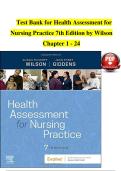
Concepts for Nursing Practice Elsevier
eBook on VitalSource, 4th Edition
by Jean Foret Giddens, PhD, RN, FAAN,
ANEF
Elsevier
TEST BANK
Concepts for Nursing Practice — Concept 1: Development
1. Question Stem
A nurse defines the concept of development most
accurately as:
A. The static measurement of physical size and
anthropometric norms across the lifespan.
B. The sequence of physical, psychosocial, and cognitive
changes that occur across the lifespan, integrating growth,
differentiation, and maturation.
C. A time-limited set of motor milestones assessed only
, during childhood.
D. The genetic blueprint that fully determines an
individual's behavior and abilities.
Options A–D
Correct Answer: B
Concise Concept-Based Rationale
Development is a dynamic, lifespan concept involving
interrelated physical, psychosocial, and cognitive change
(growth, differentiation, maturation), not a static or purely
genetic construct.
Text Citation: Concepts for Nursing Practice, Chapter 1:
Development.
Metadata Tags:
Concept: Development
Exemplar: Lifespan development (general)
Cognitive Level: 1 (Remember/Understand)
Clinical Judgment Domain: Recognizing cues
Difficulty Estimate: Easy
Primary Attribute Tested: Definition / Scope
2. Question Stem
Which attribute best illustrates the “differentiation”
component of development?
A. Increase in overall body size only.
B. Emergence of specialized fine-motor skills from earlier,
, gross movements.
C. Complete cessation of growth after adolescence.
D. Uniform maturation of all organ systems at the same
rate.
Options A–D
Correct Answer: B
Concise Concept-Based Rationale
Differentiation refers to progressive specialization (e.g., gross
motor → fine motor skills); increase in size alone is growth, and
maturation is functional readiness—so B matches
differentiation.
Text Citation: Concepts for Nursing Practice, Chapter 1:
Development.
Metadata Tags:
Concept: Development
Exemplar: Motor development (pediatric)
Cognitive Level: 2 (Understand)
Clinical Judgment Domain: Recognizing cues
Difficulty Estimate: Easy
Primary Attribute Tested: Component identification
(growth/differentiation/maturation)
3. Question Stem
A 2-month-old infant is brought to clinic: feeds poorly, has
weak cry, and poor head control. Which immediate nursing
, action best aligns with developmental surveillance?
A. Schedule routine immunizations and discharge with
standard anticipatory guidance.
B. Document findings and arrange prompt referral for
developmental evaluation and early intervention services.
C. Reassure the parents that variability at 2 months is
expected and reassess in 6 months.
D. Recommend adult caregiver support groups without
further assessment.
Options A–D
Correct Answer: B
Concise Concept-Based Rationale
Concerning cues (feeding difficulty, poor head control) at 2
months warrant timely referral for developmental
evaluation/early intervention; delaying reassessment risks
missed opportunity.
Text Citation: Concepts for Nursing Practice, Chapter 1:
Development.
Metadata Tags:
Concept: Development
Exemplar: Developmental delay identification (infant)
Cognitive Level: 3 (Apply)
Clinical Judgment Domain: Prioritizing hypotheses
Difficulty Estimate: Moderate
Primary Attribute Tested: Risk identification / Referral
eBook on VitalSource, 4th Edition
by Jean Foret Giddens, PhD, RN, FAAN,
ANEF
Elsevier
TEST BANK
Concepts for Nursing Practice — Concept 1: Development
1. Question Stem
A nurse defines the concept of development most
accurately as:
A. The static measurement of physical size and
anthropometric norms across the lifespan.
B. The sequence of physical, psychosocial, and cognitive
changes that occur across the lifespan, integrating growth,
differentiation, and maturation.
C. A time-limited set of motor milestones assessed only
, during childhood.
D. The genetic blueprint that fully determines an
individual's behavior and abilities.
Options A–D
Correct Answer: B
Concise Concept-Based Rationale
Development is a dynamic, lifespan concept involving
interrelated physical, psychosocial, and cognitive change
(growth, differentiation, maturation), not a static or purely
genetic construct.
Text Citation: Concepts for Nursing Practice, Chapter 1:
Development.
Metadata Tags:
Concept: Development
Exemplar: Lifespan development (general)
Cognitive Level: 1 (Remember/Understand)
Clinical Judgment Domain: Recognizing cues
Difficulty Estimate: Easy
Primary Attribute Tested: Definition / Scope
2. Question Stem
Which attribute best illustrates the “differentiation”
component of development?
A. Increase in overall body size only.
B. Emergence of specialized fine-motor skills from earlier,
, gross movements.
C. Complete cessation of growth after adolescence.
D. Uniform maturation of all organ systems at the same
rate.
Options A–D
Correct Answer: B
Concise Concept-Based Rationale
Differentiation refers to progressive specialization (e.g., gross
motor → fine motor skills); increase in size alone is growth, and
maturation is functional readiness—so B matches
differentiation.
Text Citation: Concepts for Nursing Practice, Chapter 1:
Development.
Metadata Tags:
Concept: Development
Exemplar: Motor development (pediatric)
Cognitive Level: 2 (Understand)
Clinical Judgment Domain: Recognizing cues
Difficulty Estimate: Easy
Primary Attribute Tested: Component identification
(growth/differentiation/maturation)
3. Question Stem
A 2-month-old infant is brought to clinic: feeds poorly, has
weak cry, and poor head control. Which immediate nursing
, action best aligns with developmental surveillance?
A. Schedule routine immunizations and discharge with
standard anticipatory guidance.
B. Document findings and arrange prompt referral for
developmental evaluation and early intervention services.
C. Reassure the parents that variability at 2 months is
expected and reassess in 6 months.
D. Recommend adult caregiver support groups without
further assessment.
Options A–D
Correct Answer: B
Concise Concept-Based Rationale
Concerning cues (feeding difficulty, poor head control) at 2
months warrant timely referral for developmental
evaluation/early intervention; delaying reassessment risks
missed opportunity.
Text Citation: Concepts for Nursing Practice, Chapter 1:
Development.
Metadata Tags:
Concept: Development
Exemplar: Developmental delay identification (infant)
Cognitive Level: 3 (Apply)
Clinical Judgment Domain: Prioritizing hypotheses
Difficulty Estimate: Moderate
Primary Attribute Tested: Risk identification / Referral