

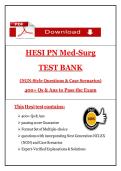
HESI PN Med-Surg
TEST BANK
(NGN-Style Questions & Case Scenarios)
400+ Qs & Ans to Pass the Exam
This Hesi test contains:
- - - -
400+-Qs-&-Ans-
passing-score-Guarantee-
Format-Set-of-Multiple-choice
questions-with-incorporating-Next-Generation-NCLEX-
(NGN)-and-Case-Scenarios
Expert-Verified-Explanations-&-Solutions
,---
####-1.-A-client-with-prostate-cancer-undergoes-brachytherapy-(radioactive-seed-
implantation).-What-nursing-action-has-the-highest-priority?--
A.-Follow-radiation-exposure-precautions.--
B.-Encourage-the-client-to-consume-regular-meals.--
C.-Collect-all-urine-in-sealed-containers.--
D.-Avoid-touching-the-client.--
Answer:-A.-Follow-radiation-exposure-precautions.
Expert-Rationale:--
Radiation-precautions-protect-healthcare-workers,-clients,-and-visitors-from-
unnecessary-exposure.-Protocols-generally-include-time,-distance,-and-shielding-
measures.-For-brachytherapy,-staff-must-maintain-limited,-computed-exposure-times-
near-the-client.
---
####-2.-NGN-Style-Case-Scenario:-A-home-health-PN-visits-a-client-with-emphysema-
who-is-oxygen-dependent-and-independently-manages-self-care.-Recent-findings-reveal:-
-
--Oxygen-Saturation:-91%-on-2-L/min-oxygen.--
--Weight:-5-lbs-less-than-the-last-home-visit-(30-days-ago).--
--Reported-Fatigue:-Unchanged-since-the-prior-visit.--
--Home-Environment:-Disheveled-with-dirty-dishes-and-clothing-scattered.--
Based-on-this-assessment,-what-requires-immediate-consultation-with-the-RN-case-
manager?--
A.-Oxygen-saturation-of-91%-on-oxygen-at-2-L/min.--
,B.-Weight-loss-of-5-pounds-within-the-past-month.--
C.-Report-of-unchanged-fatigue-from-the-prior-visit.--
D.-Disheveled-appearance-of-the-home-environment.--
Answer:-B.-Weight-loss-of-5-pounds-within-the-past-month.
Expert-Rationale:--
Unintended-weight-loss-in-clients-with-COPD-could-indicate-increased-energy-
expenditure-and-nutritional-deficiencies-requiring-urgent-dietary-intervention.-Oxygen-
saturation-of-91%-is-expected-in-COPD.-Fatigue-and-disorganized-surroundings-may-
also-result-from-illness-but-are-secondary-concerns-compared-to-potential-malnutrition.
---
####-3.-A-client-with-diabetes-mellitus-is-being-educated-on-symptoms-of-diabetic-
ketoacidosis-(DKA).-Which-symptoms-should-the-PN-reinforce?-(Select-all-that-apply.)
A.-Fruity-breath-odor.--
B.-Rapid,-weak-pulse.--
C.-Cold,-clammy-skin.--
D.-Extreme-thirst.--
E.-Urinary-frequency.--
F.-Protruding-eyeballs.--
Answers:--
A.-Fruity-breath-odor.--
B.-Rapid,-weak-pulse.--
D.-Extreme-thirst.--
E.-Urinary-frequency.--
Expert-Rationale:--
, DKA-results-from-significant-insulin-deficiency,-leading-to-hyperglycemia,-ketonemia,-
and-dehydration.-Symptoms-include-fruity-breath,-tachycardia-(from-hypovolemia),-
polydipsia,-polyuria,-and-hyperventilation.-Cold,-clammy-skin-is-a-sign-of-hypoglycemia,-
not-DKA.
####-4.-During-a-clinic-visit,-a-client-reports-discovering-a-solid,-painless-mass-in-their-
breast-during-self-examination.-What-instruction-should-the-practical-nurse-(PN)-
reinforce-with-the-client?
A.-Continue-to-monitor-the-mass-until-the-next-scheduled-annual-exam.--
B.-Notify-the-healthcare-provider-if-the-mass-becomes-painful-or-starts-to-drain.--
C.-Schedule-an-appointment-with-the-healthcare-provider-for-evaluation.--
D.-Breast-masses-are-insignificant-if-they-feel-soft-or-are-easily-movable.--
Answer:-C.-Schedule-an-appointment-with-the-healthcare-provider-for-evaluation.--
Expert-Rationale:--
A-painless-breast-mass-is-considered-an-abnormal-finding-and-requires-prompt-medical-
evaluation.-Early-detection-of-potential-breast-cancer-is-crucial.-Delaying-evaluation-
may-lead-to-progression-of-undiagnosed-malignancy.
---
####-5.-A-client-with-stage-4-liver-cancer-learns-the-metastasis-has-spread-to-the-spine-
but-incorrectly-states,-"It's-not-malignant."-What-is-the-PN’s-initial-action?--
A.-Encourage-the-client-to-attend-a-cancer-education-program.--
B.-Perform-a-complete-history-and-physical-assessment.--
C.-Ask-the-client-to-explain-their-understanding-of-the-term-malignancy.--
D.-Offer-the-client-emotional-support-to-deal-with-the-diagnosis.--
TEST BANK
(NGN-Style Questions & Case Scenarios)
400+ Qs & Ans to Pass the Exam
This Hesi test contains:
- - - -
400+-Qs-&-Ans-
passing-score-Guarantee-
Format-Set-of-Multiple-choice
questions-with-incorporating-Next-Generation-NCLEX-
(NGN)-and-Case-Scenarios
Expert-Verified-Explanations-&-Solutions
,---
####-1.-A-client-with-prostate-cancer-undergoes-brachytherapy-(radioactive-seed-
implantation).-What-nursing-action-has-the-highest-priority?--
A.-Follow-radiation-exposure-precautions.--
B.-Encourage-the-client-to-consume-regular-meals.--
C.-Collect-all-urine-in-sealed-containers.--
D.-Avoid-touching-the-client.--
Answer:-A.-Follow-radiation-exposure-precautions.
Expert-Rationale:--
Radiation-precautions-protect-healthcare-workers,-clients,-and-visitors-from-
unnecessary-exposure.-Protocols-generally-include-time,-distance,-and-shielding-
measures.-For-brachytherapy,-staff-must-maintain-limited,-computed-exposure-times-
near-the-client.
---
####-2.-NGN-Style-Case-Scenario:-A-home-health-PN-visits-a-client-with-emphysema-
who-is-oxygen-dependent-and-independently-manages-self-care.-Recent-findings-reveal:-
-
--Oxygen-Saturation:-91%-on-2-L/min-oxygen.--
--Weight:-5-lbs-less-than-the-last-home-visit-(30-days-ago).--
--Reported-Fatigue:-Unchanged-since-the-prior-visit.--
--Home-Environment:-Disheveled-with-dirty-dishes-and-clothing-scattered.--
Based-on-this-assessment,-what-requires-immediate-consultation-with-the-RN-case-
manager?--
A.-Oxygen-saturation-of-91%-on-oxygen-at-2-L/min.--
,B.-Weight-loss-of-5-pounds-within-the-past-month.--
C.-Report-of-unchanged-fatigue-from-the-prior-visit.--
D.-Disheveled-appearance-of-the-home-environment.--
Answer:-B.-Weight-loss-of-5-pounds-within-the-past-month.
Expert-Rationale:--
Unintended-weight-loss-in-clients-with-COPD-could-indicate-increased-energy-
expenditure-and-nutritional-deficiencies-requiring-urgent-dietary-intervention.-Oxygen-
saturation-of-91%-is-expected-in-COPD.-Fatigue-and-disorganized-surroundings-may-
also-result-from-illness-but-are-secondary-concerns-compared-to-potential-malnutrition.
---
####-3.-A-client-with-diabetes-mellitus-is-being-educated-on-symptoms-of-diabetic-
ketoacidosis-(DKA).-Which-symptoms-should-the-PN-reinforce?-(Select-all-that-apply.)
A.-Fruity-breath-odor.--
B.-Rapid,-weak-pulse.--
C.-Cold,-clammy-skin.--
D.-Extreme-thirst.--
E.-Urinary-frequency.--
F.-Protruding-eyeballs.--
Answers:--
A.-Fruity-breath-odor.--
B.-Rapid,-weak-pulse.--
D.-Extreme-thirst.--
E.-Urinary-frequency.--
Expert-Rationale:--
, DKA-results-from-significant-insulin-deficiency,-leading-to-hyperglycemia,-ketonemia,-
and-dehydration.-Symptoms-include-fruity-breath,-tachycardia-(from-hypovolemia),-
polydipsia,-polyuria,-and-hyperventilation.-Cold,-clammy-skin-is-a-sign-of-hypoglycemia,-
not-DKA.
####-4.-During-a-clinic-visit,-a-client-reports-discovering-a-solid,-painless-mass-in-their-
breast-during-self-examination.-What-instruction-should-the-practical-nurse-(PN)-
reinforce-with-the-client?
A.-Continue-to-monitor-the-mass-until-the-next-scheduled-annual-exam.--
B.-Notify-the-healthcare-provider-if-the-mass-becomes-painful-or-starts-to-drain.--
C.-Schedule-an-appointment-with-the-healthcare-provider-for-evaluation.--
D.-Breast-masses-are-insignificant-if-they-feel-soft-or-are-easily-movable.--
Answer:-C.-Schedule-an-appointment-with-the-healthcare-provider-for-evaluation.--
Expert-Rationale:--
A-painless-breast-mass-is-considered-an-abnormal-finding-and-requires-prompt-medical-
evaluation.-Early-detection-of-potential-breast-cancer-is-crucial.-Delaying-evaluation-
may-lead-to-progression-of-undiagnosed-malignancy.
---
####-5.-A-client-with-stage-4-liver-cancer-learns-the-metastasis-has-spread-to-the-spine-
but-incorrectly-states,-"It's-not-malignant."-What-is-the-PN’s-initial-action?--
A.-Encourage-the-client-to-attend-a-cancer-education-program.--
B.-Perform-a-complete-history-and-physical-assessment.--
C.-Ask-the-client-to-explain-their-understanding-of-the-term-malignancy.--
D.-Offer-the-client-emotional-support-to-deal-with-the-diagnosis.--


