

ATI 2026 Maternal Newborn Proctored Exam – Verified
Questions with Correct Answers and Detailed Rationales
for Comprehensive ATI RN Maternal and Newborn
Nursing Study Guide and Exam Preparation
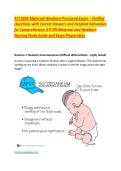
Question 1: Newborn Head Assessment (Difficult differentiation – highly tested)
A nurse is assessing a newborn 24 hours after a vaginal delivery. The newborn has
swelling on the head. Which condition is shown in the left image versus the right
image?
nicunursenatalie.com
,getlabtest.com
A. Left: Cephalohematoma; Right: Caput succedaneum
B. Left: Caput succedaneum; Right: Cephalohematoma
C. Both: Caput succedaneum
D. Both: Cephalohematoma
Answer-: B. Left: Caput succedaneum; Right: Cephalohematoma Rationale: Caput
succedaneum is boggy edema crossing suture lines, resolving spontaneously.
Cephalohematoma is a blood collection under the periosteum, not crossing
sutures, and may take weeks to resolve with risk of jaundice.
Question 2: Newborn Skin Findings (Commonly tested benign vs. concerning)
A nurse observes the following rash on a 2-day-old newborn. What is the most
likely diagnosis, and what action should the nurse take?
hellodoctor.com.ph
, medicalnewstoday.com
A. Erythema toxicum – Reassure parents, no treatment needed
B. Mongolian spots – Document and monitor for abuse concerns
C. Both require immediate intervention
D. Erythema toxicum – Requires antibiotics
Answer-: A (first image: Erythema toxicum) and B (second image: Mongolian
spots) are both benign. Rationale: Erythema toxicum is a common self-limiting
rash. Mongolian spots are benign dermal melanocytosis, common in darker-
skinned infants, and should be documented to avoid misinterpretation as
bruising.
Question 3: Fetal Heart Rate Monitoring (Highly tested – variable decelerations)
A nurse is monitoring fetal heart rate during labor. What type of deceleration is
shown, and what is the priority nursing action?
Questions with Correct Answers and Detailed Rationales
for Comprehensive ATI RN Maternal and Newborn
Nursing Study Guide and Exam Preparation
Question 1: Newborn Head Assessment (Difficult differentiation – highly tested)
A nurse is assessing a newborn 24 hours after a vaginal delivery. The newborn has
swelling on the head. Which condition is shown in the left image versus the right
image?
nicunursenatalie.com
,getlabtest.com
A. Left: Cephalohematoma; Right: Caput succedaneum
B. Left: Caput succedaneum; Right: Cephalohematoma
C. Both: Caput succedaneum
D. Both: Cephalohematoma
Answer-: B. Left: Caput succedaneum; Right: Cephalohematoma Rationale: Caput
succedaneum is boggy edema crossing suture lines, resolving spontaneously.
Cephalohematoma is a blood collection under the periosteum, not crossing
sutures, and may take weeks to resolve with risk of jaundice.
Question 2: Newborn Skin Findings (Commonly tested benign vs. concerning)
A nurse observes the following rash on a 2-day-old newborn. What is the most
likely diagnosis, and what action should the nurse take?
hellodoctor.com.ph
, medicalnewstoday.com
A. Erythema toxicum – Reassure parents, no treatment needed
B. Mongolian spots – Document and monitor for abuse concerns
C. Both require immediate intervention
D. Erythema toxicum – Requires antibiotics
Answer-: A (first image: Erythema toxicum) and B (second image: Mongolian
spots) are both benign. Rationale: Erythema toxicum is a common self-limiting
rash. Mongolian spots are benign dermal melanocytosis, common in darker-
skinned infants, and should be documented to avoid misinterpretation as
bruising.
Question 3: Fetal Heart Rate Monitoring (Highly tested – variable decelerations)
A nurse is monitoring fetal heart rate during labor. What type of deceleration is
shown, and what is the priority nursing action?


