

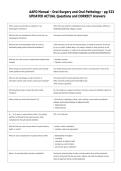
AAPD Manual - Oral Surgery and Oral Pathology - pg 523
UPDATED ACTUAL Questions and CORRECT Answers
When would you prescribe an antibiotic for an When there are systemic manifestations such as fever, facial cellulitis, difficulty in
odontogenic infection? breathing/swallowing, fatigue, nausea.
What are the rare complications that can arise from an Cavernous sinus thrombosis and Ludwig's angina
odontogenic infection?
What are the recommendations when it comes to If the fractured root tip can be removed easily, it should be removed. If the root
fractured primary tooth roots and extractions? tip is very small, located deep in the socket, situated in close proximity to the
permanent successor, or unable to be retrieved after several attempts, it is best
left to be resorbed. MUST INFORM GUARDIAN and MONITOR APPROPRIATELY.
What are the most common impacted teeth besides third 1. Maxillary canines
molars? 2. Maxillary central incisors
When should you extract primary canines when looking You should extract when the permanent canine is covering half or more of the
at the position of the permanent? lateral incisor root.
What are the percentages of self-correction of 91% self correct if covering less than half of root.
permanent canines when primary canines are extracted? 64% correct if covering more than half of root.
78% correct in general.
Will extracting primary canines help with ectopic No. No evidence to support extraction of primary canines to facilitate eruption of
eruption? ectopic permanent maxillary canines.
When should you extract third molars? (3) 1. When there is pathology (caries, cysts, infection, pericoronitis, periodontal
disease, detrimental changes of adjacent teeth)
2. Malpositioned
3. Nonfunctional
In _ % of cases, a supernumerary tooth in the primary 33% (1/3 of the time)
dentition is followed by the supernumerary tooth
compliment in the permanent dentition.
What are the two most common sites for supernumerary 1. anterior maxilla (mesiodens)
teeth in order?` 2. maxillary molar area (paramolar)
What are some complications of supernumerary teeth? 1. delayed/lack of eruption
2. crowding
3. resorption of adjacent teeth
4. dentigerous cyst formation
5. pericoronal space ossification
When is it recommended to extract a mesiodens? During the mixed dentition to allow normal eruptive force of the permanent
incisor to bring itself into the oral cavity. Ideally, wait until the adjacent incisors
have at least two-thirds root development
UPDATED ACTUAL Questions and CORRECT Answers
When would you prescribe an antibiotic for an When there are systemic manifestations such as fever, facial cellulitis, difficulty in
odontogenic infection? breathing/swallowing, fatigue, nausea.
What are the rare complications that can arise from an Cavernous sinus thrombosis and Ludwig's angina
odontogenic infection?
What are the recommendations when it comes to If the fractured root tip can be removed easily, it should be removed. If the root
fractured primary tooth roots and extractions? tip is very small, located deep in the socket, situated in close proximity to the
permanent successor, or unable to be retrieved after several attempts, it is best
left to be resorbed. MUST INFORM GUARDIAN and MONITOR APPROPRIATELY.
What are the most common impacted teeth besides third 1. Maxillary canines
molars? 2. Maxillary central incisors
When should you extract primary canines when looking You should extract when the permanent canine is covering half or more of the
at the position of the permanent? lateral incisor root.
What are the percentages of self-correction of 91% self correct if covering less than half of root.
permanent canines when primary canines are extracted? 64% correct if covering more than half of root.
78% correct in general.
Will extracting primary canines help with ectopic No. No evidence to support extraction of primary canines to facilitate eruption of
eruption? ectopic permanent maxillary canines.
When should you extract third molars? (3) 1. When there is pathology (caries, cysts, infection, pericoronitis, periodontal
disease, detrimental changes of adjacent teeth)
2. Malpositioned
3. Nonfunctional
In _ % of cases, a supernumerary tooth in the primary 33% (1/3 of the time)
dentition is followed by the supernumerary tooth
compliment in the permanent dentition.
What are the two most common sites for supernumerary 1. anterior maxilla (mesiodens)
teeth in order?` 2. maxillary molar area (paramolar)
What are some complications of supernumerary teeth? 1. delayed/lack of eruption
2. crowding
3. resorption of adjacent teeth
4. dentigerous cyst formation
5. pericoronal space ossification
When is it recommended to extract a mesiodens? During the mixed dentition to allow normal eruptive force of the permanent
incisor to bring itself into the oral cavity. Ideally, wait until the adjacent incisors
have at least two-thirds root development


